







Question: *uses data gathered by phyphox In Python do the following: 1. Load the acceleration data into a Pandas dataframe in colab and show the first
*uses data gathered by phyphox
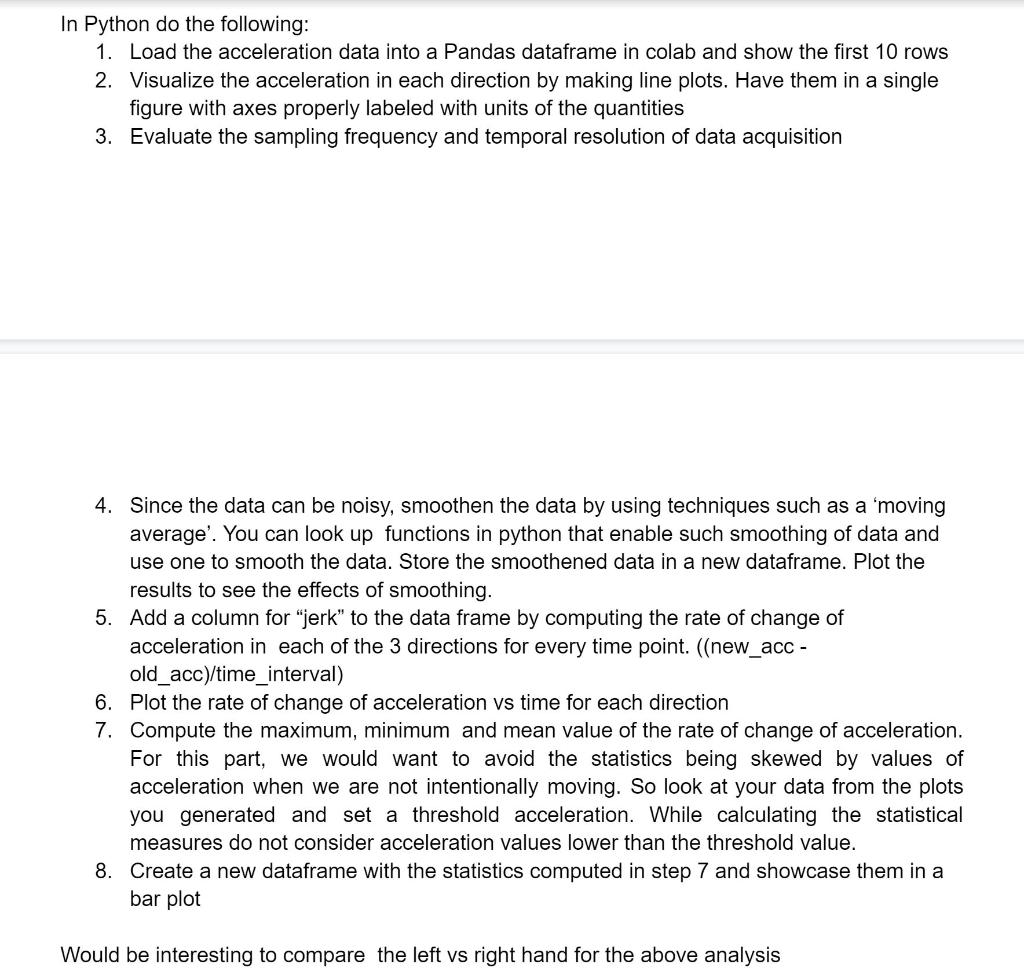
In Python do the following: 1. Load the acceleration data into a Pandas dataframe in colab and show the first 10 rows 2. Visualize the acceleration in each direction by making line plots. Have them in a single figure with axes properly labeled with units of the quantities 3. Evaluate the sampling frequency and temporal resolution of data acquisition 4. Since the data can be noisy, smoothen the data by using techniques such as a 'moving average'. You can look up functions in python that enable such smoothing of data and use one to smooth the data. Store the smoothened data in a new dataframe. Plot the results to see the effects of smoothing. 5. Add a column for "jerk" to the data frame by computing the rate of change of acceleration in each of the 3 directions for every time point. ((new_acc old_acc)/time_interval) 6. Plot the rate of change of acceleration vs time for each direction 7. Compute the maximum, minimum and mean value of the rate of change of acceleration. For this part, we would want to avoid the statistics being skewed by values of acceleration when we are not intentionally moving. So look at your data from the plots you generated and set a threshold acceleration. While calculating the statistical measures do not consider acceleration values lower than the threshold value. 8. Create a new dataframe with the statistics computed in step 7 and showcase them in a bar plot Would be interesting to compare the left vs right hand for the above analysis
Step by Step Solution
There are 3 Steps involved in it

Get step-by-step solutions from verified subject matter experts
 Study Help