







Question: Using all 1991 birth records in the computerized national birth certificate registry compiled by the National Center for Health Statistics (NCHS), statisticians Traci Clemons and
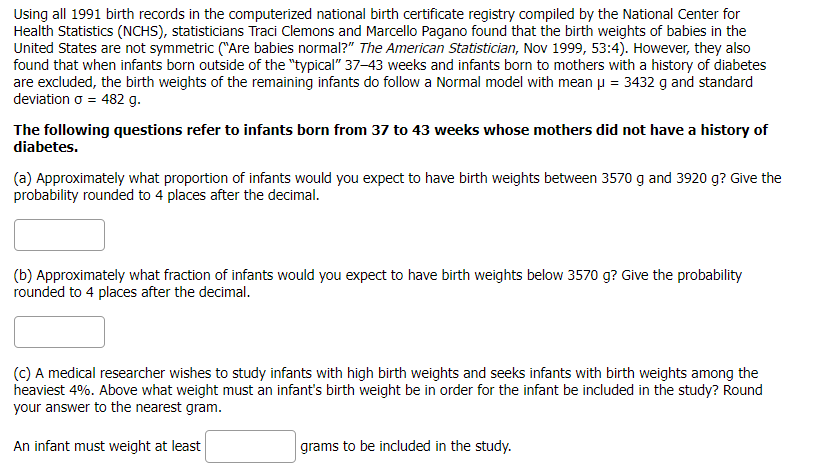
Using all 1991 birth records in the computerized national birth certificate registry compiled by the National Center for Health Statistics (NCHS), statisticians Traci Clemons and Marcello Pagano found that the birth weights of babies in the United States are not symmetric ("Are babies normal?" The American Statistician, Nov 1999, 53:4). However, they also found that when infants born outside of the "typical" 37-43 weeks and infants born to mothers with a history of diabetes are excluded, the birth weights of the remaining infants do follow a Normal model with mean p = 3432 g and standard deviation 0 = 482 g. The following questions refer to infants born from 37 to 43 weeks whose mothers did not have a history of diabetes. (a) Approximately what proportion of infants would you expect to have birth weights between 3570 g and 3920 g? Give the probability rounded to 4 places after the decimal. (b) Approximately what fraction of infants would you expect to have birth weights below 3570 g? Give the probability rounded to 4 places after the decimal. (c) A medical researcher wishes to study infants with high birth weights and seeks infants with birth weights among the heaviest 4%. Above what weight must an infant's birth weight be in order for the infant be included in the study? Round your answer to the nearest gram. An infant must weight at least grams to be included in the study
Step by Step Solution
There are 3 Steps involved in it

Get step-by-step solutions from verified subject matter experts
 Study Help