







Question: Can elasticity of demand tell us something about the likely effect of university fee increases? YRAMMU2 MI In its 2017-18 budget the Turnbull government
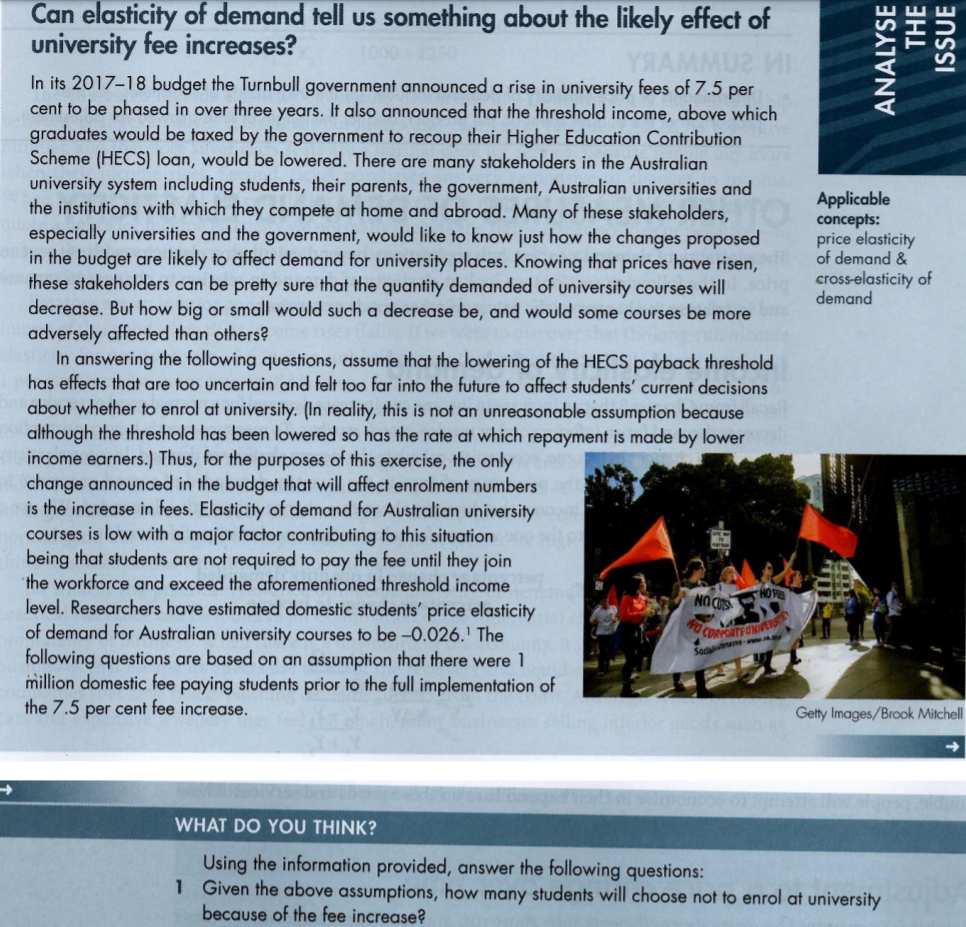
Can elasticity of demand tell us something about the likely effect of university fee increases? YRAMMU2 MI In its 2017-18 budget the Turnbull government announced a rise in university fees of 7.5 per cent to be phased in over three years. It also announced that the threshold income, above which graduates would be taxed by the government to recoup their Higher Education Contribution Scheme (HECS) loan, would be lowered. There are many stakeholders in the Australian university system including students, their parents, the government, Australian universities and the institutions with which they compete at home and abroad. Many of these stakeholders, especially universities and the government, would like to know just how the changes proposed in the budget are likely to affect demand for university places. Knowing that prices have risen, ill these stakeholders can be pretty sure that the quantity demanded of university courses will decrease. But how big or small would such a decrease be, and would some courses be more adversely affected than others? In answering the following questions, assume that the lowering of the HECS payback threshold has effects that are too uncertain and felt too far into the future to affect students' current decisions about whether to enrol at university. (In reality, this is not an unreasonable assumption because although the threshold has been lowered so has the rate at which repayment is made by lower income earners.) Thus, for the purposes of this exercise, the only change announced in the budget that will affect enrolment numbers is the increase in fees. Elasticity of demand for Australian university courses is low with a major factor contributing to this situation i being that students are not required to pay the fee until they join the workforce and exceed the aforementioned threshold income level. Researchers have estimated domestic students' price elasticity of demand for Australian university courses to be -0.026. The following questions are based on an assumption that there were 1 million domestic fee paying students prior to the full implementation of the 7.5 per cent fee increase. NO NO C CORPORTFONIVERS Sac-www.A THE ANALYSE ISSUE Applicable concepts: price elasticity of demand & cross-elasticity of demand Getty Images/Brook Mitchell WHAT DO YOU THINK? Using the information provided, answer the following questions: 1 Given the above assumptions, how many students will choose not to enrol at university zuby because of the fee increase?
Step by Step Solution
There are 3 Steps involved in it
Number of students before the fee increase 1 million Percentage increase in fees 75 Price elast... View full answer

Get step-by-step solutions from verified subject matter experts
 Study Help