







Question: using c++ Constraints: a. You should use an indefinite loop to obtain the choice of growth model from the user; check the user input for
using c++
Constraints:
a. You should use an indefinite loop to obtain the choice of growth model from the user; check the user input for errors, and re-prompt the user until they make an error free selection.
b. You should use the preferred method of declaring and defining the two functions required for this problem (specified above)
c. You should use the predefined functions in the cmath library as appropriate.
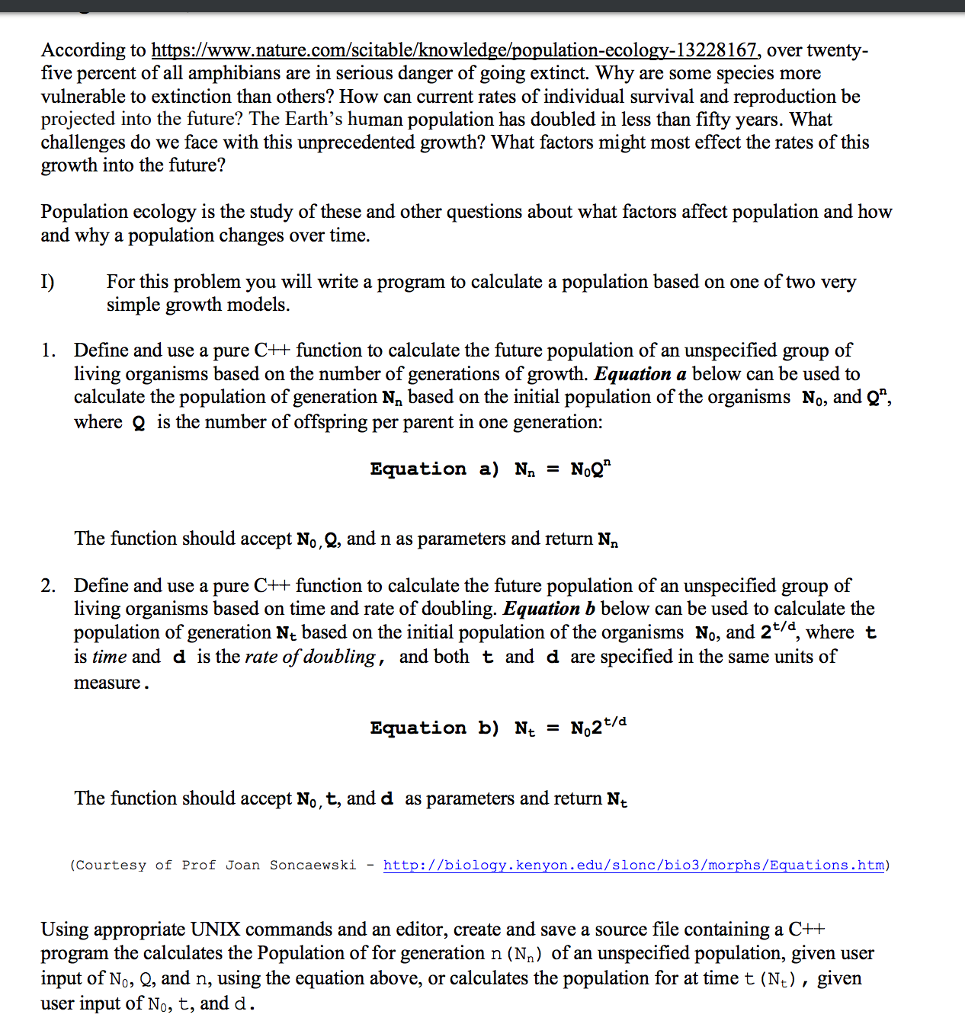
According to https://www.nature.com/scitable/knowledge/population-ecology-13228167, over twenty five percent of all amphibians are in serious danger of going extinct. Why are some species more vulnerable to extinction than others? How can current rates of individual survival and reproduction be projected into the future? The Earth's human population has doubled in less than fifty years. What challenges do we face with this unprecedented growth? What factors might most effect the rates of this growth into the future? Population ecology is the study of these and other questions about what factors affect population and how and why a population changes over time For this problem you will write a program to calculate a population based on one of two very simple growth models 1. Define and use a pure C++ function to calculate the future population of an unspecified group of living organisms based on the number of generations of growth. Equation a below can be used to calculate the population of generation Nn based on the initial population of the organisms No, and Q" where Q is the number of offspring per parent in one generation Ecuation a) Nn NoQ The function should accept No,2, and n as parameters and return Nn 2. Define and use a pure C++ function to calculate the future population of an unspecified group of living organisms based on time and rate of doubling. Equation b below can be used to calculate the population of generation Nt based on the initial population of the organisms No, and 2t/d, where t is time and d is the rate of doubling, and both t and d are specified in the same units of measure Equation b) N. - No2t'* The function should accept No,t, and d as parameters and return Nt (Courtesy of Prof Joan Soncaewski http://biology. Kenyon .edu/slonc/bio3/morphs/Equations.htm) - Using appropriate UNIX commands and an editor, create and save a source file containing a C++ program the calculates the Population of for generation n (Nn) of an unspecified population, given user input of No, Q, and n, using the equation above, or calculates the population for at time t (Nt) , given user input of No, t, and d
Step by Step Solution
There are 3 Steps involved in it

Get step-by-step solutions from verified subject matter experts
 Study Help