







Question: Using case study attached, help solve below: 1 . Based on the information provided for the policy documents and assuming that the company operates 3
Using case study attached, help solve below:
Based on the information provided for the policy documents and assuming that the company operates days a year, determine the optimal ordering policy, including the order quantity and reorder point, for this inventory item. Calculate the total annual inventoryrelated cost at optimality and explain how following the optimal strategy could improve various performance measures compared to the companys current inventory management practices.
For the printer cartridges, determine the optimal ordering policy to minimize the total annual cost, considering the variability in demand and lead time. Identify the customer service measures under this policy and discuss what they indicate about meeting customer demand and satisfaction.
Calculate the safety stock levels required to maintain different cycle service levels eg and for the printer cartridges, considering the variability in demand and lead time. For each service level, determine the reorder point and the total inventoryrelated cost. Discuss how these different service levels could impact the companys ability to improve customer satisfaction without incurring excessive costs.
Determine the optimal order quantity for the marketing materials needed for the upcoming campaign. Consider the tradeoffs between the costs of overstocking and understocking.
Given the current capacity constraints of the storage facility and the impending increase in inventory due to the upcoming marketing campaign, discuss whether the company may need to lease additional storage space after optimizing its current inventory practices. What factors should be considered in making this decision? If leasing additional storage space is not feasible, what would be your recommendation to reduce the overall inventory levels so that the company can have enough storage space for the upcoming campaign?
Capstone Project Phase V
As the Chief Operations Officer COO of Trust Guard Insurance, your ongoing mission has been
to refine and optimize various operational aspects of the company. With several improvements
already implemented in the processing of policies and customer service, your focus now shifts to
a more behindthescenes but equally critical component: Inventory Management. This area,
though less visible to the customer, plays a pivotal role in ensuring that every other department
functions smoothly and without interruption.
The New Policy Issuance Department, for instance, relies heavily on a steady supply of policy
documents, printer cartridges, and other office supplies. If any of these materials were to run out
unexpectedly, the repercussions would ripple through the company, affecting everything from
policy issuance to customer satisfaction. The company's marketing team, too, depends on timely
access to promotional materials and other marketing collateral to effectively execute campaigns
that attract and retain customers.
At the heart of Trust Guard Insurance's operations is a centralized inventory system that manages
all these supplies. However, recent assessments have revealed significant inefficiencies in how
inventory is managed. The inventory management practices currently in place are inconsistent and
lack a coherent strategy tailored to the specific needs of each type of item. This has led to situations
where the company either holds excess inventory, tying up valuable capital and incurring
unnecessary storage costs, or experiences stockouts, disrupting operations and negatively
impacting customer satisfaction. These inconsistent practices have led to tangible issues, such as
increased costs and inefficiencies, highlighting the need for a more strategic approach to inventory
management.
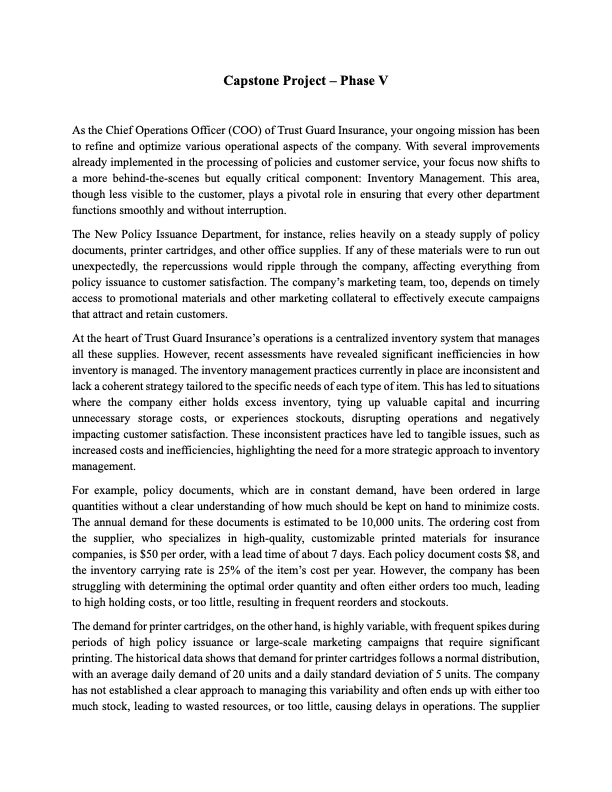
For example, policy documents, which are in constant demand, have been ordered in large
quantities without a clear understanding of how much should be kept on hand to minimize costs.
The annual demand for these documents is estimated to be units. The ordering cost from
the supplier, who specializes in highquality, customizable printed materials for insurance
companies, is $ per order, with a lead time of about days. Each policy document costs $ and
the inventory carrying rate is of the item's cost per year. However, the company has been
struggling with determining the optimal order quantity and often either orders too much, leading
to high holding costs, or too little, resulting in frequent reorders and stockouts.
The demand for printer cartridges, on the other hand, is highly variable, with frequent spikes during
periods of high policy issuance or largescale marketing campaigns that require significant
printing. The historical data shows that demand for printer cartridges follows a normal distribution,
with an average daily demand of units and a daily standard deviation of units. The company
has not established a clear approach to managing thi
for printer cartridges has a lead time
Step by Step Solution
There are 3 Steps involved in it
1 Expert Approved Answer
Step: 1 Unlock

Question Has Been Solved by an Expert!
Get step-by-step solutions from verified subject matter experts
Step: 2 Unlock
Step: 3 Unlock
 Study Help