Question: Using Heun's Method The range of aerosol size released during different expiration events are 1 to 128um. The different sizes of aerosol you could consider
Using Heun's Method
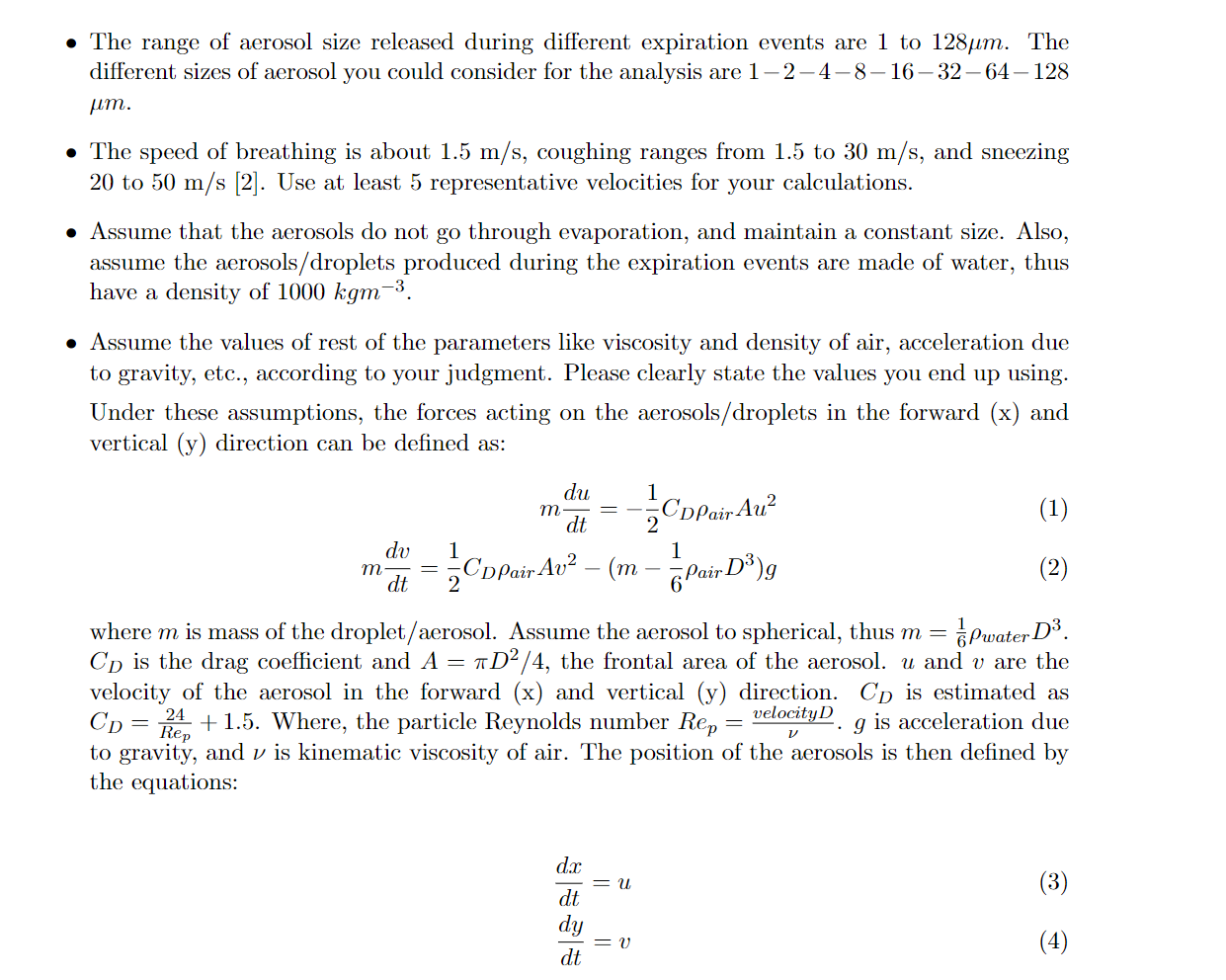
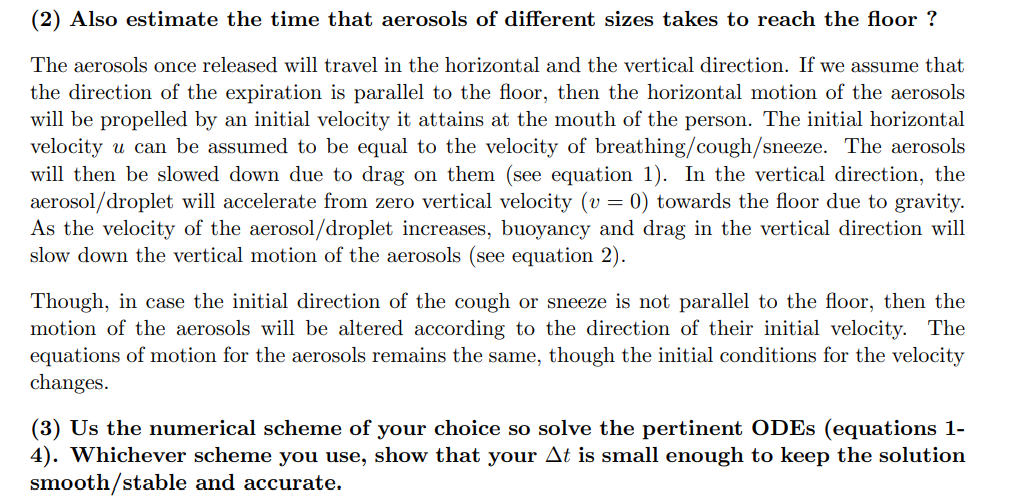
The range of aerosol size released during different expiration events are 1 to 128um. The different sizes of aerosol you could consider for the analysis are 1-2-4-8-16 32 64 128 um. The speed of breathing is about 1.5 m/s, coughing ranges from 1.5 to 30 m/s, and sneezing 20 to 50 m/s [2]. Use at least 5 representative velocities for your calculations. Assume that the aerosols do not go through evaporation, and maintain a constant size. Also, assume the aerosols/droplets produced during the expiration events are made of water, thus have a density of 1000 kgm-3. Assume the values of rest of the parameters like viscosity and density of air, acceleration due to gravity, etc., according to your judgment. Please clearly state the values you end up using. Under these assumptions, the forces acting on the aerosols/droplets in the forward (x) and vertical (y) direction can be defined as: 1 m dv 1 . dt du CDPair Au? (1) dt 2 1 z CDpair Av2 (m a pair D)g Au- (2) where m is mass of the droplet/aerosol. Assume the aerosol to spherical, thus m = Opwater D3 Cp is the drag coefficient and A = AD2/4, the frontal area of the aerosol. u and v are the velocity of the aerosol in the forward (x) and vertical (y) direction. Cp is estimated as Cp = Re, +1.5. Where, the particle Reynolds number Rep g is acceleration due to gravity, and v is kinematic viscosity of air. The position of the aerosols is then defined by the equations: 24 velocity = = =U (3) dx dt dy dt = (4) (2) Also estimate the time that aerosols of different sizes takes to reach the floor ? The aerosols once released will travel in the horizontal and the vertical direction. If we assume that the direction of the expiration is parallel to the floor, then the horizontal motion of the aerosols will be propelled by an initial velocity it attains at the mouth of the person. The initial horizontal velocity u can be assumed to be equal to the velocity of breathing/cough/sneeze. The aerosols will then be slowed down due to drag on them (see equation 1). In the vertical direction, the aerosol/droplet will accelerate from zero vertical velocity (v = 0) towards the floor due to gravity. As the velocity of the aerosol/droplet increases, buoyancy and drag in the vertical direction will slow down the vertical motion of the aerosols (see equation 2). Though, in case the initial direction of the cough or sneeze is not parallel to the floor, then the motion of the aerosols will be altered according to the direction of their initial velocity. The equations of motion for the aerosols remains the same, though the initial conditions for the velocity changes. (3) Us the numerical scheme of your choice so solve the pertinent ODEs (equations 1- 4). Whichever scheme you use, show that your At is small enough to keep the solution smooth/stable and accurate. The range of aerosol size released during different expiration events are 1 to 128um. The different sizes of aerosol you could consider for the analysis are 1-2-4-8-16 32 64 128 um. The speed of breathing is about 1.5 m/s, coughing ranges from 1.5 to 30 m/s, and sneezing 20 to 50 m/s [2]. Use at least 5 representative velocities for your calculations. Assume that the aerosols do not go through evaporation, and maintain a constant size. Also, assume the aerosols/droplets produced during the expiration events are made of water, thus have a density of 1000 kgm-3. Assume the values of rest of the parameters like viscosity and density of air, acceleration due to gravity, etc., according to your judgment. Please clearly state the values you end up using. Under these assumptions, the forces acting on the aerosols/droplets in the forward (x) and vertical (y) direction can be defined as: 1 m dv 1 . dt du CDPair Au? (1) dt 2 1 z CDpair Av2 (m a pair D)g Au- (2) where m is mass of the droplet/aerosol. Assume the aerosol to spherical, thus m = Opwater D3 Cp is the drag coefficient and A = AD2/4, the frontal area of the aerosol. u and v are the velocity of the aerosol in the forward (x) and vertical (y) direction. Cp is estimated as Cp = Re, +1.5. Where, the particle Reynolds number Rep g is acceleration due to gravity, and v is kinematic viscosity of air. The position of the aerosols is then defined by the equations: 24 velocity = = =U (3) dx dt dy dt = (4) (2) Also estimate the time that aerosols of different sizes takes to reach the floor ? The aerosols once released will travel in the horizontal and the vertical direction. If we assume that the direction of the expiration is parallel to the floor, then the horizontal motion of the aerosols will be propelled by an initial velocity it attains at the mouth of the person. The initial horizontal velocity u can be assumed to be equal to the velocity of breathing/cough/sneeze. The aerosols will then be slowed down due to drag on them (see equation 1). In the vertical direction, the aerosol/droplet will accelerate from zero vertical velocity (v = 0) towards the floor due to gravity. As the velocity of the aerosol/droplet increases, buoyancy and drag in the vertical direction will slow down the vertical motion of the aerosols (see equation 2). Though, in case the initial direction of the cough or sneeze is not parallel to the floor, then the motion of the aerosols will be altered according to the direction of their initial velocity. The equations of motion for the aerosols remains the same, though the initial conditions for the velocity changes. (3) Us the numerical scheme of your choice so solve the pertinent ODEs (equations 1- 4). Whichever scheme you use, show that your At is small enough to keep the solution smooth/stable and accurate









 Study Help