







Question: Using Implicit Differentiation. Suppose that y = _f(z) is a d'rerentiable function of 3. Then, d i } {1 113 my dy- NGTE: If your




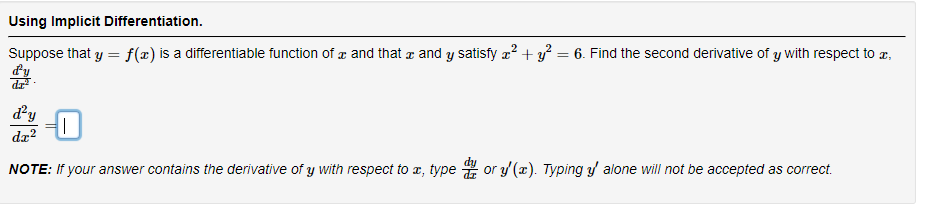




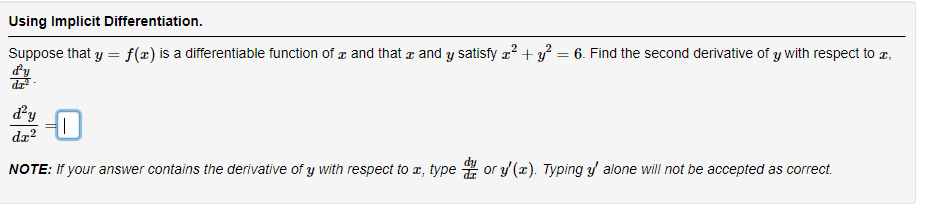
Using Implicit Differentiation. Suppose that y = _f(z) is a d'rerentiable function of 3. Then, d i } {1 113 my dy- NGTE: If your answer contains the derivative of y with respect to n (we E or 3,?(2). Typing 3,," alone will not be accepted as correct. Using Implicit Differentiation. Suppose that y = f() is a differentiable function of c. Then, d NOTE: If your answer contains the derivative of y with respect to x, type - ory' (@). Typing y' alone will not be accepted as correct.Using Implicit Differentiation. Suppose that y = f() is a differentiable function of c. Then, d dx (cos(ry)) NOTE: If your answer contains the derivative of y with respect to x, type - ory' (@). Typing y' alone will not be accepted as correct.Using Implicit Differentiation. Suppose that y = f(x) is a differentiable function of c. Then, d (y tan y) I NOTE: If your answer contains the derivative of y with respect to x, type - ory'(x). Typing y' alone will not be accepted as correct.Using Implicit Differentiation. Suppose that y 2 x) is a dierentiable function of in and that z and y satisfy :2 + y\" = 6. Find the second derivative of y with respect to a}, 1; E- . L29 (1:2 NOTE: tr your answer contains the derivative of 3; With respect to 3; type % or {(3). Typing y' atone wiit not be accepted as connect
Step by Step Solution
There are 3 Steps involved in it

Get step-by-step solutions from verified subject matter experts
 Study Help