Question: Using information and data from the Case Study: Implementing Career Academies in Local High Schools, complete each section of the chart below relevant to the
Using information and data from the "Case Study: Implementing Career Academies in Local High Schools," complete each section of the chart below relevant to the risks associated with the implementation of the proposed change initiative. You should identify a minimum of 10 risks and the mitigation strategies associated with each.
In the "Email Communication" section below the chart, prepare the email you will share with the high school administrators about communicating this information to faculty and staff so they can address questions as they arise and provide consistent messaging to community stakeholders.
Risk
Briefly describe each risk.
Mitigation Strategy
In 1-2 sentences, describe each mitigation strategy you will employ to address the identified risk. The goal is to provide administrators, faculty, and staff with clear talking points so they can effectively address public concerns related to risk management.
Email Communication: In a 250-500 word email to the high school administrators, address the following:
Explain the purpose of the "Risk and Mitigation Strategy" chart and how you want administrators to direct faculty and staff to use the information when addressing questions and concerns community stakeholders have about the risks associated with the change initiative.
Explain the importance of communicating a consistent, uniform message to stakeholders and how failure to do so could hamper the success of the change initiative.
Provide clear directions for what building administrators should do if a hot button issue that is not included on the chart emerges among building stakeholders.
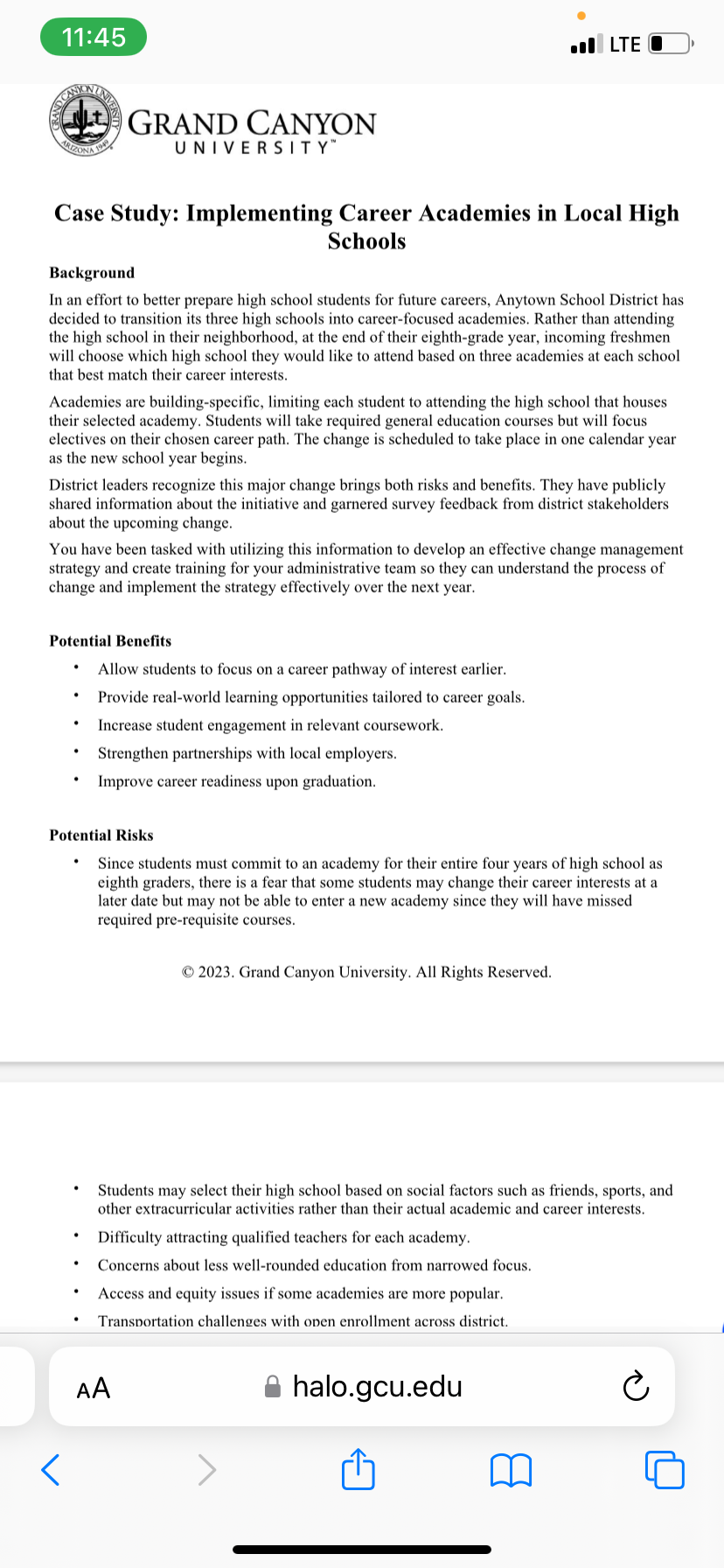
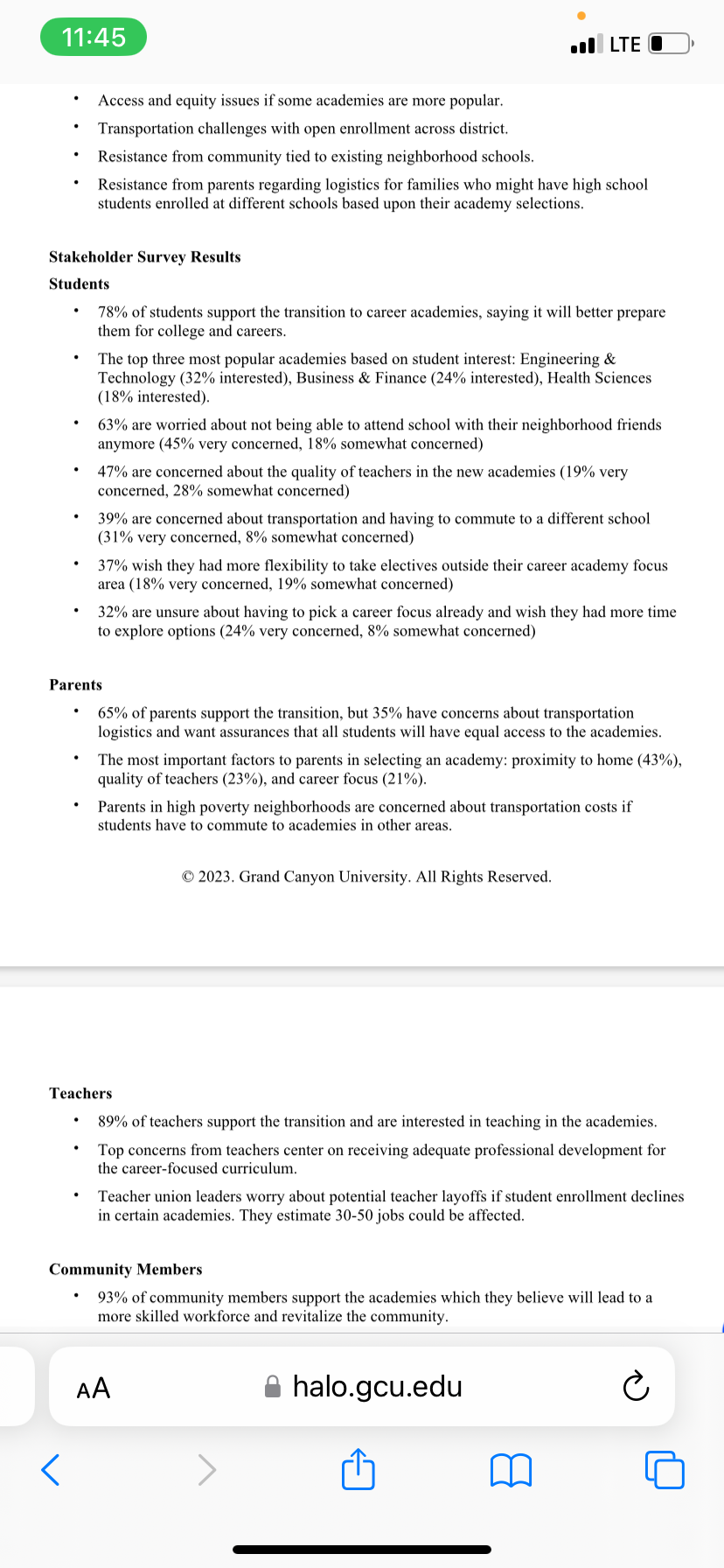
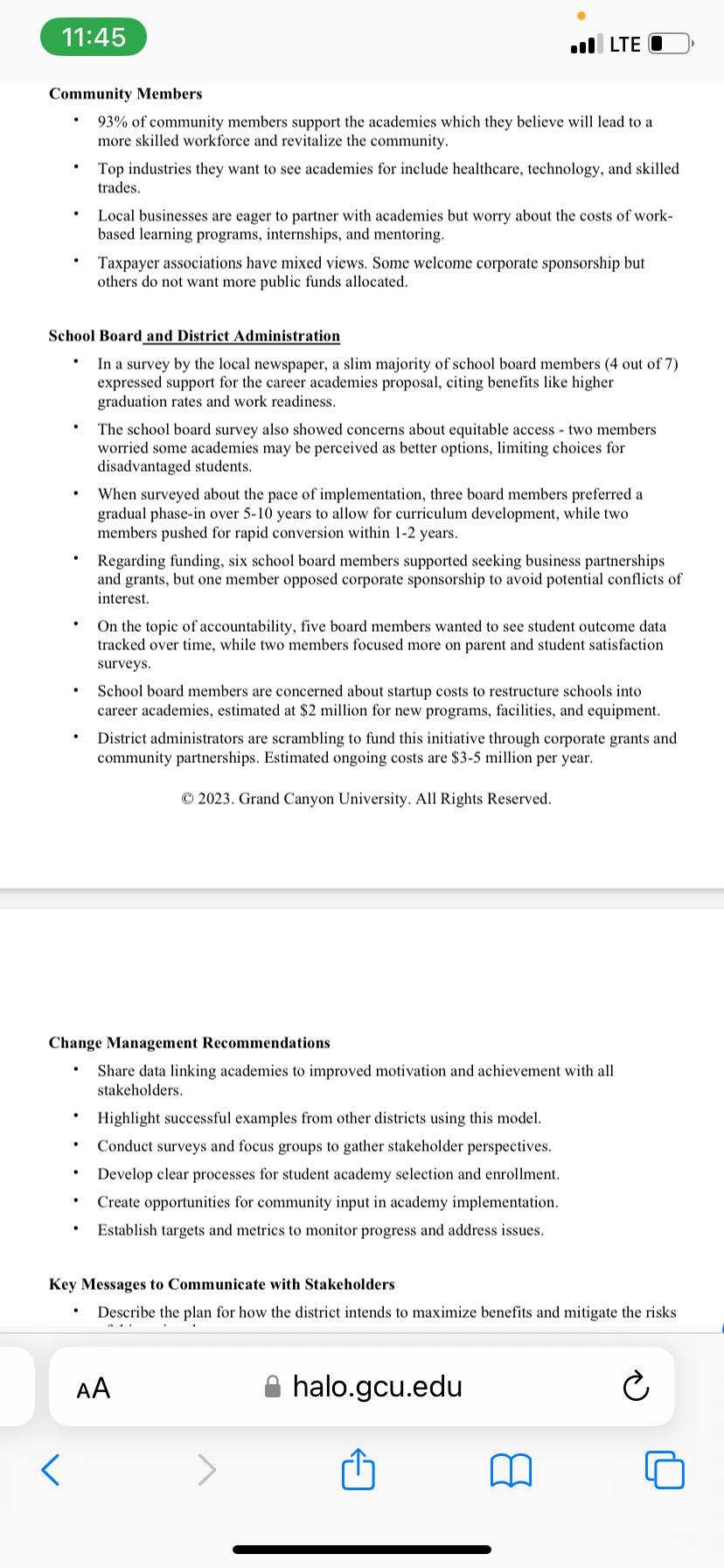
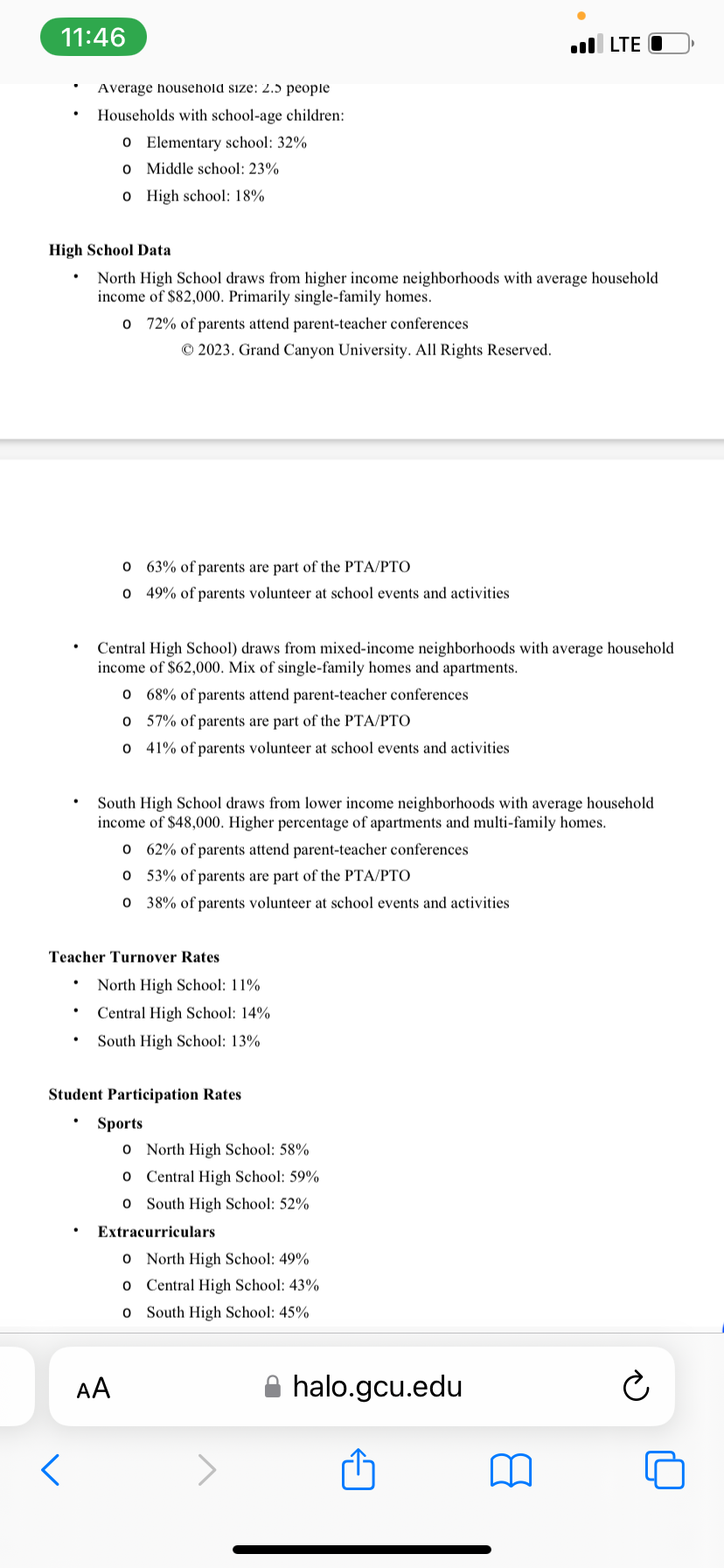
atl LTE @ > \")) GRAND CANYON eon UNIVERSITY" Case Study: Implementing Career Academies in Local High Schools Background In an effort to better prepare high school students for future careers, Anytown School District has decided to transition its three high schools into career-focused academies. Rather than attending the high school in their neighborhood, at the end of their eighth-grade year, incoming freshmen will choose which high school they would like to attend based on three academies at each school that best match their career interests. Academies are building-specitic, limiting each student to attending the high school that houses their selected academy. Students will take required general education courses but will focus electives on their chosen career path. The change is scheduled to take place in one calendar year as the new school year begins. District leaders recognize this major change brings both risks and benefits. They have publicly shared information about the initiative and garnered survey feedback from district stakeholders about the upcoming change. You have been tasked with utilizing this information to develop an effective change management strategy and create training for your administrative team so they can understand the process of change and implement the strategy effectively over the next year. Potential Benefits * Allow students to focus on a career pathway of interest earlier. * Provide real-world learning opportunities tailored to career goals. * Increase student engagement in relevant coursework, * Strengthen partnerships with local employers. * Improve career readiness upon graduation. Potential Risks * Since students must commit to an academy for their entire four years of high school as eighth graders, there is a fear that some students may change their career interests at a later date but may not be able to enter a new academy since they will have missed required pre-requisite courses. 2023. Grand Canyon University. All Rights Reserved. * Students may select their high school based on social factors such as friends, sports, and other extracurricular activities rather than their actual academic and career interests. * Difficulty attracting qualified teachers for each academy. * Concerns about less well-rounded education from narrowed focus. * Access and equity issues 1f some academies are more popular. * Transnortation challenges with onen enrollment across district. AA @ halo.gcu.edu Cc, Community Members 93% of community members support the academies which they believe will lead to a more skilled workforce and revitalize the community. Top industries they want to see academies for include healthcare, technology, and skilled trades. Local businesses are eager to partner with academies but worry about the costs of work- based learning programs, internships, and mentoring. Taxpayer associations have mixed views. Some welcome corporate sponsorship but others do not want more public funds allocated. School Board and District Administration Ina survey by the local newspaper, a slim majority of school board members (4 out of 7) expressed support for the career academies proposal, citing benefits like higher graduation rates and work readiness. The school board survey also showed concerns about equitable access - two members worried some academies may be perceived as better options, limiting choices for disadvantaged students. When surveyed about the pace of implementation, three board members preferred a gradual phase-in over 5-10 years to allow for curriculum development, while two members pushed for rapid conversion within 1-2 years. Regarding funding, six school board members supported seeking business partnerships and grants, but one member opposed corporate sponsorship to avoid potential conflicts of interest. On the topic of accountability, five board members wanted to see student outcome data tracked over time, while two members focused more on parent and student satisfaction surveys. School board members are concerned about startup costs to restructure schools into career academies, estimated at $2 million for new programs, facilities, and equipment. District administrators are scrambling to fund this initiative through corporate grants and community partnerships. Estimated ongoing costs are $3-5 million per year. 2023. Grand Canyon University. All Rights Reserved. Change Management Recommendations Share data linking academies to improved motivation and achievement with all stakeholders. Highlight successful examples from other districts using this model. Conduct surveys and focus groups to gather stakeholder perspectives. Develop clear processes for student academy selection and enrollment. Create opportunities for community input in academy implementation. Establish targets and metrics to monitor progress and address Key Messages to Communicate with Stakeholders Describe the plan for how the district intends to maximize benefits and mitigate the risks AA @ halo.gcu.edu Cc, 4 aa DO 11:46 .I LTE Average household size: 2.5 people Households with school-age children: 0 Elementary school: 32% o Middle school: 23% 0 High school: 18% High School Data North High School draws from higher income neighborhoods with average household income of $82,000. Primarily single-family homes 0 72% of parents attend parent-teacher conferences 2023. Grand Canyon University. All Rights Reserved. 0 63% of parents are part of the PTA/PTO 0 49% of parents volunteer at school events and activities Central High School) draws from mixed-income neighborhoods with average household income of $62,000. Mix of single-family homes and apartments. 0 68% of parents attend parent-teacher conferences 0 57% of parents are part of the PTA/PTO 0 41% of parents volunteer at school events and activities South High School draws from lower income neighborhoods with average household income of $48,000. Higher percentage of apartments and multi-family homes. 0 62% of parents attend parent-teacher conferences 0 53% of parents are part of the PTA/PTO 0 38% of parents volunteer at school events and activities Teacher Turnover Rates North High School: 11% Central High School: 14% South High School: 13% Student Participation Rates Sports 0 North High School: 58% 0 Central High School: 59% 0 South High School: 52% . Extracurriculars 0 North High School: 49% o Central High School: 43% 0 South High School: 45% AA halo.gcu.edu C A
Step by Step Solution
There are 3 Steps involved in it
1 Expert Approved Answer
Step: 1 Unlock
Question Has Been Solved by an Expert!
Get step-by-step solutions from verified subject matter experts
Step: 2 Unlock
Step: 3 Unlock
Students Have Also Explored These Related Accounting Questions!









 Study Help