







Question: Using Jupyter notebooks and google colab, we will explore the functions and dictionaries structures of the python programming language. 1. Define a function in python
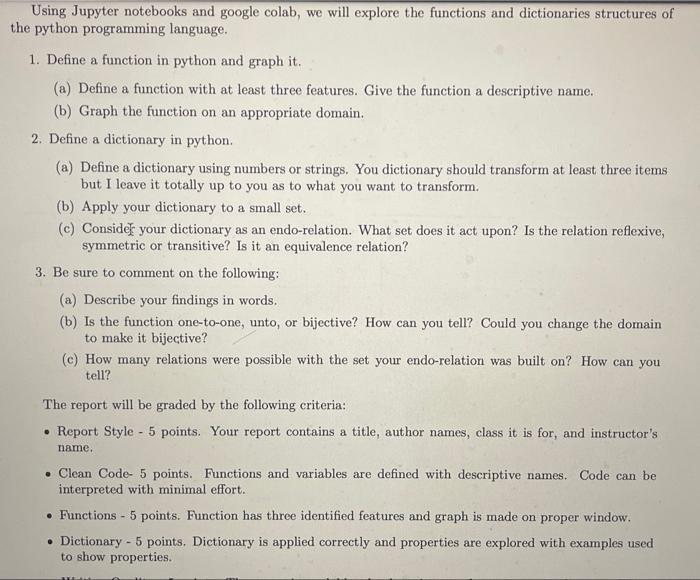
Using Jupyter notebooks and google colab, we will explore the functions and dictionaries structures of the python programming language. 1. Define a function in python and graph it. (a) Define a function with at least three features. Give the function a descriptive name. (b) Graph the function on an appropriate domain. 2. Define a dictionary in python. (a) Define a dictionary using numbers or strings. You dictionary should transform at least three items but I leave it totally up to you as to what you want to transform. (b) Apply your dictionary to a small set. (c) Consider your dictionary as an endo-relation. What set does it act upon? Is the relation reflexive, symmetric or transitive? Is it an equivalence relation? 3. Be sure to comment on the following: (a) Describe your findings in words. (b) is the function one-to-one, unto, or bijective? How can you tell? Could you change the domain to make it bijective? (c) How many relations were possible with the set your endo-relation was built on? How can you tell? The report will be graded by the following criteria: Report Style - 5 points. Your report contains a title, author names, class it is for, and instructor's name. Clean Code- 5 points. Functions and variables are defined with descriptive names. Code can be interpreted with minimal effort. Functions - 5 points. Function has three identified features and graph is made on proper window. Dictionary - 5 points, Dictionary is applied correctly and properties are explored with examples used to show properties
Step by Step Solution
There are 3 Steps involved in it

Get step-by-step solutions from verified subject matter experts
 Study Help