







Question: Using Maple, no need to do anything by hand. In order to get full marks, you should explain (briefly) what you are doing and why
Using Maple, no need to do anything by hand.
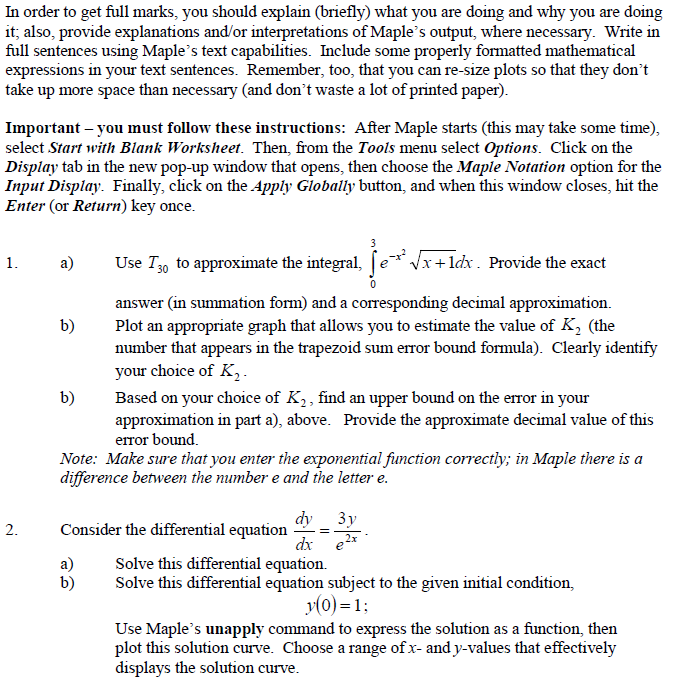
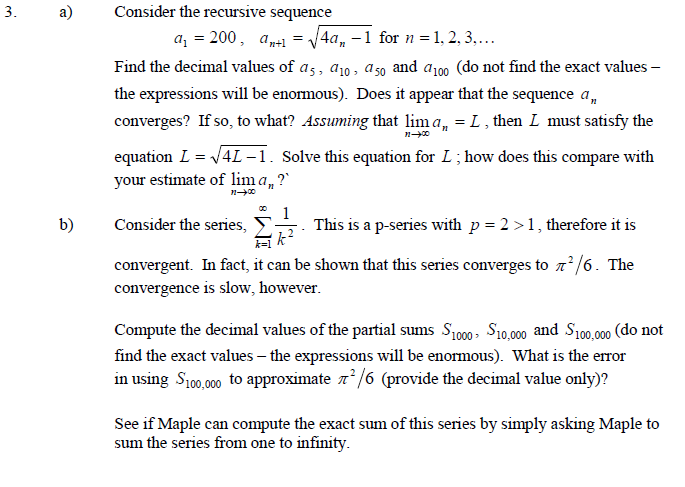
In order to get full marks, you should explain (briefly) what you are doing and why you are doing it; also, provide explanations and/or interpretations of Maple's output, where necessary. Write in full sentences using Maple's text capabilities. Include some properly formatted mathematical expressions in your text sentences. Remember, too, that you can re-size plots so that they don't take up more space than necessary (and don't waste a lot of printed paper). Important - you must follow these instructions: After Maple starts (tins may take some time), select Start with Blank Worksheet. Then, from the Tools menu select Options. Click on the Display tab in the new pop-up window that opens, then choose the Maple Notation option for the Input Display. Finally, click on the Apply Globally button, and when tins window closes, hit the Enter (or Return) key once. a) Use T_30 to approximate the integral, integral^3_0 e^x^2 Squareroot x + 1 dx. Provide the exact answer (in summation form) and a corresponding decimal approximation. b) Plot an appropriate graph that allows you to estimate the value of K_2 (the number that appears in the trapezoid sum error bound formula). Clearly identify your choice of K_2. b) Based on your choice of K_2, find an upper bound on the error in your approximation in part a), above. Provide the approximate decimal value of this error bound. Consider the differential equation dy/dx = 3y/e^2x a) Solve this differential equation. b) Solve this differential equation subject to the given initial condition, y(0)=1: Use Maple's unapply command to express the solution as a function, then plot tins solution curve. Choose a range of x- and y-values that effectively displays the solution curve. Consider the recursive sequence a_1 = 200, a_n+1 = Squareroot 4a_n - 1 for n = 1, 2, 3, ... Find the decimal values of a_5, a_10, a_50 and a_100 (do not find the exact values -the expressions will be enormous). Does it appeal- that the sequence a_n converges? If so, to what? Assuming that lima_n rightarrow infinity a_n = L, then L must satisfy the equation L = Squareroot 4L - 1. Solve tins equation for L; how does this compare with your estimate of lim_n rightarrow infinity a_n? b) Consider the series, sigma_k=1^infinity 1/k^2. Tins is a p-series with p = 2 > 1, therefore it is convergent. In fact, it can be shown that tins series converges to pi^2/6. The convergence is slow, however. Compute the decimal values of the partial sums S_1000, S_10,000 and S_100, 000 (do not find the exact values - the expressions will be enormous). What is the error in using S_100,000 to approximate pi^2/6 (provide the decimal value only)? See if Maple can compute the exact sum of this series by simply asking Maple to sum the series from one to infinity. In order to get full marks, you should explain (briefly) what you are doing and why you are doing it; also, provide explanations and/or interpretations of Maple's output, where necessary. Write in full sentences using Maple's text capabilities. Include some properly formatted mathematical expressions in your text sentences. Remember, too, that you can re-size plots so that they don't take up more space than necessary (and don't waste a lot of printed paper). Important - you must follow these instructions: After Maple starts (tins may take some time), select Start with Blank Worksheet. Then, from the Tools menu select Options. Click on the Display tab in the new pop-up window that opens, then choose the Maple Notation option for the Input Display. Finally, click on the Apply Globally button, and when tins window closes, hit the Enter (or Return) key once. a) Use T_30 to approximate the integral, integral^3_0 e^x^2 Squareroot x + 1 dx. Provide the exact answer (in summation form) and a corresponding decimal approximation. b) Plot an appropriate graph that allows you to estimate the value of K_2 (the number that appears in the trapezoid sum error bound formula). Clearly identify your choice of K_2. b) Based on your choice of K_2, find an upper bound on the error in your approximation in part a), above. Provide the approximate decimal value of this error bound. Consider the differential equation dy/dx = 3y/e^2x a) Solve this differential equation. b) Solve this differential equation subject to the given initial condition, y(0)=1: Use Maple's unapply command to express the solution as a function, then plot tins solution curve. Choose a range of x- and y-values that effectively displays the solution curve. Consider the recursive sequence a_1 = 200, a_n+1 = Squareroot 4a_n - 1 for n = 1, 2, 3, ... Find the decimal values of a_5, a_10, a_50 and a_100 (do not find the exact values -the expressions will be enormous). Does it appeal- that the sequence a_n converges? If so, to what? Assuming that lima_n rightarrow infinity a_n = L, then L must satisfy the equation L = Squareroot 4L - 1. Solve tins equation for L; how does this compare with your estimate of lim_n rightarrow infinity a_n? b) Consider the series, sigma_k=1^infinity 1/k^2. Tins is a p-series with p = 2 > 1, therefore it is convergent. In fact, it can be shown that tins series converges to pi^2/6. The convergence is slow, however. Compute the decimal values of the partial sums S_1000, S_10,000 and S_100, 000 (do not find the exact values - the expressions will be enormous). What is the error in using S_100,000 to approximate pi^2/6 (provide the decimal value only)? See if Maple can compute the exact sum of this series by simply asking Maple to sum the series from one to infinity
Step by Step Solution
There are 3 Steps involved in it

Get step-by-step solutions from verified subject matter experts
 Study Help