





Question: Using Maple software, Please help me answer this question (with explanations) I don't understand it Question 3 Question 4 Insert restart : with(LinearAlgebra) : Convert
Using Maple software, Please help me answer this question (with explanations)
I don't understand it
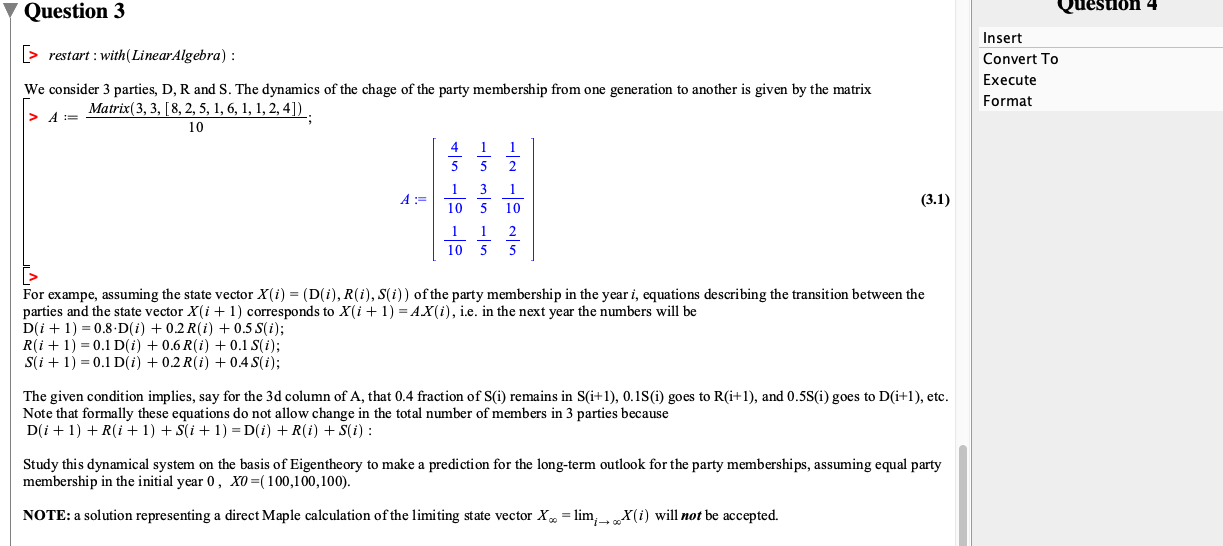
Question 3 Question 4 Insert restart : with(LinearAlgebra) : Convert To We consider 3 parties, D, R and S. The dynamics of the chage of the party membership from one generation to another is given by the matrix Execute > A : Matrix( 3, 3, [8, 2, 5, 1, 6, 1, 1, 2, 4 ]). Format 10 A := U/ N 5 - N/ - (3.1) For exampe, assuming the state vector X(i) = (D(i), R(i), S(i) ) of the party membership in the year i, equations describing the transition between the parties and the state vector X(i + 1) corresponds to X(i + 1) = AX(i), i.e. in the next year the numbers will be D(i + 1) = 0.8 .D(i) + 0.2R(i) + 0.5 S(i); R(i + 1) = 0.1 D(i) + 0.6R(i) + 0.1 S(i); S(i + 1) = 0.1 D(i) + 0.2R(i) + 04S(i); The given condition implies, say for the 3d column of A, that 0.4 fraction of S(i) remains in S(i+1), 0.1S(i) goes to R(i+1), and 0.5S(i) goes to D(i+1), etc. Note that formally these equations do not allow change in the total number of members in 3 parties because D(i + 1) + R(i + 1) + S(i + 1) = D(i) + R(i) + S(i) : Study this dynamical system on the basis of Eigentheory to make a prediction for the long-term outlook for the party memberships, assuming equal party membership in the initial year 0, XO=( 100,100, 100). NOTE: a solution representing a direct Maple calculation of the limiting state vector X. = lim, _ X(i) will not be accepted

