







Question: Using MatLab: Step 1 - generating a noisy data set. For a 7^th degree polynomial of your choice on the interval [-1, 1] for 100
Using MatLab:
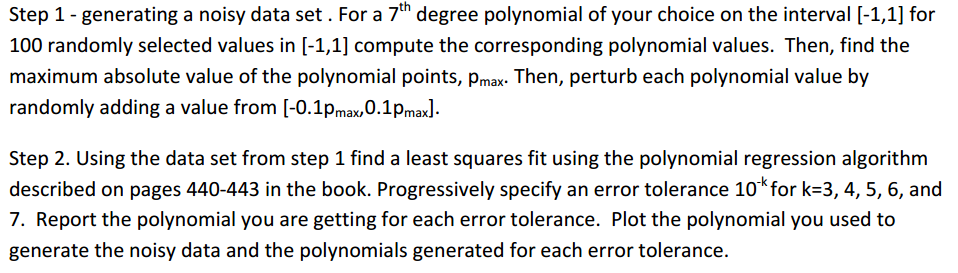
Step 1 - generating a noisy data set. For a 7^th degree polynomial of your choice on the interval [-1, 1] for 100 randomly selected values in [-1, 1] compute the corresponding polynomial values. Then, find the maximum absolute value of the polynomial points, p_max. Then, perturb each polynomial value by randomly adding a value from [-0.1p_max, 0.1p_max] Step 2. Using the data set from step 1 find a least squares fit using the polynomial regression algorithm described on pages 440-443 in the book. Progressively specify an error tolerance 10^-k for k = 3, 4, 5, 6, and 7. Report the polynomial you are getting for each error tolerance. Plot the polynomial you used to generate the noisy data and the polynomials generated for each error tolerance. Step 1 - generating a noisy data set. For a 7^th degree polynomial of your choice on the interval [-1, 1] for 100 randomly selected values in [-1, 1] compute the corresponding polynomial values. Then, find the maximum absolute value of the polynomial points, p_max. Then, perturb each polynomial value by randomly adding a value from [-0.1p_max, 0.1p_max] Step 2. Using the data set from step 1 find a least squares fit using the polynomial regression algorithm described on pages 440-443 in the book. Progressively specify an error tolerance 10^-k for k = 3, 4, 5, 6, and 7. Report the polynomial you are getting for each error tolerance. Plot the polynomial you used to generate the noisy data and the polynomials generated for each error tolerance
Step by Step Solution
There are 3 Steps involved in it

Get step-by-step solutions from verified subject matter experts
 Study Help