







Question: Using n,p , as well as the values a and b from part (a), find the probability P(a , where Y_(n)N(mu ;sigma ^(2)) , with
Using
n,p, as well as the values
aand
bfrom part (a), find the probability
P(a, where
Y_(n)N(\\\\mu ;\\\\sigma ^(2)), with mean
\\\\mu =n*p, and variance
\\\\sigma ^(2)=n*p*(1-p) (so that the standard deviation is
\\\\sigma =\\\\sqrt(np(1-p)).\ Your probability
P(a should be approximately equal to
P(a (this is due to the Central Limit Theorem, which will be discussed soon). Write your answer (i.e. the value
P(a ) as
R variable pclt , i.e.\ pclt
= some expression>\ Do not round your answer.\ Hint: Use the R function pnorm (
q, mean,
sd, lower.tail = TRUE) . (see R documentation for details).
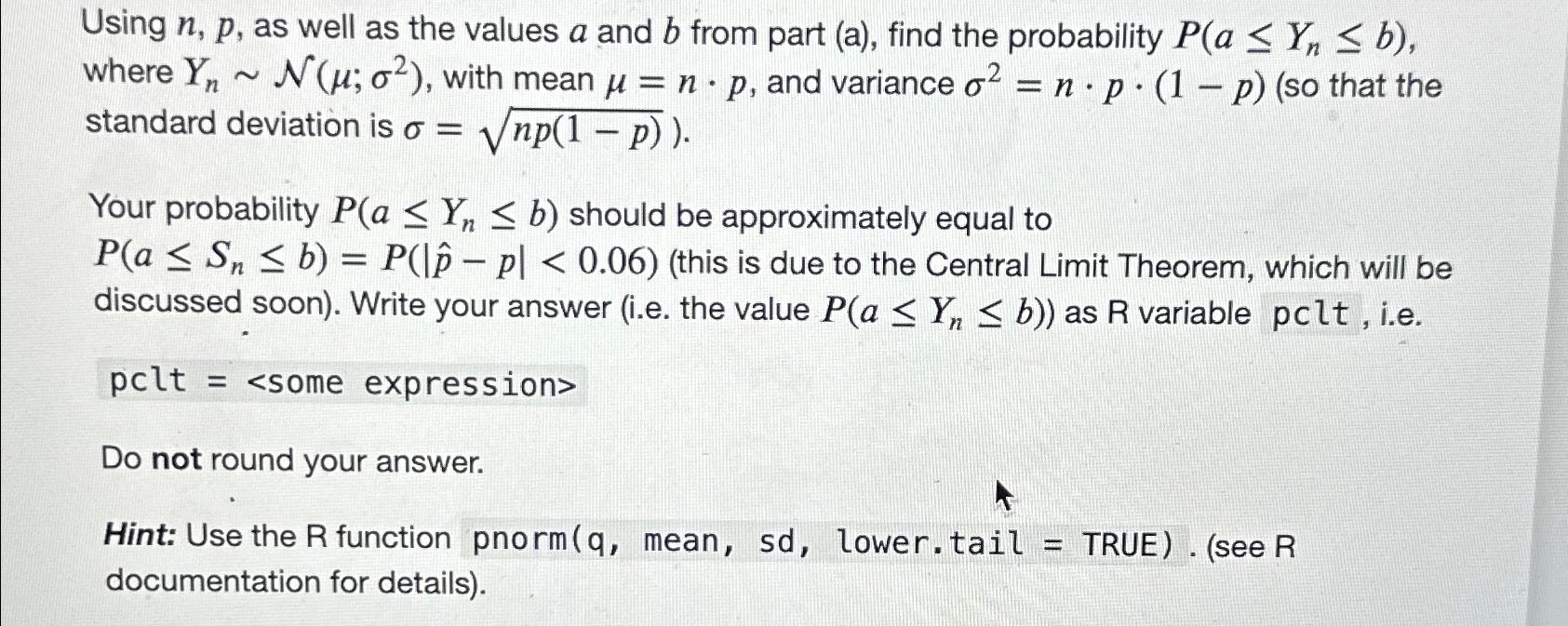
Using n,p, as well as the values a and b from part (a), find the probability P(aYnb), where YnN(;2), with mean =np, and variance 2=np(1p) (so that the standard deviation is =np(1p) ). Your probability P(aYnb) should be approximately equal to P(aSnb)=P(p^p Do not round your answer. Hint: Use the R function pnorm (q, mean, sd, lower.tail = TRUE). (see R documentation for details). Using n,p, as well as the values a and b from part (a), find the probability P(aYnb), where YnN(;2), with mean =np, and variance 2=np(1p) (so that the standard deviation is =np(1p) ). Your probability P(aYnb) should be approximately equal to P(aSnb)=P(p^p Do not round your answer. Hint: Use the R function pnorm (q, mean, sd, lower.tail = TRUE). (see R documentation for details)
Step by Step Solution
There are 3 Steps involved in it

Get step-by-step solutions from verified subject matter experts
 Study Help