



Question: using Penelope personal pocket phones case study please solve the excel sheet PAUL GOMPERS Penelope's Personal Pocket Phones Penelope Phillips sat in her laboratory at
using Penelope personal pocket phones case study please solve the excel sheet
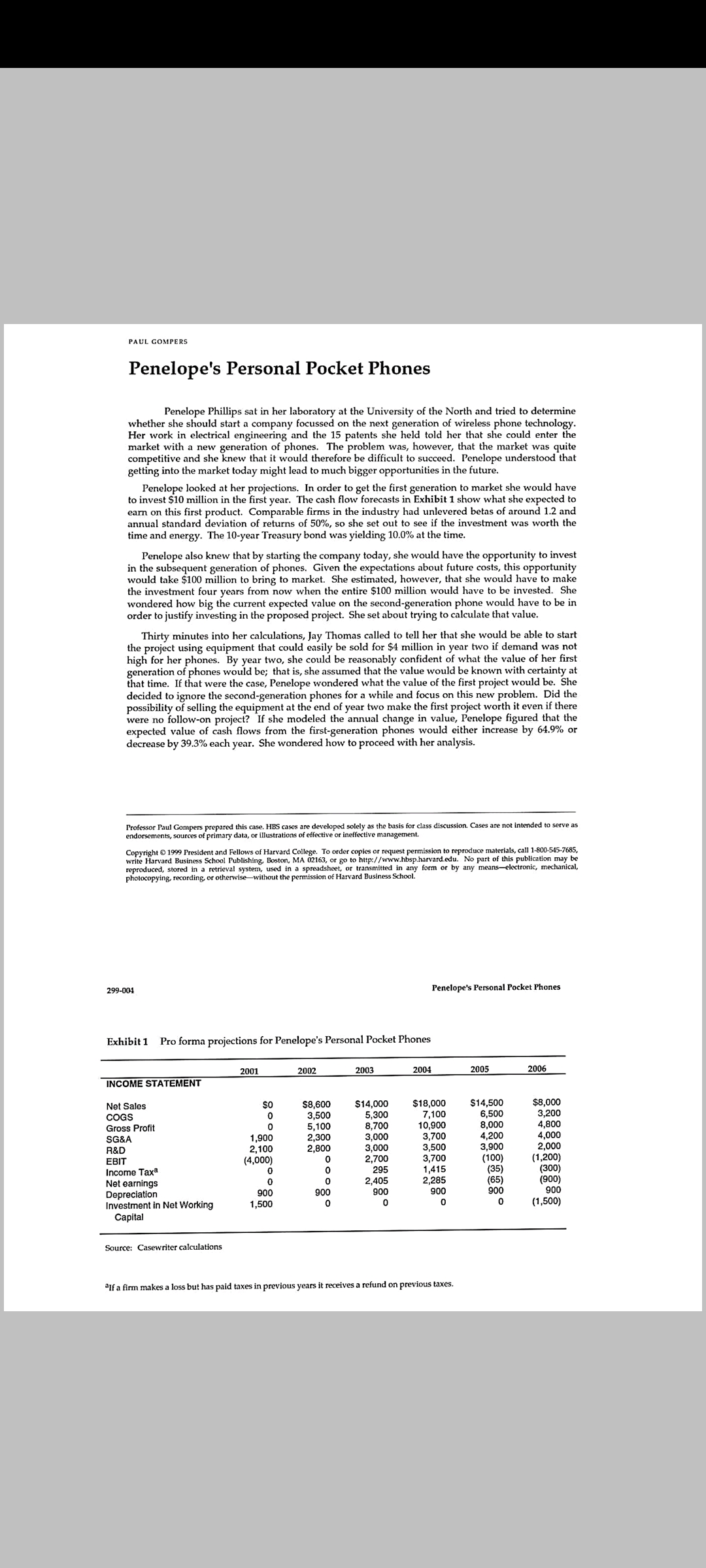
PAUL GOMPERS Penelope's Personal Pocket Phones Penelope Phillips sat in her laboratory at the University of the North and tried to determine whether she should start a company focussed on the next generation of wireless phone technology. Her work in electrical engineering and the 15 patents she held told her that she could enter the market with a new generation of phones. The problem was, however, that the market was quite competitive and she knew that it would therefore be difficult to succeed. Penelope understood that getting into the market today might lead to much bigger opportunities in the future. Penelope looked at her projections. In order to get the first generation to market she would have to invest $10 million in the first year. The cash flow forecasts in Exhibit 1 show what she expected to earn on this first product. Comparable firms in the industry had unlevered betas of around 1.2 and annual standard deviation of returns of 50%, so she set out to see if the investment was worth the time and energy. The 10-year Treasury bond was yielding 10.0% at the time. Penelope also knew that by starting the company today, she would have the opportunity to invest in the subsequent generation of phones. Given the expectations about future costs, this opportunity would take $100 million to bring to market. She estimated, however, that she would have to make the investment four years from now when the entire $100 million would have to be invested. She wondered how big the current expected value on the second-generation phone would have to be in order to justify investing in the proposed project. She set about trying to calculate that value. Thirty minutes into her calculations, Jay Thomas called to tell her that she would be able to start the project using equipment that could easily be sold for $4 million in year two if demand was not high for her phones. By year two, she could be reasonably confident of what the value of her first generation of phones would be; that is, she assumed that the value would be known with certainty at that time. If that were the case, Penelope wondered what the value of the first project would be. She decided to ignore the second-generation phones for a while and focus on this new problem. Did the possibility of selling the equipment at the end of year two make the first project worth it even if there were no follow-on project? If she modeled the annual change in value, Penelope figured that the expected value of cash flows from the first-generation phones would either increase by 64.9% or decrease by 39.3% each year. She wondered how to proceed with her analysis. Professor Paul Gompers prepared this case. HBS case opec solely as the basis for class discussion. Cases are not intended to serve as endorsements, sources of primary data, or illustrations of effective or ineffective management Copyright @ 1999 President and Fellows of Harvard College. To order copies or request permission to reproduce materials, call 1-800-545-7685, write Harvard Business School Publishing, Boston, MA 02163, or go to http://www.hosp.harvard.edu. No part of this publication may be reproduced, stored in a retrieval system, used in a spreadsheet, or transmitted in any form or by any means-electronic, mechanical, photocopying, recording, or otherwise-without the permission of Harvard Business School. 299-004 Penelope's Personal Pocket Phones Exhibit 1 Pro forma projections for Penelope's Personal Pocket Phones 2001 2002 2003 2004 2005 2006 INCOME STATEMENT Net Sales SO $8,600 $14,000 $18,000 $14,500 $8,000 COGS 0 3,500 5.300 7,10 6,500 3.200 Gross Profit 0 5,100 8,700 10,900 8,000 4,800 SG&A 1.900 2,300 3,000 3,700 4,200 4,000 R&D 2,100 2.800 3,000 3,500 3,900 2.000 EBIT (4,000) 2,700 3,700 (100) (1,200) Income Tax 0 295 1,415 (35) (300) Net earnings 0 2.405 2.285 (65) (900) Depreciation 900 900 900 900 900 90 nvestment in Net Working 1,500 (1,500) Capital Source: Casewriter calculations If a firm makes a loss but has paid taxes in previous years it receives a refund on previous taxes
Step by Step Solution
There are 3 Steps involved in it

Get step-by-step solutions from verified subject matter experts