







Question: Using Python 3. Approximate a permuted single value decomposition. Approximation with a Permuted SVD You are given the reduced SVD of a matrix A. The
Using Python 3. Approximate a permuted single value decomposition.
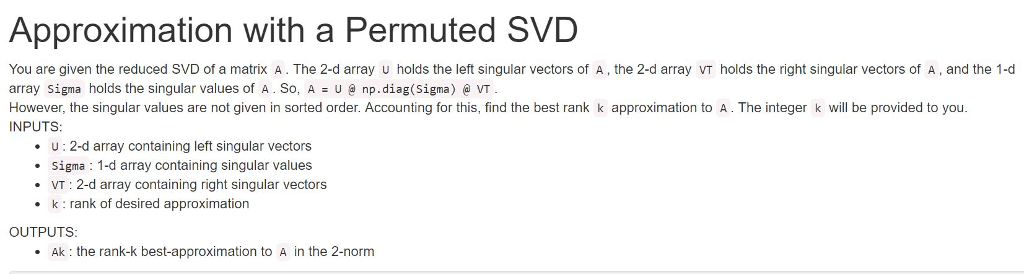
Approximation with a Permuted SVD You are given the reduced SVD of a matrix A. The 2-d array u holds the left singular vectors of A, the 2-d array VT holds the right singular vectors of A, and the 1-d array Sigma holds the singular values of A. So. A = u @ np.diag(Sigma) @ VT However, the singular values are not given in sorted order. Accounting for this, find the best rank k approximation to A. The integer k will be provided to you. INPUTS U:2-d array containing left singular vectors Sigma 1-d array containing singular values VT: 2-d array containing right singular vectors k rank of desired approximation OUTPUTS: Ak: the rank-k best-approximation to A in the 2-norm Approximation with a Permuted SVD You are given the reduced SVD of a matrix A. The 2-d array u holds the left singular vectors of A, the 2-d array VT holds the right singular vectors of A, and the 1-d array Sigma holds the singular values of A. So. A = u @ np.diag(Sigma) @ VT However, the singular values are not given in sorted order. Accounting for this, find the best rank k approximation to A. The integer k will be provided to you. INPUTS U:2-d array containing left singular vectors Sigma 1-d array containing singular values VT: 2-d array containing right singular vectors k rank of desired approximation OUTPUTS: Ak: the rank-k best-approximation to A in the 2-norm
Step by Step Solution
There are 3 Steps involved in it

Get step-by-step solutions from verified subject matter experts
 Study Help