







Question: Using Python Computer arithmetic may not behave the same as we would expect from real arithmetic. For example, if we perform the operation: = 1
Using Python
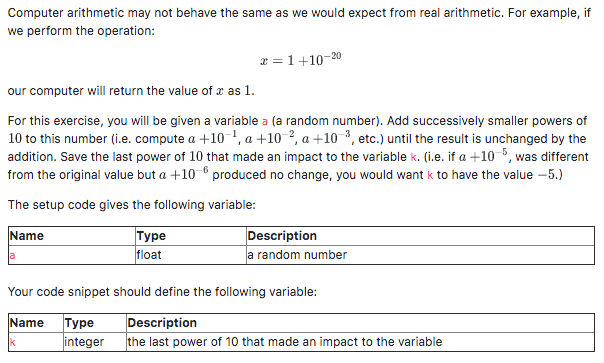
Computer arithmetic may not behave the same as we would expect from real arithmetic. For example, if we perform the operation: = 1 +10-20 our computer will return the value of x as 1. For this exercise, you will be given a variable a (a random number). Add successively smaller powers of 10 to this number (i.e. compute a +10 , a +10 , a +10, etc.) until the result is unchanged by the addition. Save the last power of 10 that made an impact to the variable k. (i.e. if a +10 , was different from the original value but a +10- produced no change, you would want k to have the value - 5.) The setup code gives the following variable: Name Type float Description a random number Your code snippet should define the following variable: Name Type integer Description the last power of 10 that made an impact to the variable
Step by Step Solution
There are 3 Steps involved in it

Get step-by-step solutions from verified subject matter experts
 Study Help