







Question: using Python (if- elif-else-sample operations -intl)-float|-input() these are thee only codes that are allowed to use. The days of the year are often numbered from
using Python (if- elif-else-sample operations -intl)-float|-input() these are thee only codes that are allowed to use.
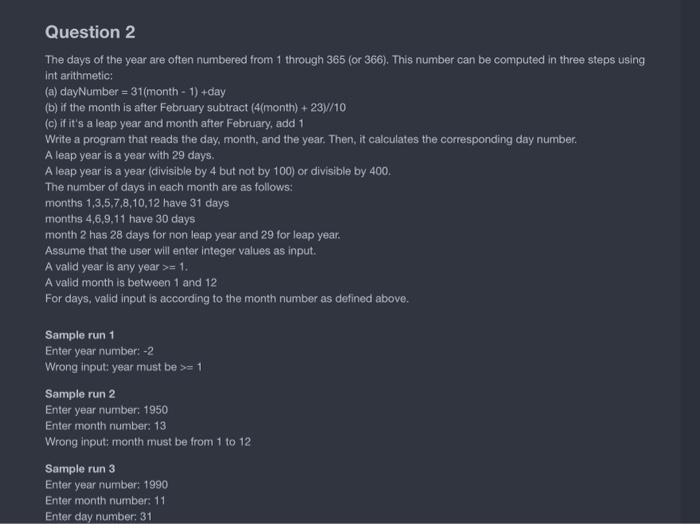
The days of the year are often numbered from 1 through 365 (or 366). This number can be computed in three steps using int arithmetic: (a) dayNumber =31(month1)+ day (b) if the month is after February subtract (4(month)+23)//10 (c) if it's a leap year and month after February, add 1 Write a program that reads the day, month, and the year. Then, it calculates the corresponding day number. A leap year is a year with 29 days. A leap year is a year (divisible by 4 but not by 100 ) or divisible by 400 . The number of days in each month are as follows: months 1,3,5,7,8,10,12 have 31 days months 4,6,9,11 have 30 days month 2 has 28 days for non leap year and 29 for leap year. Assume that the user will enter integer values as input. A valid year is any year >=1. A valid month is between 1 and 12 For days, valid input is according to the month number as defined above. Sample run 1 Enter year number: -2 Wrong input: year must be >=1 Sample run 2 Enter year number: 1950 Enter month number: 13 Wrong input: month must be from 1 to 12 Sample run 3 Enter year number: 1990 Enter month number: 11
Step by Step Solution
There are 3 Steps involved in it

Get step-by-step solutions from verified subject matter experts
 Study Help