







Question: Using Python to solve the problems. show your code, please. Thank you so much! 6 High risk and low-risk populations Now suppose that the population
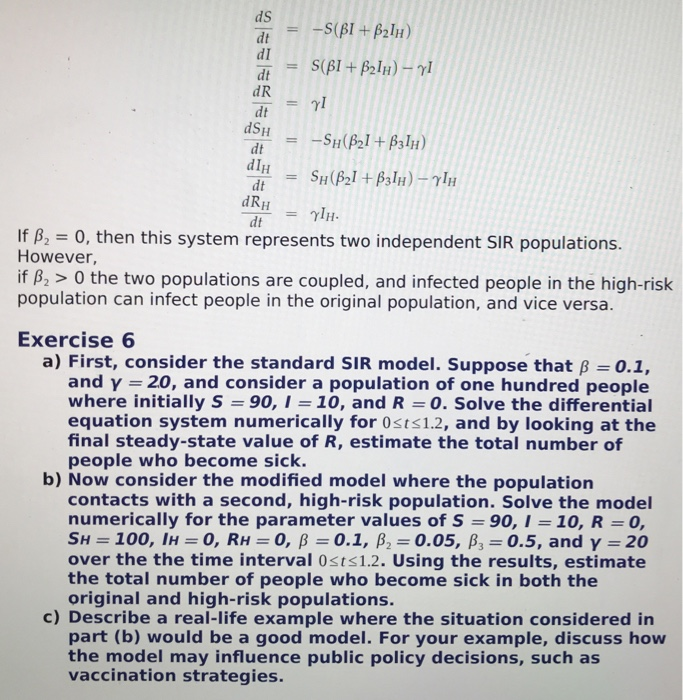
6 High risk and low-risk populations Now suppose that the population in the standard SIR model also comes into contact with a second, high-risk population. Let the number of susceptible, infected, and recovered people in this population be Sh(t), IH(t), and RH(t) respectively. A combined model for this is given by the system of differential equations di = -S(BI+ B211) = S(BI+ B21h) - 71 dlh dRH dSH = -SH(B21 + B311) = SH (B21 + B31H) - = yli If B2 = 0, then this system represents two independent SIR populations. However, if B, > 0 the two populations are coupled, and infected people in the high-risk population can infect people in the original population, and vice versa. dt Exercise 6 a) First, consider the standard SIR model. Suppose that B = 0.1, and y = 20, and consider a population of one hundred people where initially S = 90, 1 = 10, and R = 0. Solve the differential equation system numerically for Osts1.2, and by looking at the final steady-state value of R, estimate the total number of people who become sick. b) Now consider the modified model where the population contacts with a second, high-risk population. Solve the model numerically for the parameter values of S = 90, 1 = 10, R = 0, SH = 100, JH = 0, RH = 0, B = 0.1, B, = 0.05, B = 0.5, and y = 20 over the the time interval ost 1.2. Using the results, estimate the total number of people who become sick in both the original and high-risk populations. c) Describe a real-life example where the situation considered in part (b) would be a good model. For your example, discuss how the model may influence public policy decisions, such as vaccination strategies. 6 High risk and low-risk populations Now suppose that the population in the standard SIR model also comes into contact with a second, high-risk population. Let the number of susceptible, infected, and recovered people in this population be Sh(t), IH(t), and RH(t) respectively. A combined model for this is given by the system of differential equations di = -S(BI+ B211) = S(BI+ B21h) - 71 dlh dRH dSH = -SH(B21 + B311) = SH (B21 + B31H) - = yli If B2 = 0, then this system represents two independent SIR populations. However, if B, > 0 the two populations are coupled, and infected people in the high-risk population can infect people in the original population, and vice versa. dt Exercise 6 a) First, consider the standard SIR model. Suppose that B = 0.1, and y = 20, and consider a population of one hundred people where initially S = 90, 1 = 10, and R = 0. Solve the differential equation system numerically for Osts1.2, and by looking at the final steady-state value of R, estimate the total number of people who become sick. b) Now consider the modified model where the population contacts with a second, high-risk population. Solve the model numerically for the parameter values of S = 90, 1 = 10, R = 0, SH = 100, JH = 0, RH = 0, B = 0.1, B, = 0.05, B = 0.5, and y = 20 over the the time interval ost 1.2. Using the results, estimate the total number of people who become sick in both the original and high-risk populations. c) Describe a real-life example where the situation considered in part (b) would be a good model. For your example, discuss how the model may influence public policy decisions, such as vaccination strategies
Step by Step Solution
There are 3 Steps involved in it

Get step-by-step solutions from verified subject matter experts
 Study Help