







Question: Using R Markdown to solve 9.19 from the POE5 exercises. Please give specfic codes in the answer or I will report it as irrelavant. Again,
Using R Markdown to solve 9.19 from the POE5 exercises. Please give specfic codes in the answer or I will report it as irrelavant.
Again, I want answers which could be displayed in R Markdown! Please do not subit answers other than R language!!!!!!! I do not want already knitted PDF or HTML files!!!!!!
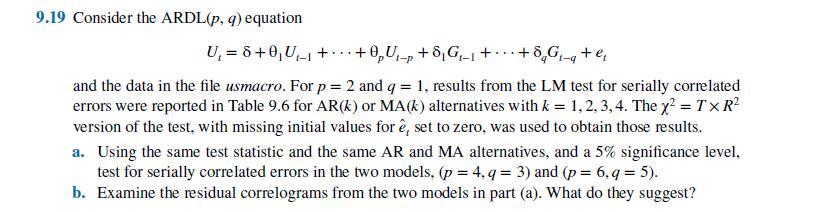
9.19 Consider the ARDL(p, q) equation U, = 6 +0,0.- +...+0,U.-- +86-1+...+86-+e and the data in the file usmacro. For p = 2 and q = 1, results from the LM test for serially correlated errors were reported in Table 9.6 for AR(k) or MA(k) alternatives with k = 1,2,3,4. The y? =Tx R2 version of the test, with missing initial values for , set to zero, was used to obtain those results. a. Using the same test statistic and the same AR and MA alternatives, and a 5% significance level, test for serially correlated errors in the two models, (p = 4,9= 3) and (p = 6,9 = 5). b. Examine the residual correlograms from the two models in part (a). What do they suggest? 9.19 Consider the ARDL(p, q) equation U, = 6 +0,0.- +...+0,U.-- +86-1+...+86-+e and the data in the file usmacro. For p = 2 and q = 1, results from the LM test for serially correlated errors were reported in Table 9.6 for AR(k) or MA(k) alternatives with k = 1,2,3,4. The y? =Tx R2 version of the test, with missing initial values for , set to zero, was used to obtain those results. a. Using the same test statistic and the same AR and MA alternatives, and a 5% significance level, test for serially correlated errors in the two models, (p = 4,9= 3) and (p = 6,9 = 5). b. Examine the residual correlograms from the two models in part (a). What do they suggest
Step by Step Solution
There are 3 Steps involved in it

Get step-by-step solutions from verified subject matter experts
 Study Help