







Question: Using RStudio to solve it. For 4A the link is https://people.math.carleton.ca/~davecampbell/datasets/2020/08/10/wild-life-data-balck-bear-hunting-activity-and-harvests-data-catalogue-from-goverrnment-of-ontario/ 4. A (1 point) Obtain the Black bear hunting activity and harvests dates from
Using RStudio to solve it. For 4A the link is https://people.math.carleton.ca/~davecampbell/datasets/2020/08/10/wild-life-data-balck-bear-hunting-activity-and-harvests-data-catalogue-from-goverrnment-of-ontario/
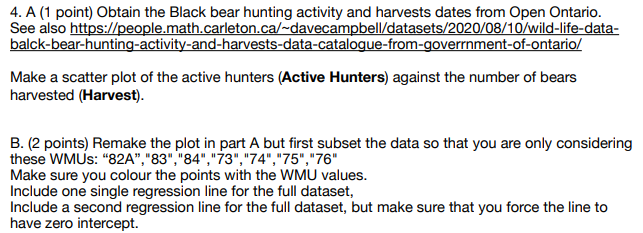
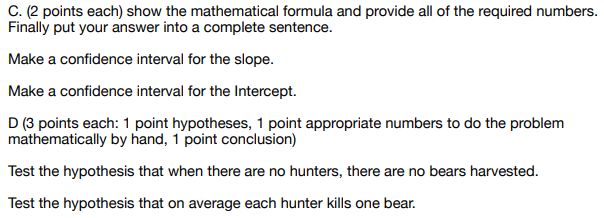
4. A (1 point) Obtain the Black bear hunting activity and harvests dates from Open Ontario. See also https://people.math.carleton.ca/~davecampbell/datasets/2020/08/10/wild-life-data- balck-bear-hunting-activity-and-harvests-data-catalogue-from-government-of-ontario/ Make a scatter plot of the active hunters (Active Hunters) against the number of bears harvested (Harvest). B. (2 points) Remake the plot in part A but first subset the data so that you are only considering these WMUs: "82A","83","84","73", "74","75","76" Make sure you colour the points with the WMU values. Include one single regression line for the full dataset, Include a second regression line for the full dataset, but make sure that you force the line to have zero intercept.C. (2 points each) show the mathematical formula and provide all of the required numbers. Finally put your answer into a complete sentence. Make a confidence interval for the slope. Make a confidence interval for the Intercept. D (3 points each: 1 point hypotheses, 1 point appropriate numbers to do the problem mathematically by hand, 1 point conclusion) Test the hypothesis that when there are no hunters, there are no bears harvested. Test the hypothesis that on average each hunter kills one bear
Step by Step Solution
There are 3 Steps involved in it

Get step-by-step solutions from verified subject matter experts
 Study Help