







Question: USING SCHEME 5. Define a tail-recursive function digits->number that takes a list of digits and returns the number represented by those digits. For example, >
USING SCHEME
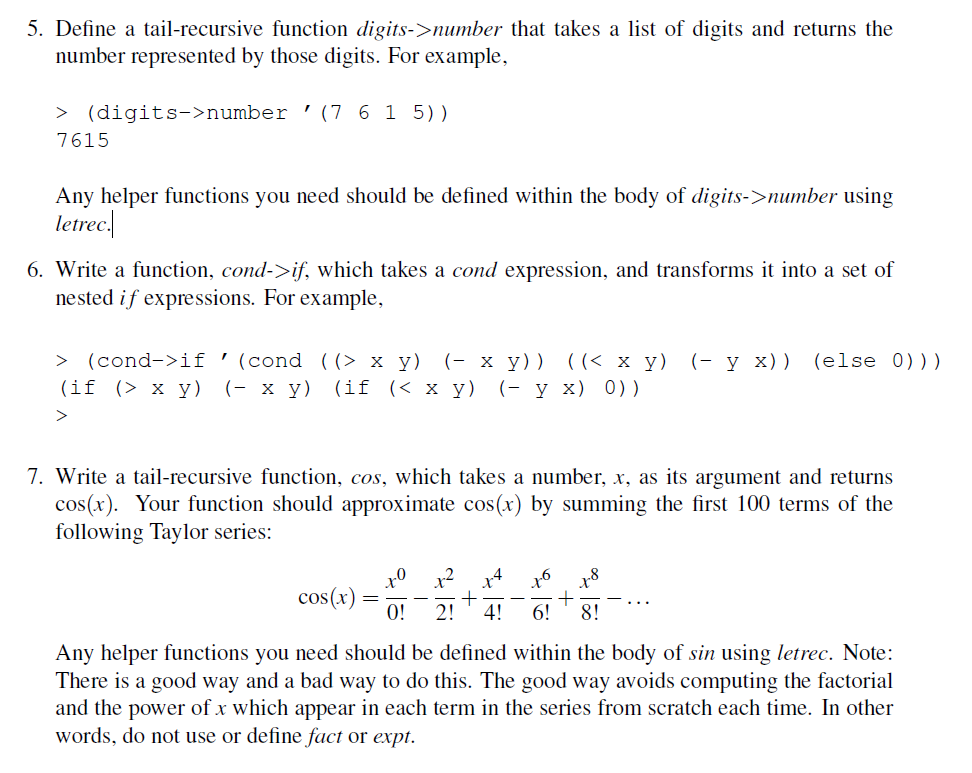
5. Define a tail-recursive function digits->number that takes a list of digits and returns the number represented by those digits. For example, > (digits->number : (7 6 1 5)) 7615 Any helper functions you need should be defined within the body of digits->number using letrec. 6. Write a function, cond->if, which takes a cond expression, and transforms it into a set of nested if expressions. For example, (else 0))) > (cond->if '(cond ((> x y) (- x y)) (( x y) (- x y) (if (number that takes a list of digits and returns the number represented by those digits. For example, > (digits->number : (7 6 1 5)) 7615 Any helper functions you need should be defined within the body of digits->number using letrec. 6. Write a function, cond->if, which takes a cond expression, and transforms it into a set of nested if expressions. For example, (else 0))) > (cond->if '(cond ((> x y) (- x y)) (( x y) (- x y) (if (
Step by Step Solution
There are 3 Steps involved in it

Get step-by-step solutions from verified subject matter experts
 Study Help