







Question: Using Scheme Programming Language R5RS ==================================================== Write a function called forAll that satisfies the following interaction. Hint: The function forEach should create a closure with
Using Scheme Programming Language R5RS
====================================================
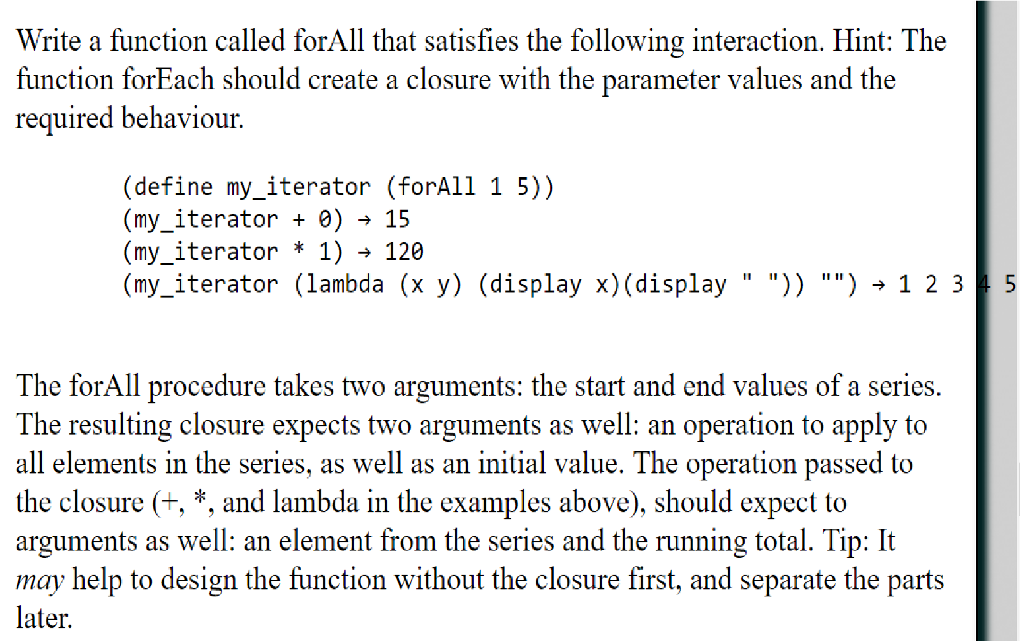
Write a function called forAll that satisfies the following interaction. Hint: The function forEach should create a closure with the parameter values and the required behaviour. (define my_iterator (forAll 1 5)) (my-iterator + 0)-15 (my-iterator * 1)-120 (my-iterator (lambda (x y) (display x)(display " ")) "")-1 2 31 The forAll procedure takes two arguments: the start and end values of a series. The resulting closure expects two arguments as well: an operation to apply to all elements in the series, as well as an initial value. The operation passed to the closure (+, *, and lambda in the examples above), should expect to arguments as well: an element from the series and the running total. Tip: It may help to design the function without the closure first, and separate the parts later. Write a function called forAll that satisfies the following interaction. Hint: The function forEach should create a closure with the parameter values and the required behaviour. (define my_iterator (forAll 1 5)) (my-iterator + 0)-15 (my-iterator * 1)-120 (my-iterator (lambda (x y) (display x)(display " ")) "")-1 2 31 The forAll procedure takes two arguments: the start and end values of a series. The resulting closure expects two arguments as well: an operation to apply to all elements in the series, as well as an initial value. The operation passed to the closure (+, *, and lambda in the examples above), should expect to arguments as well: an element from the series and the running total. Tip: It may help to design the function without the closure first, and separate the parts later
Step by Step Solution
There are 3 Steps involved in it

Get step-by-step solutions from verified subject matter experts
 Study Help