







Question: Using Stokes' Theorem, following the steps outlined below: Suppose we want the work done around the boundary of the plane 2 x + 3 y
Using Stokes' Theorem, following the steps outlined below:
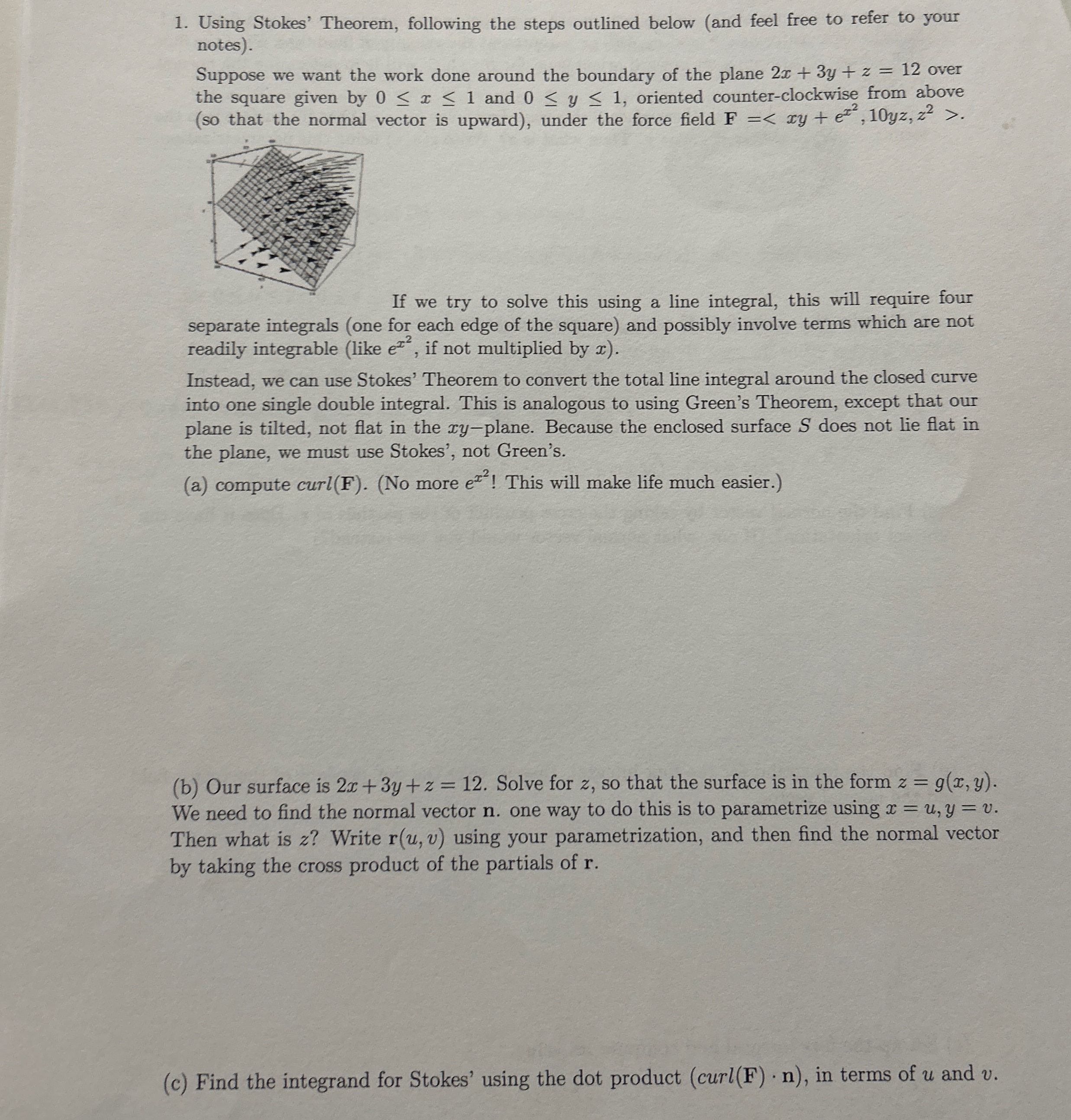
Suppose we want the work done around the boundary of the plane over the square given by and oriented counterclockwise from above so that the normal vector is upward under the force field
If we try to solve this using a line integral, this will require four separate integrals one for each edge of the square and possibly involve terms which are not readily integrable like if not multiplied by
Instead, we can use Stokes' Theorem to convert the total line integral around the closed curve into one single double integral. This is analogous to using Green's Theorem, except that our plane is tilted, not flat in the plane. Because the enclosed surface does not lie flat in the plane, we must use Stokes', not Green's.
a compute curl
b Our surface is Solve for so that the surface is in the form We need to find the normal vector one way to do this is to parametrize using Then what is Write using your parametrization, and then find the normal vector by taking the cross product of the partials of
c Find the integrand for Stokes' using the dot
product in terms of and
d Set up the double integral for Stokes' Theorum. This is now over a region in the xyplane and the limits of integration for u and v will come from the bounds on x and y
e Compute the integral you found in part d boxing your final answer.
Step by Step Solution
There are 3 Steps involved in it
1 Expert Approved Answer
Step: 1 Unlock

Question Has Been Solved by an Expert!
Get step-by-step solutions from verified subject matter experts
Step: 2 Unlock
Step: 3 Unlock
 Study Help