







Question: Using Table 11.4 , determine the sales necessary to equal a dollar of savings on purchases for a company that has: a) A net profit
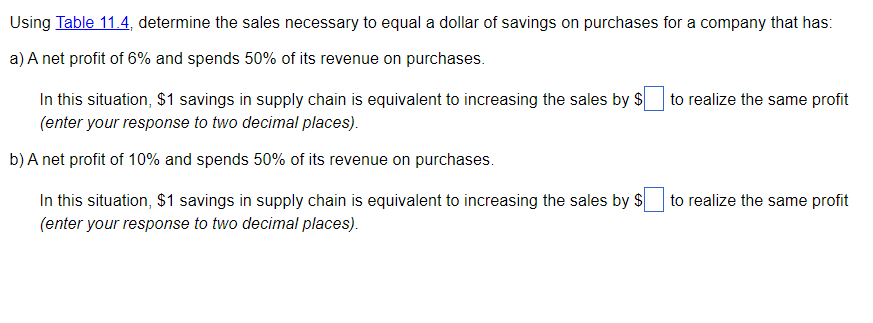
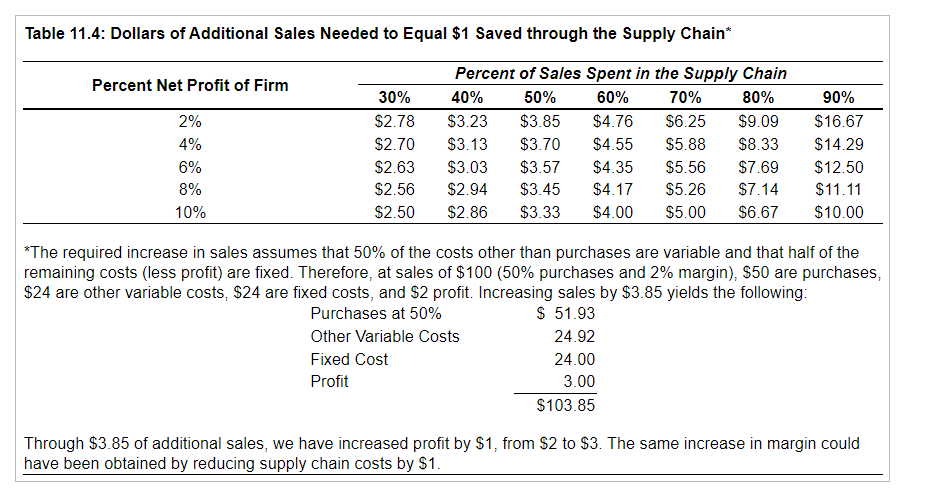
Using Table 11.4 , determine the sales necessary to equal a dollar of savings on purchases for a company that has: a) A net profit of 6% and spends 50% of its revenue on purchases. In this situation, $1 savings in supply chain is equivalent to increasing the sales by $ to realize the same profit (enter your response to two decimal places). b) A net profit of 10% and spends 50% of its revenue on purchases. In this situation, $1 savings in supply chain is equivalent to increasing the sales by $ to realize the same profit (enter your response to two decimal places). The required increase in sales assumes that 50% of the costs other than purchases are variable and that half of the remaining costs (less profit) are fixed. Therefore, at sales of $100 (50\% purchases and 2% margin), \$50 are purchases, $24 are other variable costs, $24 are fixed costs, and $2 profit. Increasing sales by $3.85 yields the following: Through $3.85 of additional sales, we have increased profit by $1, from $2 to $3. The same increase in margin could have been obtained by reducing supply chain costs by $1. Using Table 11.4 , determine the sales necessary to equal a dollar of savings on purchases for a company that has: a) A net profit of 6% and spends 50% of its revenue on purchases. In this situation, $1 savings in supply chain is equivalent to increasing the sales by $ to realize the same profit (enter your response to two decimal places). b) A net profit of 10% and spends 50% of its revenue on purchases. In this situation, $1 savings in supply chain is equivalent to increasing the sales by $ to realize the same profit (enter your response to two decimal places). The required increase in sales assumes that 50% of the costs other than purchases are variable and that half of the remaining costs (less profit) are fixed. Therefore, at sales of $100 (50\% purchases and 2% margin), \$50 are purchases, $24 are other variable costs, $24 are fixed costs, and $2 profit. Increasing sales by $3.85 yields the following: Through $3.85 of additional sales, we have increased profit by $1, from $2 to $3. The same increase in margin could have been obtained by reducing supply chain costs by $1
Step by Step Solution
There are 3 Steps involved in it

Get step-by-step solutions from verified subject matter experts
 Study Help