







Question: Using the above table pls answer these following questions: 1) Assume that the sale price of chairs is always sufficiently high that it is profitable
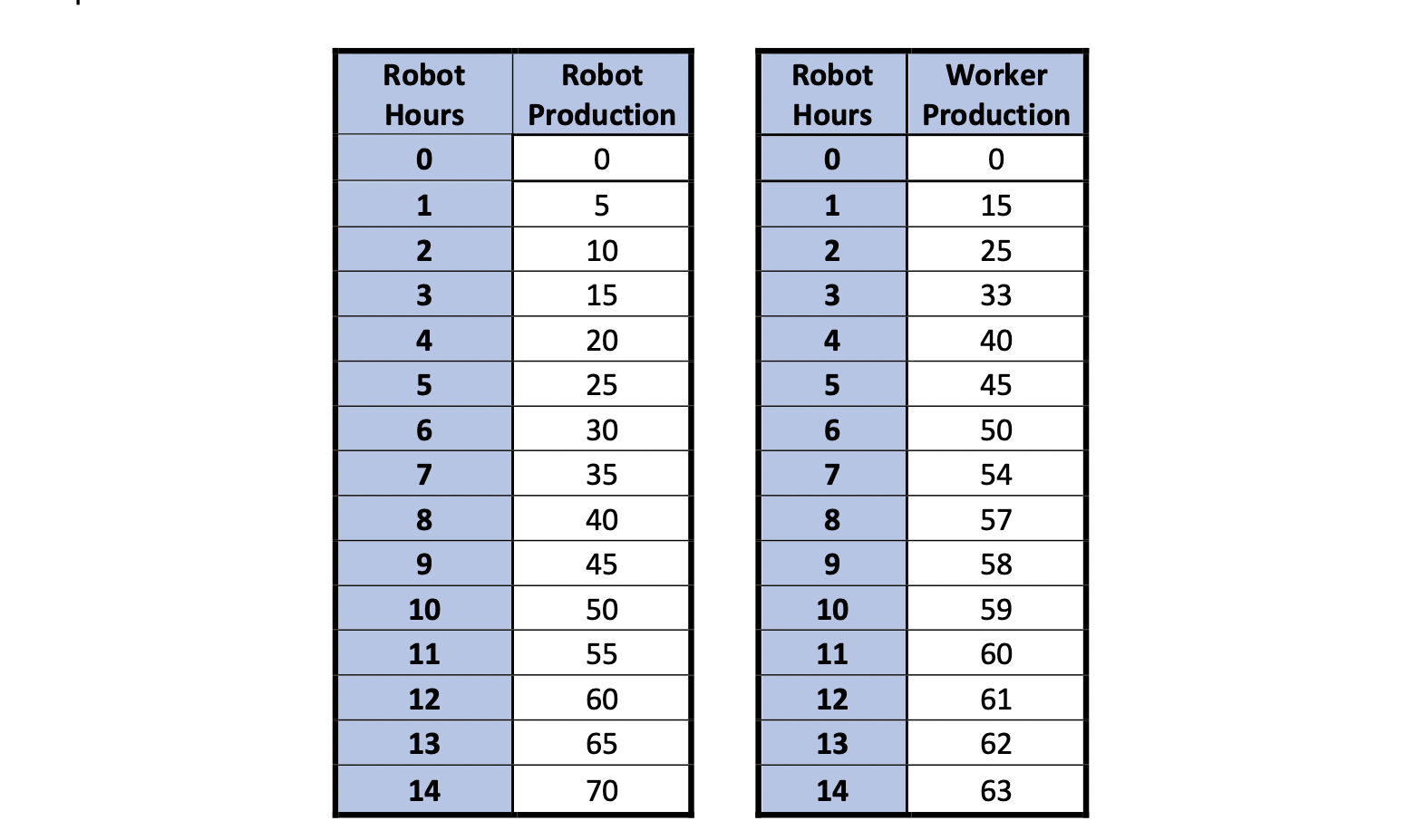
Using the above table pls answer these following questions:
1) Assume that the sale price of chairs is always sufficiently high that it is profitable to fulfill this 80-chair order. The firm needs to make 80 chairs to fulfill its order. Assume also that the firm is profit maximizing (& therefore cost minimizing). What combinations of robot and worker hours must they use to minimize costs? (Use the equation that must be true for cost minimization) ?
2) Now suppose that the local economy increases the minimum wage, and the price of an hour of a workers time increases from $18 to $27. What does the principle of substitution say should happen to the firms use of (i) worker hours and (ii) robot hours?
3) Continue to assume that it will be profitable to produce the 80 chairs and that the firm is profit- maximizing. With this new price for worker hours, what is the new combination of robot and worker hours that will minimize the cost of producing (at least) 80 chairs? (Use the equation that must be true for cost minimization)
\begin{tabular}{|c|c|} \hline Robot Hours & Robot Production \\ \hline 0 & 0 \\ \hline 1 & 5 \\ \hline 2 & 10 \\ \hline 3 & 15 \\ \hline 4 & 20 \\ \hline 5 & 25 \\ \hline 6 & 30 \\ \hline 7 & 35 \\ \hline 8 & 40 \\ \hline 9 & 45 \\ \hline 10 & 50 \\ \hline 11 & 55 \\ \hline 12 & 60 \\ \hline 13 & 65 \\ \hline 14 & 70 \\ \hline \end{tabular} \begin{tabular}{|c|c|} \hline Robot Hours & Worker Production \\ \hline 0 & 0 \\ \hline 1 & 15 \\ \hline 2 & 25 \\ \hline 3 & 33 \\ \hline 4 & 40 \\ \hline 5 & 45 \\ \hline 6 & 50 \\ \hline 7 & 54 \\ \hline 8 & 57 \\ \hline 9 & 58 \\ \hline 10 & 59 \\ \hline 11 & 60 \\ \hline 12 & 61 \\ \hline 13 & 62 \\ \hline 14 & 63 \\ \hline \end{tabular} \begin{tabular}{|c|c|} \hline Robot Hours & Robot Production \\ \hline 0 & 0 \\ \hline 1 & 5 \\ \hline 2 & 10 \\ \hline 3 & 15 \\ \hline 4 & 20 \\ \hline 5 & 25 \\ \hline 6 & 30 \\ \hline 7 & 35 \\ \hline 8 & 40 \\ \hline 9 & 45 \\ \hline 10 & 50 \\ \hline 11 & 55 \\ \hline 12 & 60 \\ \hline 13 & 65 \\ \hline 14 & 70 \\ \hline \end{tabular} \begin{tabular}{|c|c|} \hline Robot Hours & Worker Production \\ \hline 0 & 0 \\ \hline 1 & 15 \\ \hline 2 & 25 \\ \hline 3 & 33 \\ \hline 4 & 40 \\ \hline 5 & 45 \\ \hline 6 & 50 \\ \hline 7 & 54 \\ \hline 8 & 57 \\ \hline 9 & 58 \\ \hline 10 & 59 \\ \hline 11 & 60 \\ \hline 12 & 61 \\ \hline 13 & 62 \\ \hline 14 & 63 \\ \hline \end{tabular}
Step by Step Solution
There are 3 Steps involved in it

Get step-by-step solutions from verified subject matter experts
 Study Help