







Question: using the assumptions, derive Eq 4 from Eq 3. 3.1.1. Kinetic model The kinetic model used in this work is based on the following assumptions:
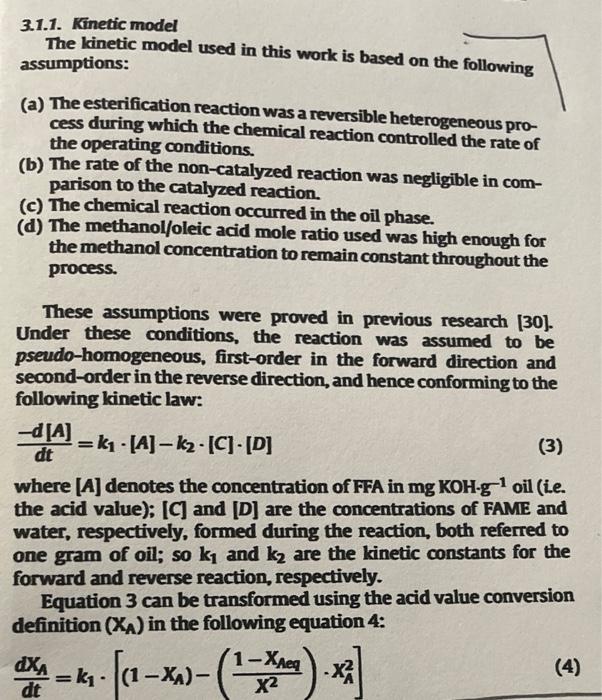
3.1.1. Kinetic model The kinetic model used in this work is based on the following assumptions: (a) The esterification reaction was a reversible heterogeneous pro- cess during which the chemical reaction controlled the rate of the operating conditions. (b) The rate of the non-catalyzed reaction was negligible in com- parison to the catalyzed reaction. (c) The chemical reaction occurred in the oil phase. (d) The methanol/oleic acid mole ratio used was high enough for the methanol concentration to remain constant throughout the process. These assumptions were proved in previous research (30). Under these conditions, the reaction was assumed to be pseudo-homogeneous, first-order in the forward direction and second-order in the reverse direction, and hence conforming to the following kinetic law: -d[A] =k-[A] -k2-(C)-[D] dt (3) where [A] denotes the concentration of FFA in mg KOH-g oil (ie. the acid value); (Cand [D] are the concentrations of FAME and water, respectively, formed during the reaction, both referred to one gram of oil; so ky and k2 are the kinetic constants for the forward and reverse reaction, respectively. Equation 3 can be transformed using the acid value conversion definition (XA) in the following equation 4: dXA 1- =k. (1-X)- dt - [-Xw- -X (4) X2
Step by Step Solution
There are 3 Steps involved in it

Get step-by-step solutions from verified subject matter experts
 Study Help