







Question: Using the attached lesson plan, develop a rubric for the assessment of the lesson plan with the following requirements: Discussion of Rubrics: rubrics should match
Using the attached lesson plan, develop a rubric for the assessment of the lesson plan with the following requirements:
- Discussion of Rubrics: rubrics should match the objectives, the description of the rubric is clear and precise, and the description accurately details what is measuring in the student
- Discussion of Criteria for Rubrics: Rubrics are described in detail how the criteria was developed for the respected standards/lesson for the selected age group
- Discussion of how ALL rubrics can be Individualized: An in depth discussion of how the educator would individualize a rubric's expectations for a student with a disability (e.g., students with IEPs, 504s, BIPs, Asthma Plans etc.
Assessment Rubric:
| Type of Assessment: | Timing Within Lesson: | Objective/ Goal Assessed: |
| Legend: (eg Behaviors, Skill Level and Knowledge Criteria Descriptions) | ||
Assessment Template/Rubric (must make your own based on type of assessment and objective being assessed): | |||
| Sorting / Categorizing | 3 | 2 | 1 |
| Counting | |||
| Quantifying |
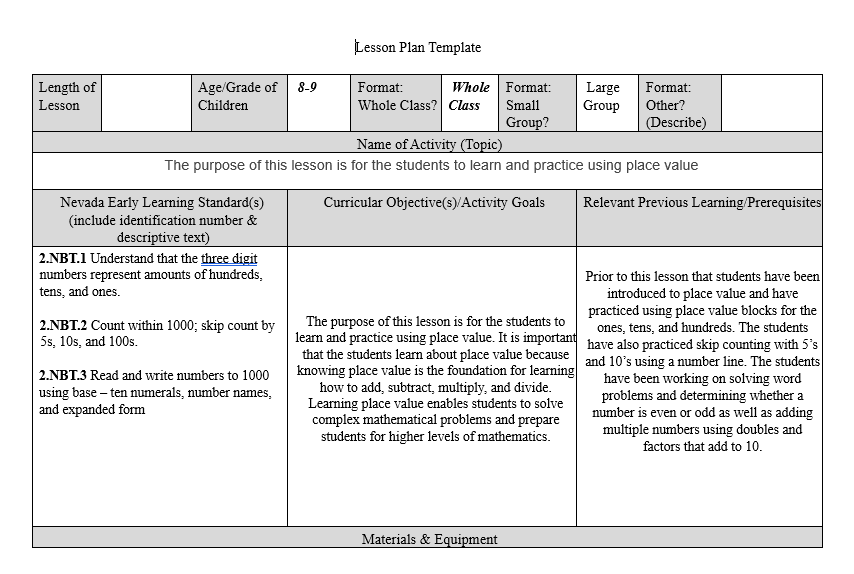
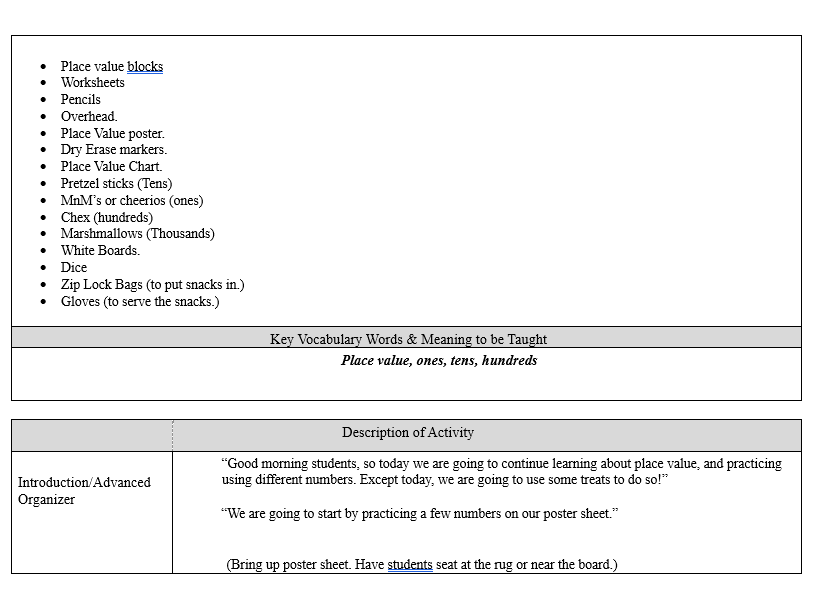
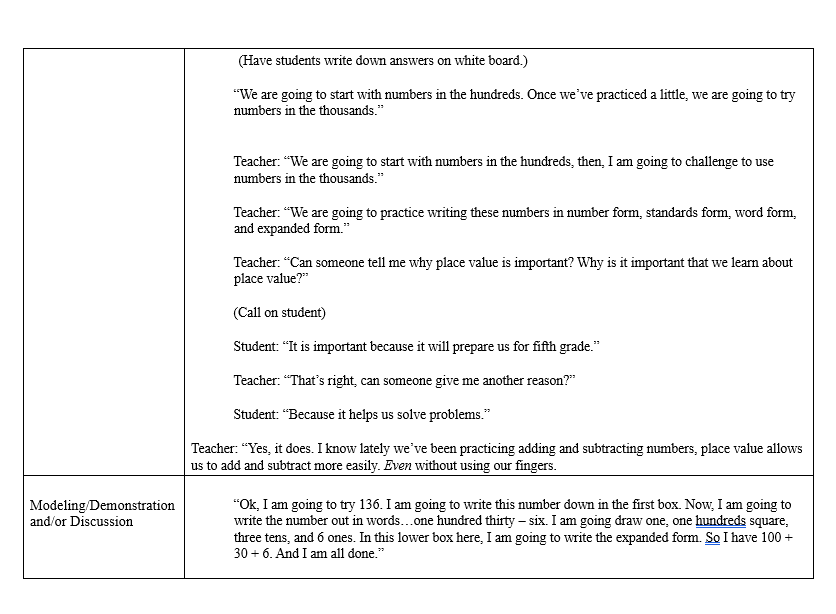
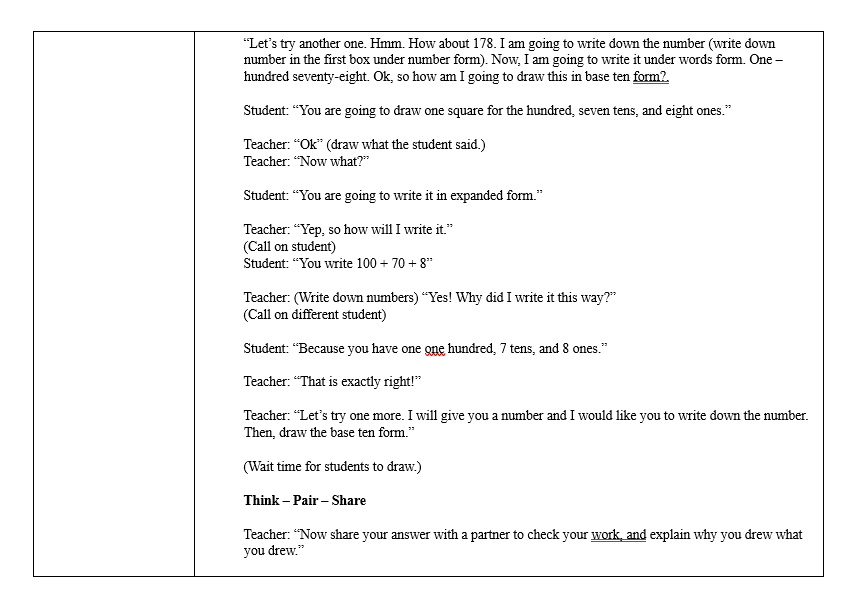
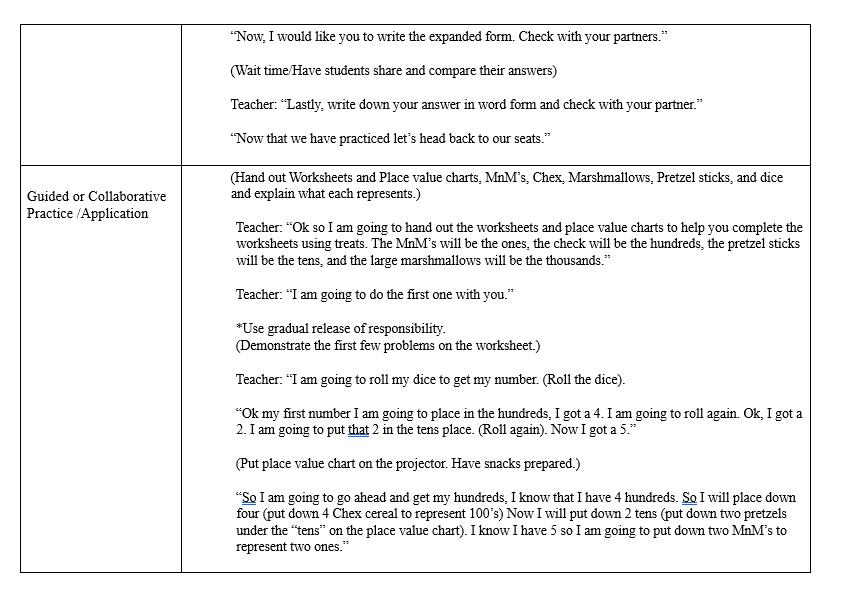
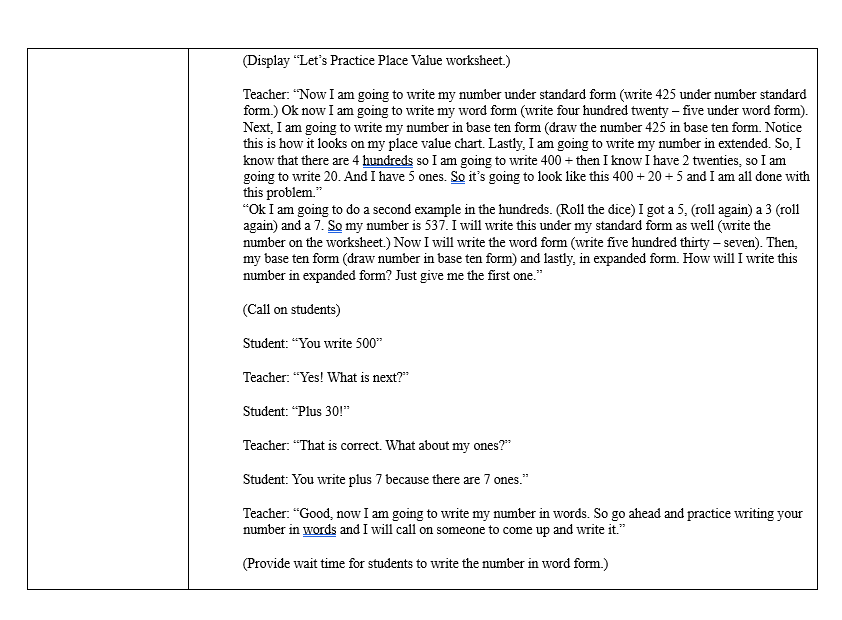
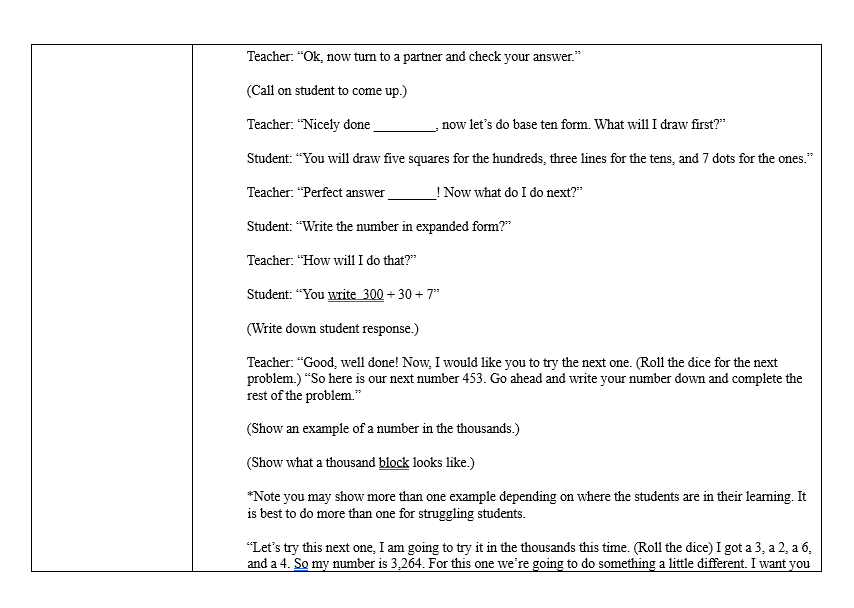
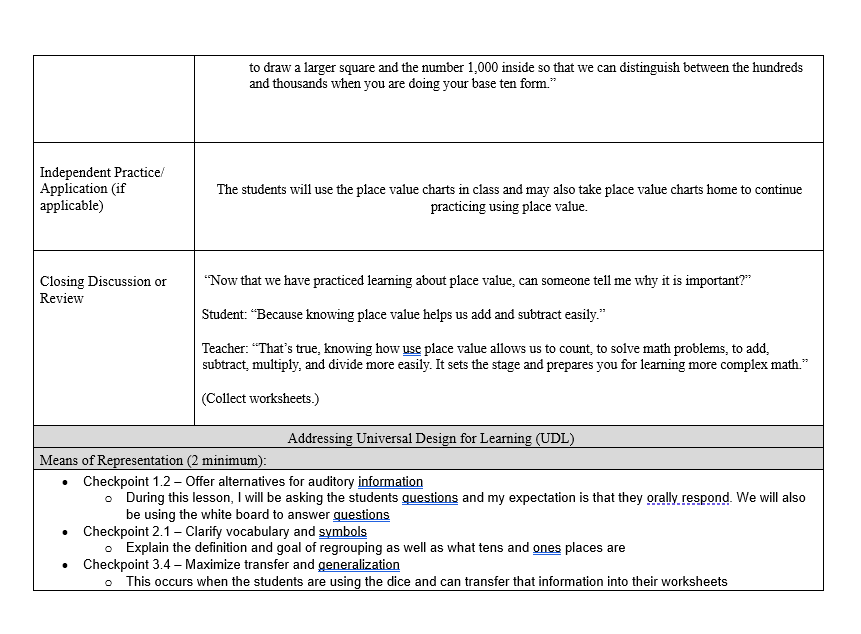
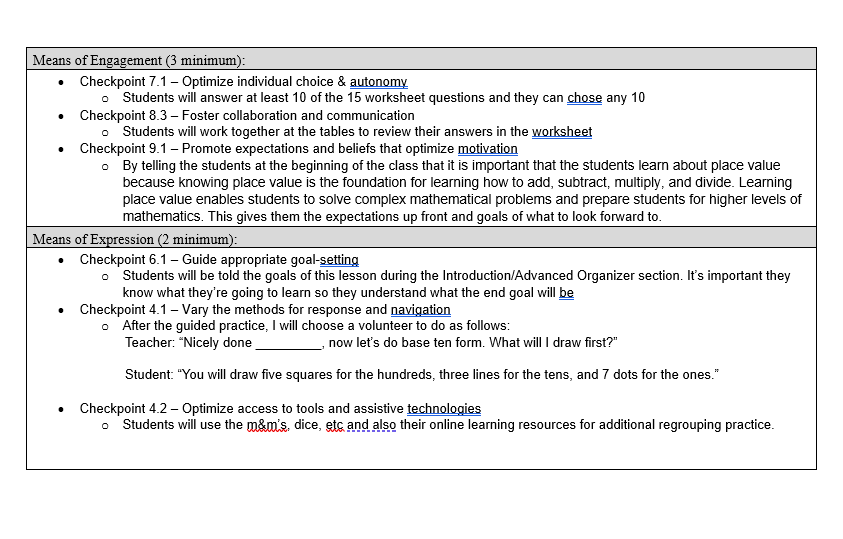
Lesson Plan Template Length of Age/Grade of 8-9 Format: Whole Format: Large Format: Lesson Children Whole Class? Class Small Group Other? Group? (Describe) Name of Activity (Topic) The purpose of this lesson is for the students to learn and practice using place value Nevada Early Learning Standard(s) Curricular Objective(s)/Activity Goals Relevant Previous Learning Prerequisites (include identification number & descriptive text) 2.NBT.1 Understand that the three digit numbers represent amounts of hundreds, Prior to this lesson that students have been tens, and ones. introduced to place value and have practiced using place value blocks for the 2.NBT.2 Count within 1000; skip count by The purpose of this lesson is for the students to ones, tens, and hundreds. The students 5s, 10s, and 100s. learn and practice using place value. It is important have also practiced skip counting with 5's that the students learn about place value because and 10's using a number line. The students 2.NBT.3 Read and write numbers to 1000 knowing place value is the foundation for learning how to add, subtract, multiply, and divide. have been working on solving word using base - ten numerals, number names, and expanded form Learning place value enables students to solve problems and determining whether a complex mathematical problems and prepare number is even or odd as well as adding students for higher levels of mathematics. multiple numbers using doubles and factors that add to 10. Materials & EquipmentPlace value blocks Worksheets Pencils Overhead. Place Value poster. Dry Erase markers. Place Value Chart. Pretzel sticks (Tens) MnM's or cheerios (ones) Chex (hundreds) Marshmallows (Thousands) White Boards. Dice Zip Lock Bags (to put snacks in.) Gloves (to serve the snacks.) Key Vocabulary Words & Meaning to be Taught Place value, ones, tens, hundreds Description of Activity "Good morning students, so today we are going to continue learning about place value, and practicing Introduction/Advanced using different numbers. Except today, we are going to use some treats to do so!" Organizer "We are going to start by practicing a few numbers on our poster sheet." (Bring up poster sheet. Have students seat at the rug or near the board.)(Have students write down answers on white board.) \"We are going to start with numbers in the hundreds. Once we've practiced a little, we are going to trv numbers in the thousands Teacher: *We are going to start with numbers in the hundreds, then, [ am going to challenge to use numbers in the thousands.\" Teacher: \"We are going to practice writing these numbers in number form, standards form, word form, and expanded form.\" Teacher: \"Can someone tell me why place value 1s important? Why is 1t important that we learn about place value (Call on student) Student: \"It is important becanse it will prepare us for fifth grade Teacher: \"That's right, can someone give me another reason Student: \"Because it helps us solve problems.\" Teacher: \"Yes, it does. [ know lately we 've been practicing adding and subtracting numbers, place value allows us to add and subtract more easily. Even without using our fingers. Modeling/Demonstration \"0k, I am going to try 136. I am going to write this number down in the first box. Now, [ am going to and/or Discussion write the number out in words. ..one hundred thirty six. I am going draw one, one hundreds square, three tens, and 6 ones. In this lower box here, I am going to write the expanded form. So I have 100 + 30+ 6. And [ am all done "Let's try another one. Hmm. How about 178. I am going to write down the number (write down number in the first box under number form). Now, I am going to write it under words form. One - hundred seventy-eight. OK, so how am I going to draw this in base ten form?. Student: "You are going to draw one square for the hundred, seven tens, and eight ones." Teacher: "Ok" (draw what the student said.) Teacher: "Now what?" Student: "You are going to write it in expanded form." Teacher: "Yep, so how will I write it." (Call on student) Student: "You write 100 + 70 + 8" Teacher: (Write down numbers) "Yes! Why did I write it this way?" (Call on different student) Student: "Because you have one one hundred, 7 tens, and 8 ones." Teacher: "That is exactly right!" Teacher: "Let's try one more. I will give you a number and I would like you to write down the number. Then, draw the base ten form." (Wait time for students to draw.) Think - Pair - Share Teacher: "Now share your answer with a partner to check your work, and explain why you drew what you drew."Guided or Collaborative Practice /Application \"Now, I would like you to write the expanded form. Check with your partners.\" (Wait timeHave students share and compare their answers) Teacher: \"Lastly, write down vour answer in word form and check with vour partner.\" \"Now that we have practiced let's head back to our seats.\" (Hand out Worksheets and Place value charts, MnM's, Chex, Marshmallows, Pretzel sticks, and dice and explain what each represents.) Teacher: \"Ok so I am going to hand out the worksheets and place value charts to help vou complete the worksheets using treats. The MM s will be the ones, the check will be the hundreds, the pretzel sticks will be the tens, and the large marshmallows will be the thousands.\" Teacher: \"T am going to do the first one with vou *Use gradual release of responsibility. {Demonstrate the first few problems on the worksheet.) Teacher: \"T am going to roll my dice to get my number. (Roll the dice). \"Ok my first number I am going to place in the hundreds, I got a 4. [ am going to roll again. Ok, I gota 2.1 am geing to put that 2 in the tens place. (Roll again). Now I gota 5.7 {Put place value chart on the projector. Have snacks prepared.) \"50 I am going to go ahead and get my hundreds, I know that [ have 4 hundreds. So I will place down four (put down 4 Chex cereal to represent 100s) Now I will put down 2 tens (put down two pretzels under the \"tens on the place value chart). I know I have 5 so I am going to put down two Mnh{'s to represent two ones.\" (Display \"Let's Practice Place Value worksheet ) Teacher: \"Now [ am going to write my number under standard form (write 425 under number standard form ) Ok now [ am going to write my word form (write four hundred twenty five under word form). Next, I am going to write my number in base ten form (draw the number 425 in base ten form. Notice this is how it looks on my place value chart Lastly, [ am going to write my number in extended. 5o, I know that there are 4 hundreds so T am going to write 400 + then I know I have 2 twenties, so T am going to write 20. And I have 5 ones. So it's going to look like thiz 400 + 20 + 5 and I am all done with this problem \"0Ok I am going to do a second example in the hundreds. (Roll the dice) I got a 5, (roll again) a 3 {roll again) and a 7. S0 my number 15 537. I will write this under my standard form as well (write the number on the worksheet ) Now I will write the word form (write five hundred thirty seven). Then, my base ten form (draw number in base ten form) and lastly, in expanded form. How will T write this number in expanded form? Just give me the first one.\" (Call on students) Student: \"You write 5007 Teacher: \"Yes! What is next? Student: \"Plus 3017 Teacher: \"That iz correct. What about my ones?\" Student: You write plus 7 because there are 7 ones.\" Teacher: \"Good, now I am going to write my number in words. So go ahead and practice writing vour number in words and I will call on someone to come up and write it.\" (Provide wait time for students to write the number in word form ) Teacher: "Ok, now turn to a partner and check your answer." (Call on student to come up.) Teacher: "Nicely done now let's do base ten form. What will I draw first?" Student: "You will draw five squares for the hundreds, three lines for the tens, and 7 dots for the ones." Teacher: "Perfect answer ! Now what do I do next?" Student: "Write the number in expanded form?" Teacher: "How will I do that?" Student: "You write 300 + 30+ 7" (Write down student response.) Teacher: "Good, well done! Now, I would like you to try the next one. (Roll the dice for the next problem.) "So here is our next number 453. Go ahead and write your number down and complete the rest of the problem." (Show an example of a number in the thousands.) (Show what a thousand block looks like.) *Note you may show more than one example depending on where the students are in their learning. It is best to do more than one for struggling students. "Let's try this next one, I am going to try it in the thousands this time. (Roll the dice) I got a 3, a 2, a 6, and a 4. So my number is 3.264. For this one we're going to do something a little different. I want youto draw a larger square and the number 1,000 inside so that we can distinguish between the hundreds and thousands when you are doing vour base ten form. Independent Practice/ Application (1if The students will use the place value charts in class and may also take place value charts home to continue applicable) practicing using place value. Closing Discussion or \"Wow that we have practiced learning about place value, can someone tell me why it is important?\" Review Student: \"Because knowing place value helps us add and subtract easily.\" Teacher: \"That's true, knowing how use place value allows us to count, to solve math problems, to add, subtract, multiply, and divide more easily. It sets the stage and prepares you for learning more complex math. B (Collect worksheets_) Addressing Universal Design for Learming (UDL) Means of Representation (2 mimmum): Checkpoint 1.2 Offer alternatives for auditory information be using the white board to answer guestions Checkpoint 2.1 Clarify vocabulary and symbols o Explain the definition and goal of regrouping as well as what tens and ones places are Checkpoint 3.4 Maximize transfer and generalization o= This occurs when the students are using the dice and can transfer that information into their worksheets Means of Engagement (3 minimum): Checkpoint 7.1 Optimize individual choice & autonomy o Students will answer at least 10 of the 15 worksheet questions and they can chose any 10 + Checkpoint 8.3 Foster collaboration and communication o Students will work together at the tables to review their answers in the worksheet Checkpoint 9.1 Promote expectations and beliefs that optimize mofivation o By telling the students at the beginning of the class that it is important that the students leam about place value because knowing place value is the foundation for learning how to add, subtract, multiply, and divide. Leaming place value enables students to solve complex mathematical problems and prepare students for higher levels of mathematics. This gives them the expectations up front and goals of what to look forward to. Means of Expression (2 minimum): + Checkpoint 6.1 Guide appropriate goal-setting o Students will be told the goals of this lesson during the Introduction/Advanced Organizer section. It's important they know what they're going to learn so they understand what the end goal will be + Checkpoint 4.1 Vary the methods for response and navigation o After the guided practice, | will choose a volunteer to do as follows: Teacher: \"Nicely done , now let's do base ten form. What will | draw first?" Student: \"You will draw five squares for the hundreds, three lines for the tens, and 7 dots for the ones\" + Checkpoint 4 2 Optimize access to tools and assistive technologies
Step by Step Solution
There are 3 Steps involved in it

Get step-by-step solutions from verified subject matter experts
 Study Help