







Question: Using the balanced scorecard framework and the Uber case information provided above, explain the customer perspective with specific examples. Uber has around 3.9 million active
Using the balanced scorecard framework and the Uber case information provided above, explain the customer perspective with specific examples.
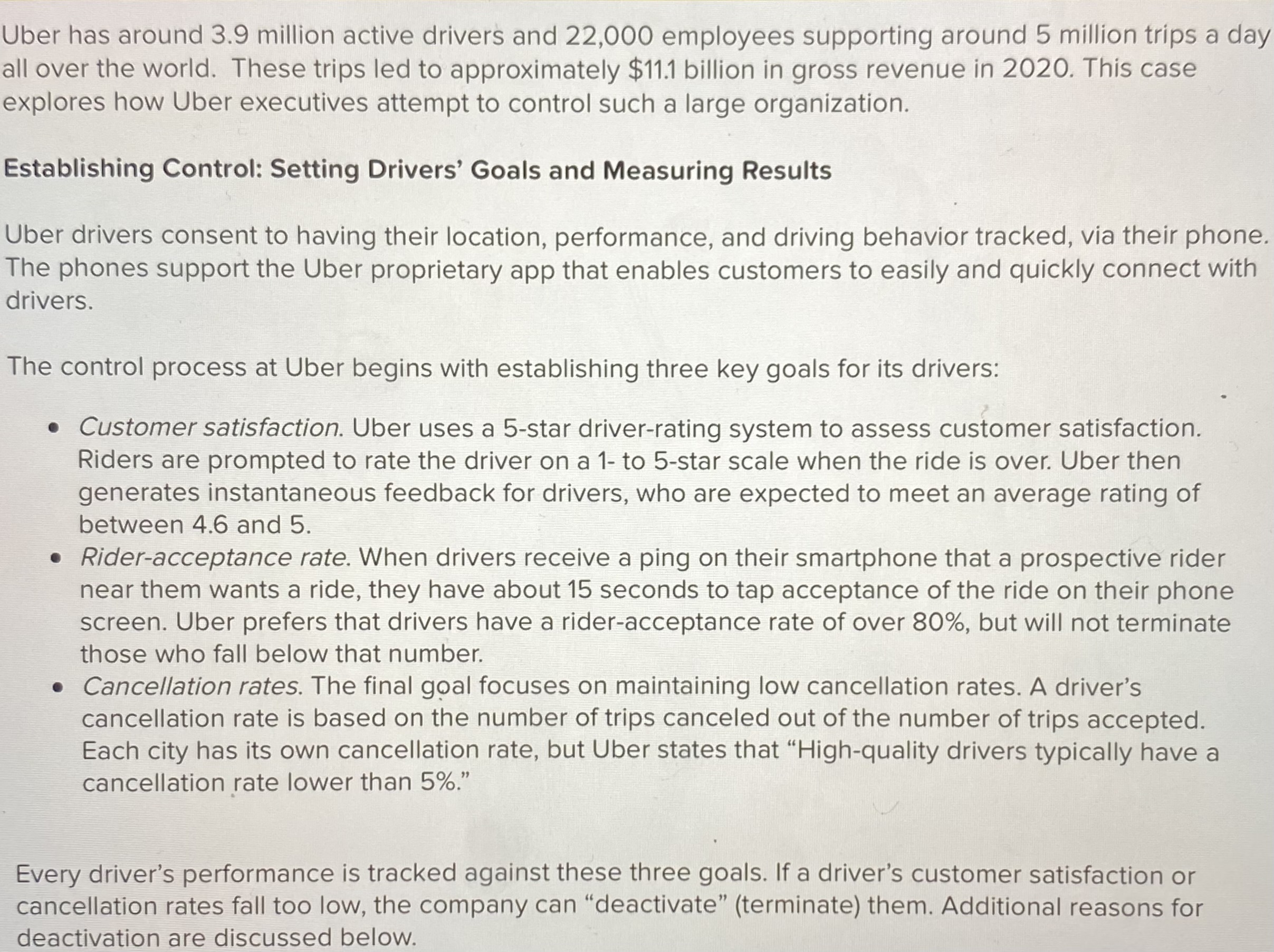
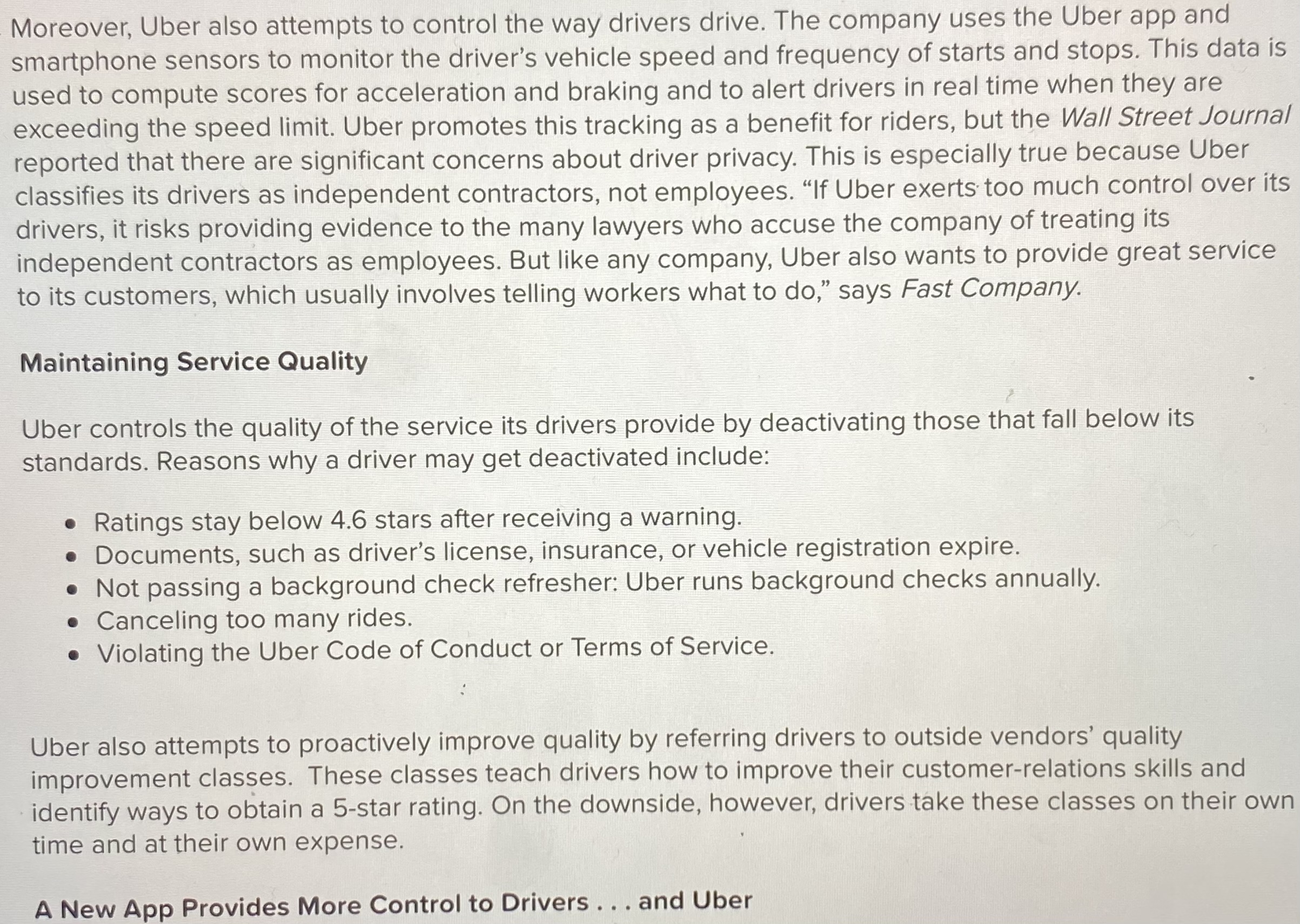
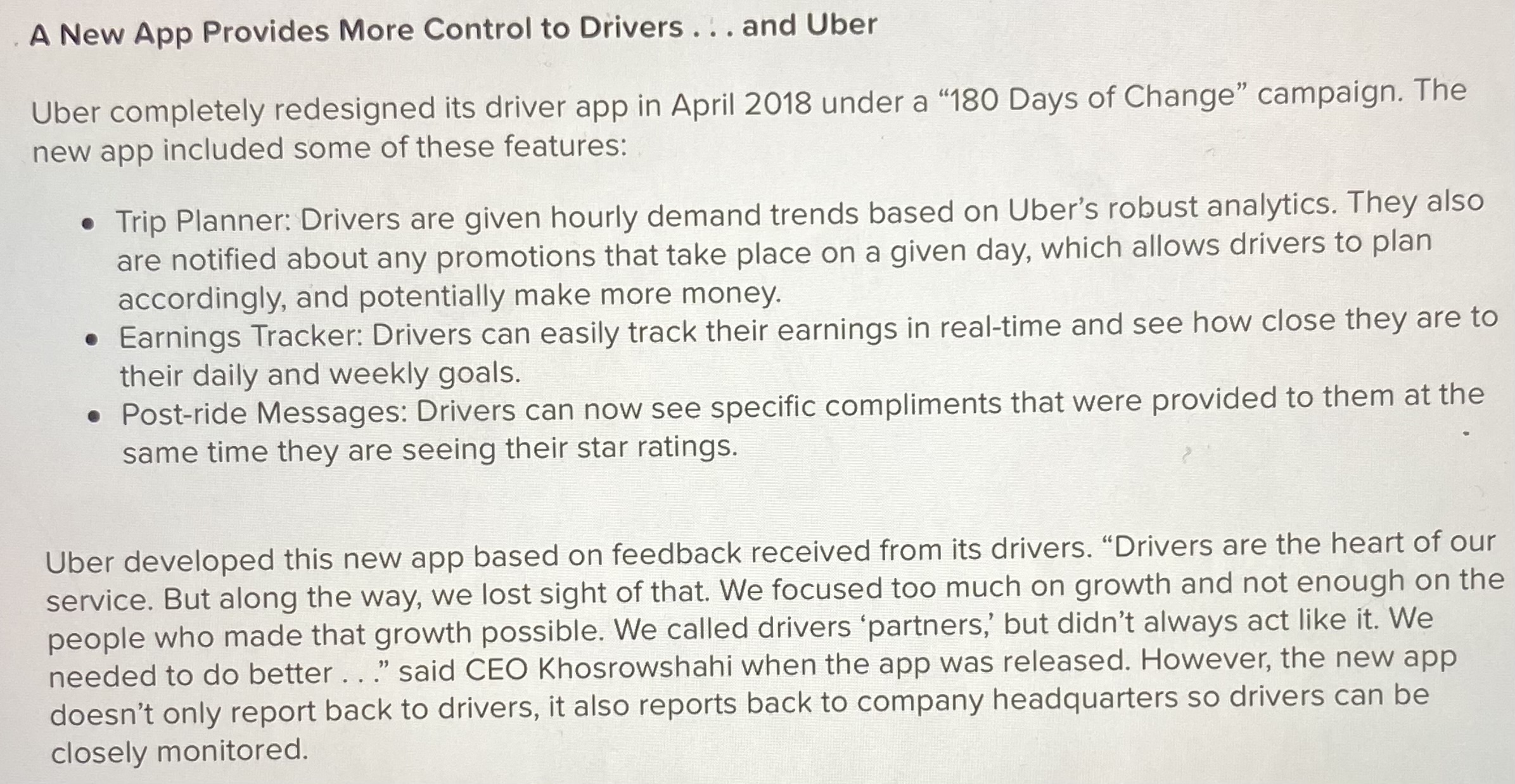
Uber has around 3.9 million active drivers and 22,000 employees supporting around 5 million trips a day all over the world. These trips led to approximately $11.1 billion in gross revenue in 2020 . This case explores how Uber executives attempt to control such a large organization. Establishing Control: Setting Drivers' Goals and Measuring Results Uber drivers consent to having their location, performance, and driving behavior tracked, via their phone. The phones support the Uber proprietary app that enables customers to easily and quickly connect with drivers. The control process at Uber begins with establishing three key goals for its drivers: - Customer satisfaction. Uber uses a 5-star driver-rating system to assess customer satisfaction. Riders are prompted to rate the driver on a 1- to 5-star scale when the ride is over. Uber then generates instantaneous feedback for drivers, who are expected to meet an average rating of between 4.6 and 5 . - Rider-acceptance rate. When drivers receive a ping on their smartphone that a prospective rider near them wants a ride, they have about 15 seconds to tap acceptance of the ride on their phone screen. Uber prefers that drivers have a rider-acceptance rate of over 80%, but will not terminate those who fall below that number. - Cancellation rates. The final goal focuses on maintaining low cancellation rates. A driver's cancellation rate is based on the number of trips canceled out of the number of trips accepted. Each city has its own cancellation rate, but Uber states that "High-quality drivers typically have a cancellation rate lower than 5%." Every driver's performance is tracked against these three goals. If a driver's customer satisfaction or cancellation rates fall too low, the company can "deactivate" (terminate) them. Additional reasons for deactivation are discussed below. Moreover, Uber also attempts to control the way drivers drive. The company uses the Uber app and smartphone sensors to monitor the driver's vehicle speed and frequency of starts and stops. This data is used to compute scores for acceleration and braking and to alert drivers in real time when they are exceeding the speed limit. Uber promotes this tracking as a benefit for riders, but the Wall Street Journal reported that there are significant concerns about driver privacy. This is especially true because Uber classifies its drivers as independent contractors, not employees. "If Uber exerts too much control over its drivers, it risks providing evidence to the many lawyers who accuse the company of treating its independent contractors as employees. But like any company, Uber also wants to provide great service to its customers, which usually involves telling workers what to do," says Fast Company. Maintaining Service Quality Uber controls the quality of the service its drivers provide by deactivating those that fall below its standards. Reasons why a driver may get deactivated include: - Ratings stay below 4.6 stars after receiving a warning. - Documents, such as driver's license, insurance, or vehicle registration expire. - Not passing a background check refresher: Uber runs background checks annually. - Canceling too many rides. - Violating the Uber Code of Conduct or Terms of Service. Uber also attempts to proactively improve quality by referring drivers to outside vendors' quality improvement classes. These classes teach drivers how to improve their customer-relations skills and identify ways to obtain a 5-star rating. On the downside, however, drivers take these classes on their own time and at their own expense. A New App Provides More Control to Drivers ... and Uber A New App Provides More Control to Drivers ... and Uber Uber completely redesigned its driver app in April 2018 under a "180 Days of Change" campaign. The new app included some of these features: - Trip Planner: Drivers are given hourly demand trends based on Uber's robust analytics. They also are notified about any promotions that take place on a given day, which allows drivers to plan accordingly, and potentially make more money. - Earnings Tracker: Drivers can easily track their earnings in real-time and see how close they are to their daily and weekly goals. - Post-ride Messages: Drivers can now see specific compliments that were provided to them at the same time they are seeing their star ratings. Uber developed this new app based on feedback received from its drivers. "Drivers are the heart of our service. But along the way, we lost sight of that. We focused too much on growth and not enough on the people who made that growth possible. We called drivers 'partners,' but didn't always act like it. We needed to do better..." said CEO Khosrowshahi when the app was released. However, the new app doesn't only report back to drivers, it also reports back to company headquarters so drivers can be closely monitored
Step by Step Solution
There are 3 Steps involved in it

Get step-by-step solutions from verified subject matter experts
 Study Help