







Question: Using the building from the example, continue on to solve for: Calculate the wind load pressures on the building and show them on an elevation
Using the building from the example, continue on to solve for:
Calculate the wind load pressures on the building and show them on an elevation for the eastwest direction.
Calculate the wind load story forces and show them on an elevation for the northsouth and eastwest directions.
Calculate the uplift on the roof due to wind assume the wind is flat
Using Your roof gravity loads and the uplift wind loads, then determine the loading on the labeled Wx Typ Using the following LCs draw their factored shear and moment diagrams.
or or
or or or
or r or or
Using the ASCE procedure on the project assuming the building is in SDC A Calculate the seismic load story forces using the ASCE and show them on an elevation.
Compare the wind and seismic base shear the sum of the story forces from the prior two questions in both the NS and EW directions. Which one would likely control the member sizes in in each direction? Explain your answers.
Idealize a building and solve for the base and story shears on both faces here. Include all relevant details and a picturesketch Use the ASCE hazard site to obtain your wind velocity.
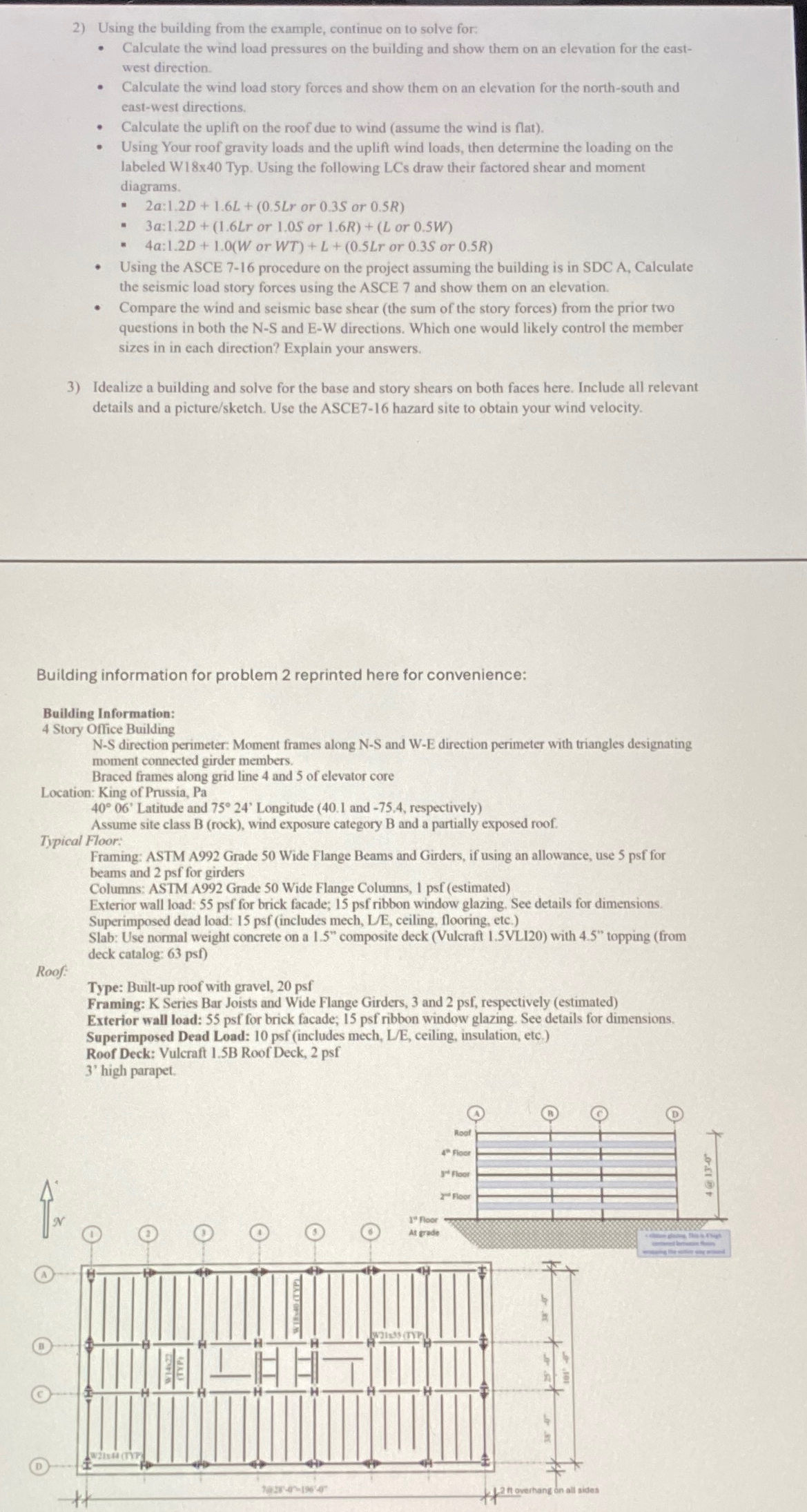
Building information for problem reprinted here for convenience:
Building Information:
Story Office Building
direction perimeter: Moment frames along and E direction perimeter with triangles designating moment connected girder members.
Braced frames along grid line and of elevator core
Location: King of Prussia, Pa
Latitude and Longitude and respectively
Assume site class B rock wind exposure category B and a partially exposed roof.
Typical Floor:
Framing: ASTM A Grade Wide Flange Beams and Girders, if using an allowance, use psf for beams and for girders
Columns: ASTM A Grade Wide Flange Columns, psf estimated
Exterior wall load: psf for brick facade; psf ribbon window glazing. See details for dimensions.
Superimposed dead load: psf includes mech, LE ceiling, flooring, etc.
Slab: Use normal weight concrete on a composite deck Vulcraft VLI with topping from deck catalog:
Roof:
Type: Builtup roof with gravel, psf
Framing: K Series Bar Joists and Wide Flange Girders, and psf respectively estimated
Exterior wall load: psf for brick facade; psf ribbon window glazing. See details for dimensions.
Superimposed Dead Load: psf includes mech, LE ceiling, insulation, etc.
Roof Deck: Vulcraft B Roof Deck, psf
high parapet.
Step by Step Solution
There are 3 Steps involved in it
1 Expert Approved Answer
Step: 1 Unlock

Question Has Been Solved by an Expert!
Get step-by-step solutions from verified subject matter experts
Step: 2 Unlock
Step: 3 Unlock
 Study Help