







Question: Using the case study answer the question: Question. (a) Describe how the product life cycle concept might apply to shopping trolleys, and discuss the extent
Using the case study answer the question:
Question.
(a) Describe how the product life cycle concept might apply to shopping trolleys, and discuss the extent to which the product life cycle for roll cages is the same as for shopping trolleys.
(b) On the basis of your view of the product life cycle stages of (a) airport trolleys and (b) roll cages, describe the marketing activities you would undertake, assuming strong market share in both product markets.
Note to Expert: Please make your answers lengthy, so I can understand it.
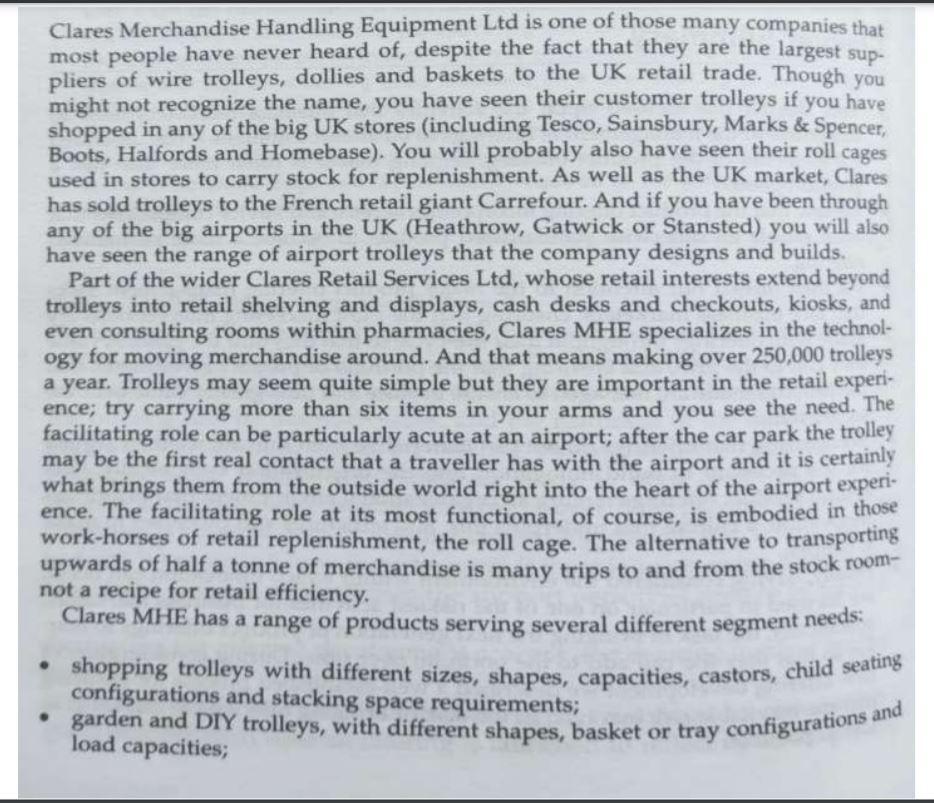
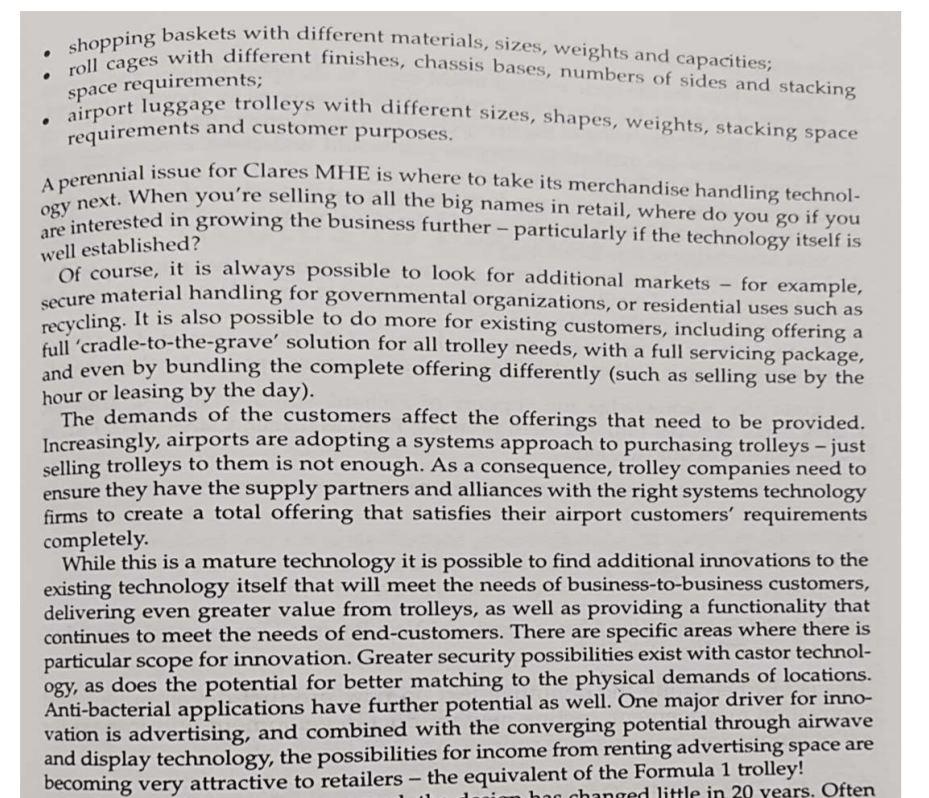
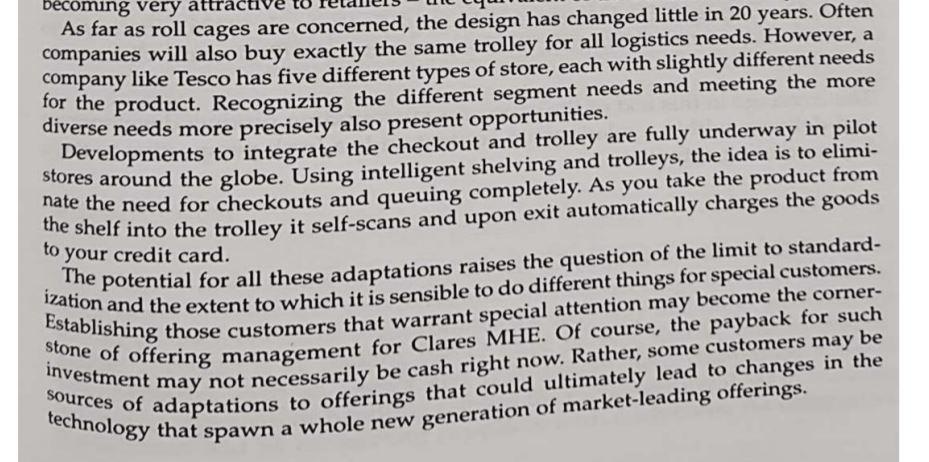
shopping trolleys with different sizes, shapes, capacities, castors, child seating garden and DIY trolleys, with different shapes, basket or tray configurations and Clares Merchandise Handling Equipment Ltd is one of those many companies that most people have never heard of, despite the fact that they are the largest sup- pliers of wire trolleys, dollies and baskets to the UK retail trade. Though you might not recognize the name, you have seen their customer trolleys if you have shopped in any of the big UK stores (including Tesco, Sainsbury, Marks & Spencer, Boots, Halfords and Homebase). You will probably also have seen their roll cages used in stores to carry stock for replenishment. As well as the UK market, Clares has sold trolleys to the French retail giant Carrefour. And if you have been through any of the big airports in the UK (Heathrow, Gatwick or Stansted) you will also have seen the range of airport trolleys that the company designs and builds. Part of the wider Clares Retail Services Ltd, whose retail interests extend beyond trolleys into retail shelving and displays, cash desks and checkouts, kiosks, and even consulting rooms within pharmacies, Clares MHE specializes in the technol- ogy for moving merchandise around. And that means making over 250,000 trolleys a year. Trolleys may seem quite simple but they are important in the retail experi- ence; try carrying more than six items in your arms and you see the need. The facilitating role can be particularly acute at an airport; after the car park the trolley may be the first real contact that a traveller has with the airport and it is certainly what brings them from the outside world right into the heart of the airport experi- ence. The facilitating role at its most functional, of course, is embodied in those work-horses of retail replenishment, the roll cage. The alternative to transporting upwards of half a tonne of merchandise is many trips to and from the stock room- not a recipe for retail efficiency. Clares MHE has a range of products serving several different segment needs: configurations and stacking space requirements; load capacities; space requirements; well established? shopping baskets with different materials, sizes, weights and capacities; roll cages with different finishes, chassis bases, numbers of sides and stacking airport luggage trolleys with different sizes, shapes, weights, stacking space requirements and customer purposes. A perennial issue for Clares MHE is where to take its merchandise handling technol- ogy next. When you're selling to all the big names in retail, where do you go if you are interested in growing the business further - particularly if the technology itself is Of course, it is always possible to look for additional markets - for example, secure material handling for governmental organizations, or residential uses such as recycling. It is also possible to do more for existing customers, including offering a full 'cradle-to-the-grave solution for all trolley needs, with a full servicing package, and even by bundling the complete offering differently (such as selling use by the hour or leasing by the day). The demands of the customers affect the offerings that need to be provided. Increasingly, airports are adopting a systems approach to purchasing trolleys - just selling trolleys to them is not enough. As a consequence, trolley companies need to ensure they have the supply partners and alliances with the right systems technology firms to create a total offering that satisfies their airport customers' requirements completely. While this is a mature technology it is possible to find additional innovations to the existing technology itself that will meet the needs of business-to-business customers, delivering even greater value from trolleys, as well as providing a functionality that continues to meet the needs of end-customers. There are specific areas where there is particular scope for innovation. Greater security possibilities exist with castor technol- ogy, as does the potential for better matching to the physical demands of locations. Anti-bacterial applications have further potential as well. One major driver for inno- vation is advertising, and combined with the converging potential through airwave and display technology, the possibilities for income from renting advertising space are becoming very attractive to retailers - the equivalent of the Formula 1 trolley! changed little in 20 years. Often Establishing those customers that warrant special attention may become the corner- stone of offering management for Clares MHE. Of course, the payback for such investment may not necessarily be cash right now. Rather, some customers may be sources of adaptations to offerings that could ultimately lead to changes in the technology that spawn a whole new generation of market-leading offerings. becoming very attra As far as roll cages are concerned, the design has changed little in 20 years. Often companies will also buy exactly the same trolley for all logistics needs. However, a company like Tesco has five different types of store, each with slightly different needs for the product. Recognizing the different segment needs and meeting the more diverse needs more precisely also present opportunities. Developments to integrate the checkout and trolley are fully underway in pilot stores around the globe. Using intelligent shelving and trolleys, the idea is to elimi- nate the need for checkouts and queuing completely. As you take the product from the shelf into the trolley it self-scans and upon exit automatically charges the goods to your credit card. The potential for all these adaptations raises the question of the limit to standard- ization and the extent to which it is sensible to do different things for special customersStep by Step Solution
There are 3 Steps involved in it
1 Expert Approved Answer
Step: 1 Unlock

Question Has Been Solved by an Expert!
Get step-by-step solutions from verified subject matter experts
Step: 2 Unlock
Step: 3 Unlock
 Study Help