







Question: Using the case study from a previous unit and the following information, complete an additional assignment. Case Study 1 - Mike Crafone 4-year-old boy Lives
Using the case study from a previous unit and the following information, complete an additional assignment.
Case Study 1 - Mike Crafone
- 4-year-old boy
- Lives with mother, grandmother, older sister
- Identified by his school district as having a developmental delay
- Qualified for and enrolled in early intervention program in school district at age 2.5 years
- Attendance at the early intervention program has been sporadic due to transportation difficulties the family has been experiencing
- Early intervention program has one BCBA on staff, but the program is not behavior analytic in nature and the BCBA has never met or assessed Mike's behavior
- Diagnosed by a developmental pediatrician at age 3.5 years with autism spectrum disorder. According to the developmental pediatrician, he is physically healthy.
- Recommended for ABA services by the social worker at the developmental pediatrician's clinic
- Mother is not certain about what ABA is, but she has heard from other parents on the internet that she can get help at home
- School district still is trying to determine what special education services, if any, will be needed when he enters kindergarten in approximately one year from now
- Mother reports that he:
- Flaps his hands and squeals quite often
- Hits his head with his fists and bangs his head on surfaces. He has broken a tooth from this.
- Runs away from her in public places
- Can repeat words that people say to him, but he does not always do it. He does not spontaneously produce words.
- Is a picky eater. She often cannot figure out what he wants to eat.
- Cannot complete any self-help routines that commonly can be completed by 4-year-olds (e.g., putting on slip-on shoes)
- Requests items or activities by leading her by the hand to certain locations
- IIs not toilet-trained
INFORMATION:
FUNCTIONAL BEHAVIORAL ASSESSMENT
Identifying Information
| Student | Mike Crafone | Parents/guardians | Mother and Grandmother |
| Date of Birth | 05/01/2021 | Home address & phone | 1234 Achievement Lane Learning City, IN 54321 1-231-975-8642 |
FBA Activities
| Data gathering activities (check all that apply) | |
| Indirect Observation Methods | Direct Observation Methods |
___ Raters/FBA checklists (specify): ____________________________________ ____ Student interview __X_ Parent interview (Structured Interview - Functional Assessment Interview [FAI], O'Neill et al., 2015) __X_ School staff interview | _X_ Observations (ABC recording and Structured observation across multiple settings) _X_ Functional Analysis _X_ Reinforcer /Preference Assessment |
Biopsychosocial History
Mike, a 4-year-old boy, was given an autism spectrum disorder diagnosis when he was 3.5. His mother, grandmother, and older sister reside with him. At the age of 2.5, his school district determined that he had a developmental delay and enrolled him in an early intervention program; however, because of transportation problems, his attendance has been irregular. Mike has never had direct contact with the BCBA on staff, and the early intervention program is not behavior analytic. Several excessive behaviors are displayed by Mike, such as delayed communication, elopement, hand flapping, and head banging. He does not use age-appropriate self-help techniques or spontaneous speaking, and he broke a tooth after hitting his head. A social worker has recommended ABA services. His mother is unfamiliar with ABA but is interested in support at home.
Behavior of Concern (operationally defined- Copper, 2020):Self-Injurious Behavior (SIB) for Mike is described as hitting head with fists or banging head on surfaces, resulting in visible physical injury such as a broken tooth. The behavior occurs multiple times per day across various settings.
Indirect Assessment Method(s)
Method 1 - Functional Assessment Interview (FAI - O'Neill, 2015)
To learn more about the background and occurrence of Mike's self-harming behaviors, a structured parent interview was performed. This approach works well for determining possible causes and effects from the viewpoint of caregivers (O'Neill, 2015).
Method 2 - School Staff Questionnaire-Motivation Assessment Scale (MAS - Durand & Crimmins, 1988)
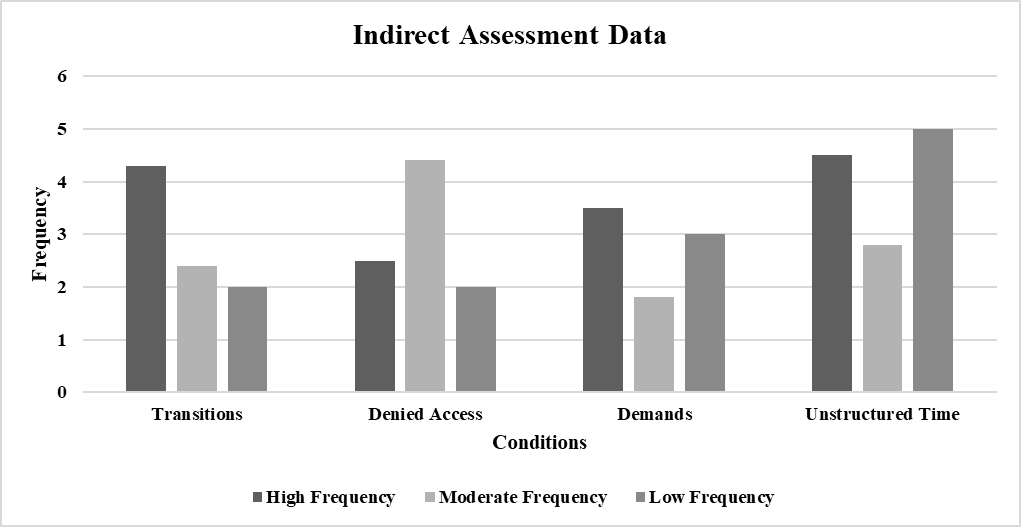
SIB often happens during transitions, when Mike is denied access to things he wants, or when he is subjected to demands, according to parents and educators. It also happens during unstructured time and occasionally seems unconnected to social factors.
Data from Indirect Assessment:Parents and teachers report that SIB frequently occurs during transitions, when Mike is denied access to preferred items, or when demands are placed on him. It also occurs in unstructured time and sometimes appears unrelated to social variables.
Step by Step Solution
There are 3 Steps involved in it

Get step-by-step solutions from verified subject matter experts
 Study Help