







Question: Using the following function prototype which statement about the argument passed to parameter A is true void F(const int A[], int Cnt); The argument is
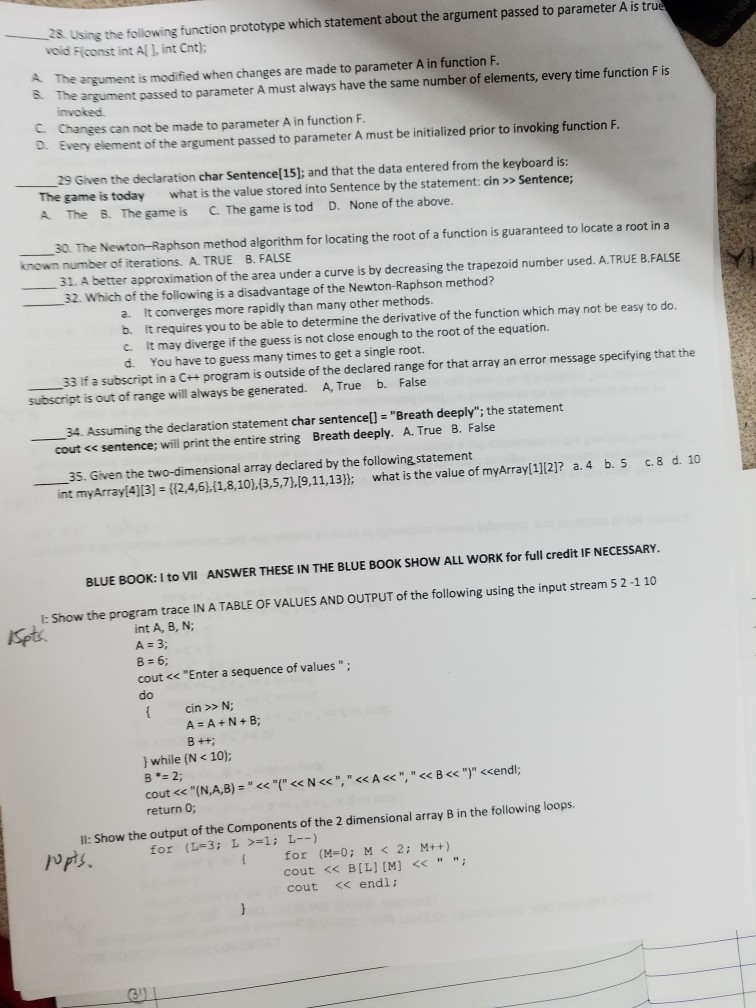
Using the following function prototype which statement about the argument passed to parameter A is true void F(const int A[], int Cnt); The argument is modified when changes are made to parameter A in function F. The argument passed to parameter A must always have the same number of elements, every time function F is invoked. Changes can not be made to parameter A in function F. Every element of the argument passed to parameter A must be initialized prior to invoking function F. Given the declaration char sentence[15]; and that the data entered from the keyboard is: The game is today what is the value stored into sentence by the statement: cin >> Sentence; The The game is The game is tod None of the above. The Newton-Raphson method algorithm for locating the root of a function is guaranteed to locate a root in a known number of iterations. A. TRUE B. FALSE A better approximation of the area under a curve is by decreasing the trapezoid number used. A.TRUE B.FALSE Which of the following is a disadvantage of the Newton-Raphson method? It converges more rapidly than many other methods. It requires you to be able to determine the derivative of the function which may not be easy to do. It may diverge if the guess is not close enough to the root of the equation. You have to guess many times to get a single root. If a subscript in a C++ program is outside of the declared range for that array an error message specifying that the subscript is out of range will always be generated. A. True b. Flase Assuming the declaration statement char sentence[] = "Breath deeply"; the statement cout > N; A = A + N = B; B++;} while (N = 1; L--) {for (M = 0; M
Step by Step Solution
There are 3 Steps involved in it

Get step-by-step solutions from verified subject matter experts
 Study Help