







Question: Using the following predicates: square (x) is true if x is a square (otherwise it is false) star (x) is true if x is
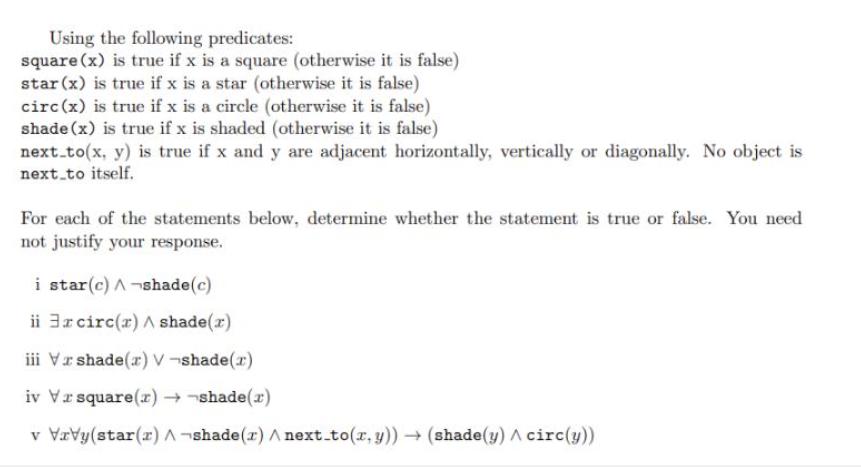

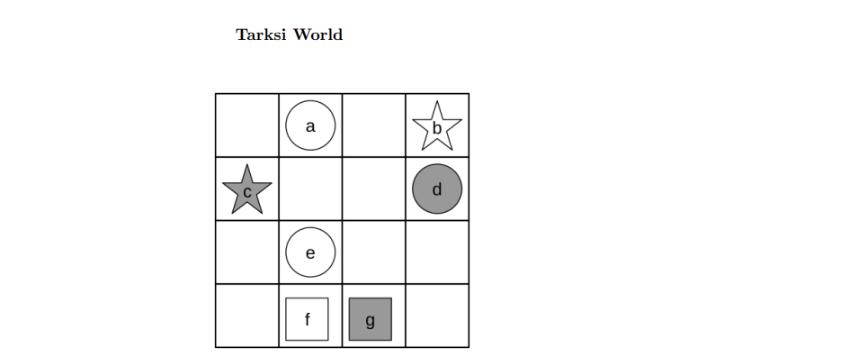
Using the following predicates: square (x) is true if x is a square (otherwise it is false) star (x) is true if x is a star (otherwise it is false) circ(x) is true if x is a circle (otherwise it is false) shade (x) is true if x is shaded (otherwise it is false) next to(x, y) is true if x and y are adjacent horizontally, vertically or diagonally. No object is next to itself. For each of the statements below, determine whether the statement is true or false. You need not justify your response. i star(c) A-shade(c). ii 3r circ(r) A shade(x) iii Vr shade(r) V-shade(r) iv Vrsquare(r) shade(x) v Vavy(star(r) A-shade (r) A next-to(x, y)) (shade(y) A circ(y)) vi Vyx shade(r) ^ next_to(x, y) Tarksi World a e f g
Step by Step Solution
There are 3 Steps involved in it

Get step-by-step solutions from verified subject matter experts
 Study Help