







Question: Using the fplot function of MATLAB, plot the following mathematical function, its first and second derivatives in one figure and in that order. x limits
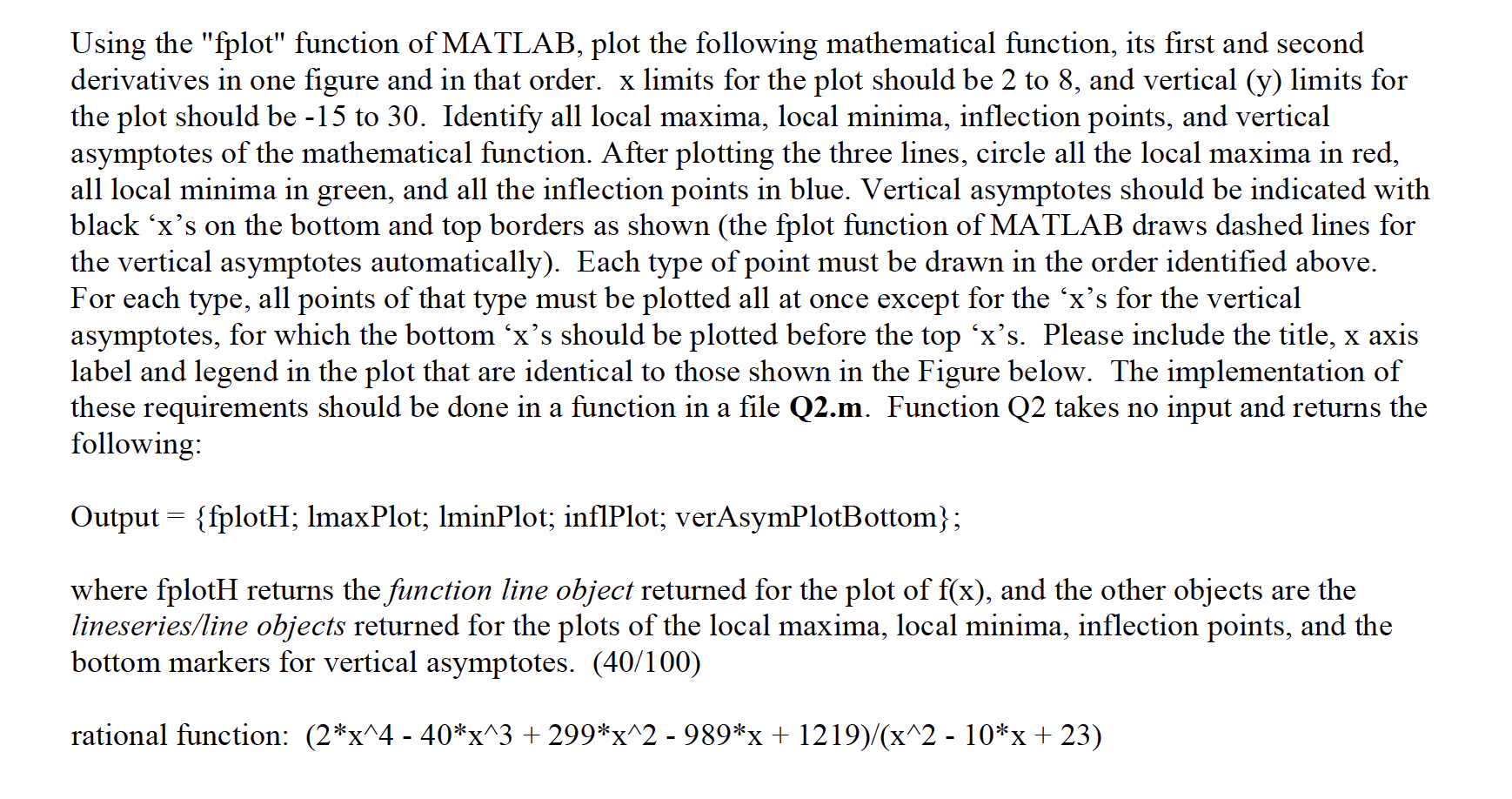
Using the "fplot" function of MATLAB, plot the following mathematical function, its first and second derivatives in one figure and in that order. x limits for the plot should be 2 to 8, and vertical (y) limits for the plot should be -15 to 30. Identify all local maxima, local minima, inflection points, and vertical asymptotes of the mathematical function. After plotting the three lines, circle all the local maxima in red, all local minima in green, and all the inflection points in blue. Vertical asymptotes should be indicated with black x's on the bottom and top borders as shown (the fplot function of MATLAB draws dashed lines for the vertical asymptotes automatically). Each type of point must be drawn in the order identified above. For each type, all points of that type must be plotted all at once except for the x's for the vertical asymptotes, for which the bottom x's should be plotted before the top ns. Please include the title, x axis label and legend in the plot that are identical to those shown in the Figure below. The implementation of these requirements should be done in a function in a file Q2.m. Function Q2 takes no input and returns the following: Output = {fplotH; ImaxPlot; IminPlot; inflPlot; verAsymPlotBottom}; where fplotH returns the function line object returned for the plot of f(x), and the other objects are the lineseries/line objects returned for the plots of the local maxima, local minima, inflection points, and the bottom markers for vertical asymptotes. (40/100) rational function: (2*x^4 - 40*x^3 + 299*x^2 - 989*x + 1219)/(x^2 - 10*x+ 23) Using the "fplot" function of MATLAB, plot the following mathematical function, its first and second derivatives in one figure and in that order. x limits for the plot should be 2 to 8, and vertical (y) limits for the plot should be -15 to 30. Identify all local maxima, local minima, inflection points, and vertical asymptotes of the mathematical function. After plotting the three lines, circle all the local maxima in red, all local minima in green, and all the inflection points in blue. Vertical asymptotes should be indicated with black x's on the bottom and top borders as shown (the fplot function of MATLAB draws dashed lines for the vertical asymptotes automatically). Each type of point must be drawn in the order identified above. For each type, all points of that type must be plotted all at once except for the x's for the vertical asymptotes, for which the bottom x's should be plotted before the top ns. Please include the title, x axis label and legend in the plot that are identical to those shown in the Figure below. The implementation of these requirements should be done in a function in a file Q2.m. Function Q2 takes no input and returns the following: Output = {fplotH; ImaxPlot; IminPlot; inflPlot; verAsymPlotBottom}; where fplotH returns the function line object returned for the plot of f(x), and the other objects are the lineseries/line objects returned for the plots of the local maxima, local minima, inflection points, and the bottom markers for vertical asymptotes. (40/100) rational function: (2*x^4 - 40*x^3 + 299*x^2 - 989*x + 1219)/(x^2 - 10*x+ 23)
Step by Step Solution
There are 3 Steps involved in it

Get step-by-step solutions from verified subject matter experts
 Study Help