







Question: Using the graph below Kinetics & Mass Transport in Immobilized Enzyme Systems, estimate the effective diffusivity of the substrate through the catalyst pores of
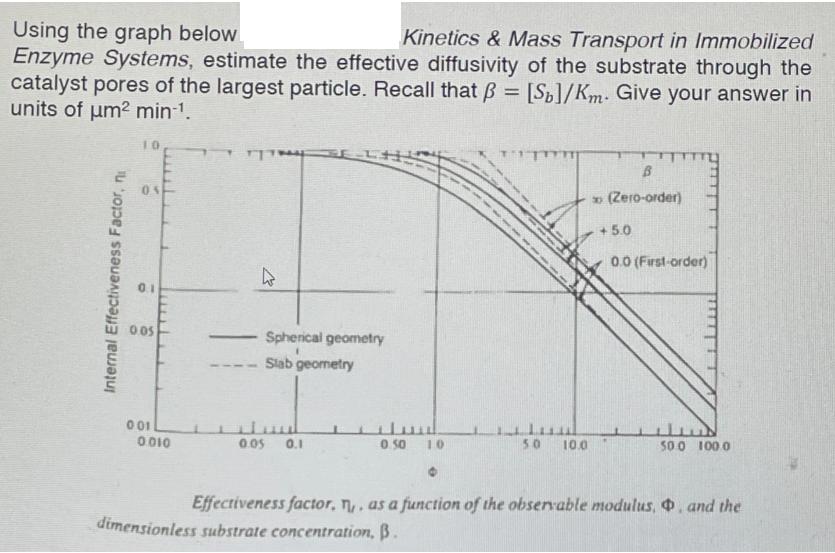
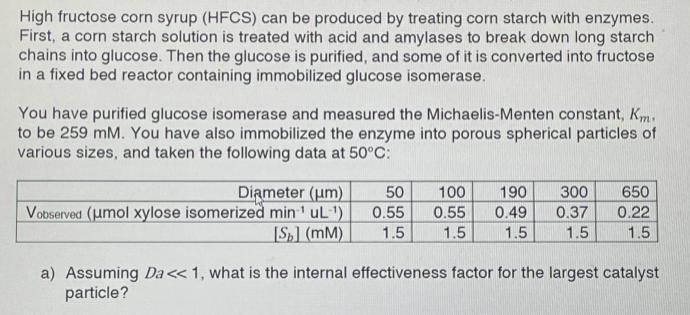
Using the graph below Kinetics & Mass Transport in Immobilized Enzyme Systems, estimate the effective diffusivity of the substrate through the catalyst pores of the largest particle. Recall that = [S]/Km. Give your answer in units of m min-1. 10 Internal Effectiveness Factor, ni 05 0.1 0.05 - Spherical geometry Slab geometry 001 B (Zero-order) +5.0 0.0 (First-order) 0.010 0.05 0.1 0.50 10 50 10.0 500 1000 Effectiveness factor, n,, as a function of the observable modulus, , and the dimensionless substrate concentration, B. High fructose corn syrup (HFCS) can be produced by treating corn starch with enzymes. First, a corn starch solution is treated with acid and amylases to break down long starch chains into glucose. Then the glucose is purified, and some of it is converted into fructose in a fixed bed reactor containing immobilized glucose isomerase. You have purified glucose isomerase and measured the Michaelis-Menten constant, Km. to be 259 mM. You have also immobilized the enzyme into porous spherical particles of various sizes, and taken the following data at 50C: Diameter (um) 50 Vobserved (umol xylose isomerized min uL 1) 0.55 100 190 0.55 0.49 0.37 300 650 0.22 [S] (mM) 1.5 1.5 1.5 1.5 1.5 a) Assuming Da < < 1, what is the internal effectiveness factor for the largest catalyst particle?
Step by Step Solution
There are 3 Steps involved in it

Get step-by-step solutions from verified subject matter experts
 Study Help