







Question: Using the historical data as a guide, construct a pro forma profit and loss statement for the clinic's average day for all of 2013 assuming
Using the historical data as a guide, construct a pro forma profit and loss statement for the clinic's average day for all of 2013 assuming the status quo. With no change in volume, is the clinc projected to make a profit. See pictures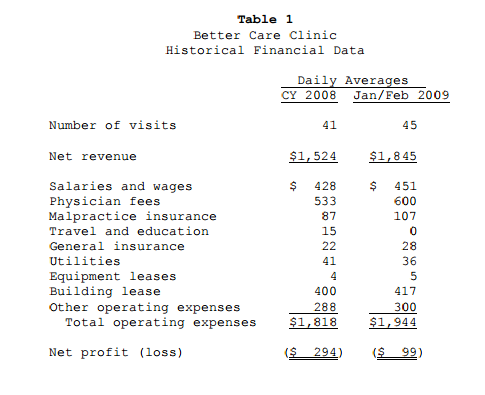
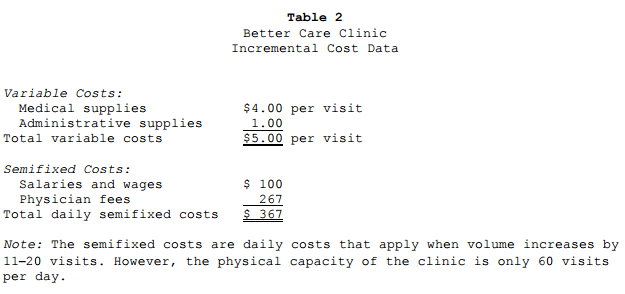
Fairbanks Memorial Hospital, an acute care hospital with 300 beds and 160 staff physicians, is one of 75 hospitals owned and operated by Health Services of America, a for-profit, publicly owned company. Although there are two other acute care hospitals serving the same general population, Fairbanks historically has been highly profitable because of its well-appointed facilities, fine medical staff, and reputation for quality care. In addition to inpatient services, Fairbanks operates an emergency room within the hospital complex and a stand-alone walk-in clinic, the Better Care Clinic, located about two miles from the hospital. Todd Greene, Fairbankss chief executive officer (CEO), is concerned about Better Care Clinics financial performance. About ten years ago, all three area hospitals jumped onto the walk-in-clinic bandwagon, and within a short time, there were five such clinics scattered around the city. Now, only three are left, and none of them appears to be a big money maker. Todd wonders whether Fairbanks should continue to operate its clinic or close it down. The clinic is currently handling a patient load of 45 visits per day, but it has the physical capacity to handle more visitsup to 60 per day. Todd has asked Jane Adams, Fairbankss chief financial officer, to look into the whole matter of the walk-in clinic. In their meeting, Todd stated that he visualizes two potential outcomes for the clinic: (1) the clinic could be closed or (2) the clinic could continue to operate as is. As a starting point for the analysis, Jane has collected the most recent historical financial and operating data for the clinic, which are summarized in Table 1. In assessing the historical data, Jane noted that one competing clinic had recently (December 2008) closed its doors. Furthermore, a review of several years of financial data revealed that the Fairbanks clinic does not have a pronounced seasonal utilization pattern. Next, Jane met several times with the clinics director. The primary purpose of the meetings was to estimate the additional costs that would have to be borne if clinic volume rose above the current January/February average level of 45 visits per day. Any incremental volume would require additional expenditures for administrative and medical supplies, estimated to be $4.00 per patient visit for medical supplies, such as tongue blades, rubber gloves, bandages, and so on, and $1.00 per patient visit for administrative supplies, such as file folders and clinical record sheets. Although the clinic has the physical capacity to handle 60 visits per day, it does not have staffing to support that volume. In fact, if the number of visits increased by 11 per day, another part-time nurse and physician would Copyright 2009 Health Administration Press have to be added to the clinics staff. The incremental costs associated with increased volume are summarized in Table 2. Jane also learned that the building is leased on a long-term basis. Fairbanks could cancel the lease, but the lease contract calls for a cancellation penalty of three months rent, or $37,500, at the current lease rate. In addition, Jane was startled to read in the newspaper that Baptist Hospital, Fairbankss major competitor, had just bought the citys largest primary care group practice, and Baptists CEO was quoted as saying that more group practice acquisitions are planned. Jane wondered whether Baptists actions should influence the decision regarding the clinics fate. Finally, in earlier conversations, Todd also wondered whether the clinic could inflate its way to profitability; that is, if volume remained at its current level, could the clinic be expected to become profitable in, say, five years, solely because of inflationary increases in revenues? Overall, Jane must consider all relevant factorsboth quantitative and qualitativeand come up with a reasonable recommendation regarding the future of the clinic.
Cited: https://www.ache.org/pubs/hap_companion/gapenski%20fhf/FHFCASE4_edited.pdf
Table l Better Care Clinic Historical Financial Data Dailv Averages CY 2008 Jan/Feb 2009 Number of visits 41 45 $1,524 S1845 Net revenue Salaries and wages Physician fees Malpractice insurance Travel and education General insurance Utilities Equipment leases Building lease Other operating expenses $ 428 533 87 15 451 600 107 0 28 36 41 400 288 417 Total operating expenses$1,818 S944 Net profit (loss) (S 294) 99)
Step by Step Solution
There are 3 Steps involved in it

Get step-by-step solutions from verified subject matter experts
 Study Help