







Question: Using the information below develop a decision tree using the Tree Plan software to determine the best course of action for Point Break Beverages. Using
Using the information below develop a decision tree using the Tree Plan software to determine the best course of action for Point Break Beverages. Using the results of the Decision Analysis that I am requesting from a tutor. I will make a Executive Summary outlining the best plan of action and justifying your decision. If you have any feedback to support, please let me know.
Point Break Beverages, Inc., founded in 1991, develops, processes, and markets mixes to be used in nonalcoholic cocktails and mixed drinks for home consumption. Mrs. Utah, who is in charge of research and development at PBB, Inc., this morning notified Mr. Pappas, the president, that exciting developments in the research and development section indicate that a new beverage, an instant Moscow mule, should be possible because of a new way to process and preserve limes. Mrs. Utah is recommending a major program to develop the Moscow mule. She estimates that expenditure on the development may be as much as $100,000 and that as much as a year's work may be required. In the discussion with Mr. Pappas, she indicated that she thought the possibility of her outstanding people successfully developing such a drink now that she'd done all the really important work was in the neighborhood of 90 percent. She also felt that the likelihood of a competing company developing a similar product in 12 months was 80 percent.
Mr. Pappas is strictly a bottom-line guy and is concerned about the sales volume of such a beverage. Consequently, Mr. Jones talked to Mr. Bodhi, his market research manager, whose specialty is new product evaluation, and was advised that a market existed for an instant Moscow mule but was some-what dependent on acceptance by both grocery stores and retail liquor stores. Mr. Bodhi also indicated that the sales reports indicate that other firms are considering a line of instant drinks. If other firms should develop a competing beverage the market would, of course, be split among them. Mr. Pappas pressed Mr. Bodhi to make future sales estimates for various possibilities and to indicate the present (discounted value of future profits) value. Mr. Bodhi provided Table 1.
Table1
Consumer Acceptance | (Sales Potential) Probability Present Values | (Discounted Value of Lifetime Profits) |
|---|---|---|
Substantial | 0.10 | $800,000 |
Moderate | 0.60 | $600,000 |
Low | 0.30 | $500,000 |
Mrs. Utah has indicated that she does have alternative development proposals, which are:
- A reduced research program to see someone else comes out with the product first and if not, then proceed with a crash program. The reduced program for the first eight months would cost $10,000 per month. One advantage of this is that if the effort was unsuccessful, then development costs would be held to the eight-month figure (8 months $ 10,000 = $80,000). The likelihood of success under this approach is the same as the more orderly development. (The likelihood of a competing company developing a product in 8 months is 60 percent.) The crash development program would take place in months 9 through 12 and would cost an additional $60,000. It would proceed only if the eight-month study guaranteed successful product development (acceptance of a successfully developed product would follow the probabilities given in Table 1).
- Use a reduced research program and maintain an awareness of industry developments to see if someone else develops a product. If someone else has developed a product at the end of six months, it would cost only an additional $30,000 to analyze their product and duplicate it. The reduced development program would cost $10,000 per month.
Mr. Bodhi, being the great marketer that he is, is of course reluctant to be second on the market with a new product. He says that the first product on the market will usually obtain a greater share of the market, and it will be difficult to win those customers back. Consequently, he indicates that only about 50 percent of the sales that he indicated in Table 1 could be expected if PBB waited until competing brands were already on the market. Moreover, he suspects that there is only a 50/50 chance that the competitor will be out with a product within the next six months.
There are three options: (1) orderly development of the Moscow mule, (2) modest development effort followed by the crash program, or (3) a modest development effort for the first six months to see if a competitive product comes on the market.
Below is an example, but I need this based on the above data set and question.
Below are example decision trees, but I need the above data to be used to create the decision tree.
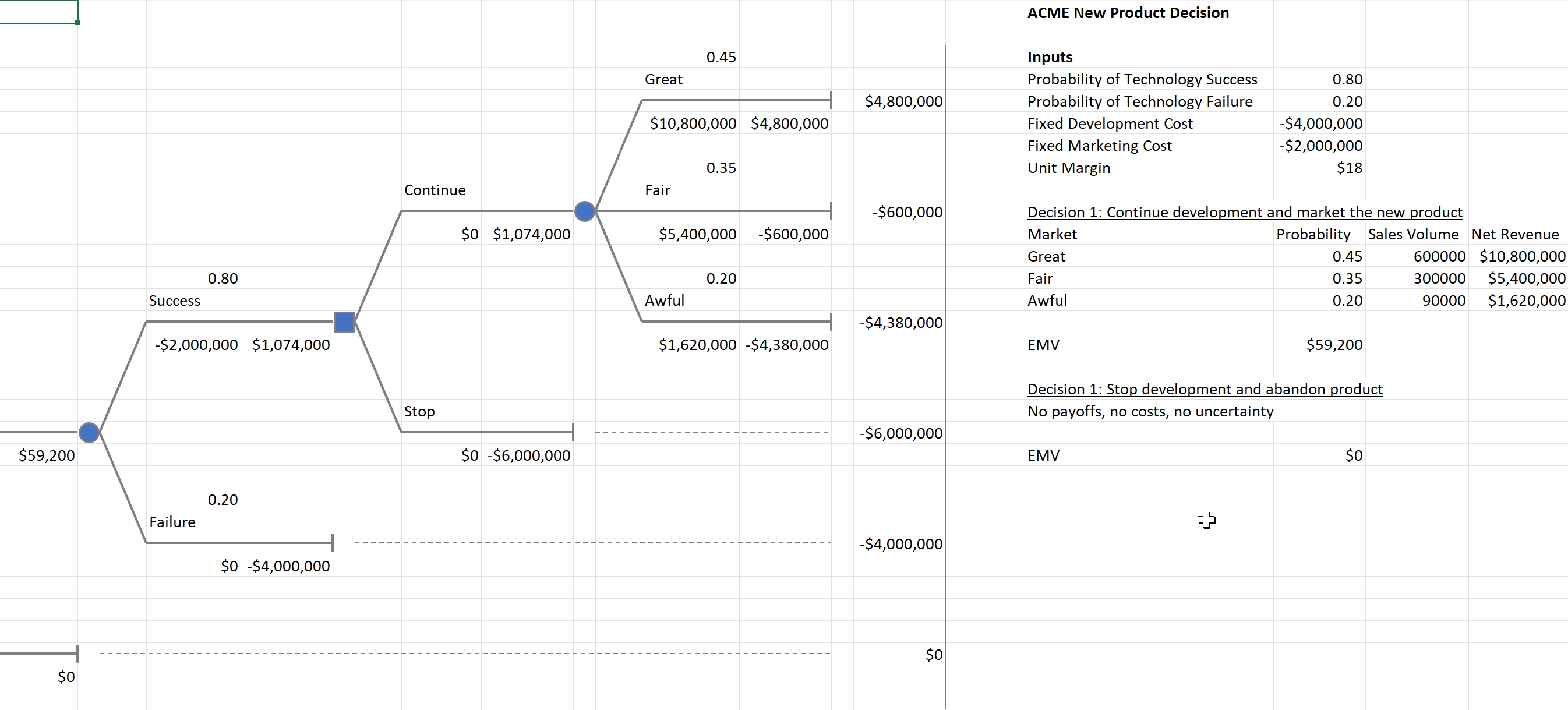
$59,200 0.45 Great $10,800,000 $4,800,000 0.35 Continue $0 $1,074,000 $5,400,000 -$600,000 0.80 0.20 Success Awful $2,000,000 $1,074,000 $1,620,000 $4,380,000 $0 $6,000,000 $0 $4,000,000 $4,800,000 $600,000 $4,380,000 -$6,000,000 -$4,000,000 $0 ACME New Product Decision Inputs Probability of Technology Success 0.80 Probability of Technology Failure 0.20 Fixed Development Cost -$4,000,000 Fixed Marketing Cost $2,000,000 Unit Margin $18 Decision 1: Continue development and market the new product Market Probability Sales Volume Net Revenue Great 0.45 600000 $10,800,000 Fair 0.35 300000 $5,400,000 Awful 0.20 90000 $1,620,000 EMV $59,200 Decision 1: Stop development and abandon product No payoffs, no costs, no uncertainty EMV $0
Step by Step Solution
There are 3 Steps involved in it

Get step-by-step solutions from verified subject matter experts
 Study Help