







Question: Using the information below, please aswer b,c,d, & e. Assets T-bills Loans* Book Value Market Value Amount Amount $ 360 S 360 10,000 $9.470 Duration
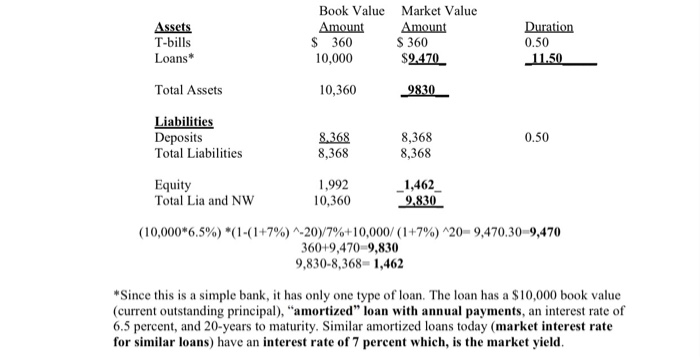
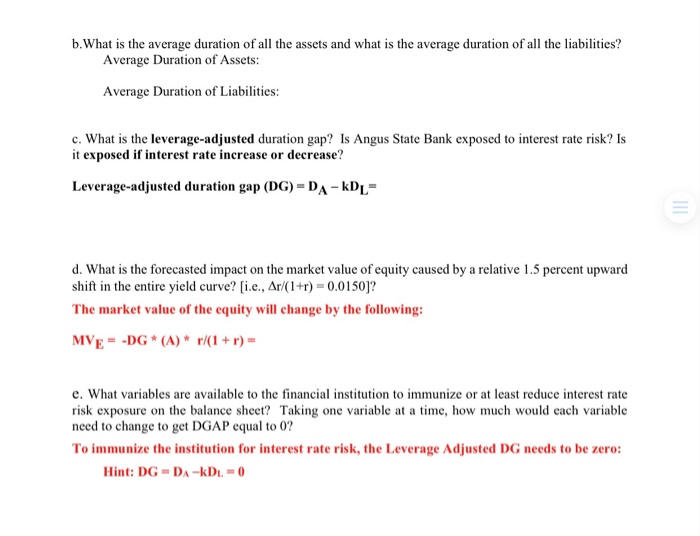
Assets T-bills Loans* Book Value Market Value Amount Amount $ 360 S 360 10,000 $9.470 Duration 0.50 11.50 Total Assets 10,360 9830 Liabilities Deposits Total Liabilities 0.50 8.368 8,368 8,368 8,368 Equity Total Lia and NW 1,992 10,360 _1,462 9.830 (10,000*6.5%) *(1-(1+7%)^-20/7%+10,000/(1+7%) 20-9,470.309,470 3609,470-9,830 9,830-8,368-1,462 *Since this is a simple bank, it has only one type of loan. The loan has a $10,000 book value (current outstanding principal), "amortized" loan with annual payments, an interest rate of 6.5 percent, and 20-years to maturity. Similar amortized loans today (market interest rate for similar loans) have an interest rate of 7 percent which, is the market yield. b. What is the average duration of all the assets and what is the average duration of all the liabilities? Average Duration of Assets: Average Duration of Liabilities: c. What is the leverage-adjusted duration gap? Is Angus State Bank exposed to interest rate risk? Is it exposed if interest rate increase or decrease? Leverage-adjusted duration gap (DG) = DA-KDL- d. What is the forecasted impact on the market value of equity caused by a relative 1.5 percent upward shift in the entire yield curve? [i.e., Ar/(1+r) = 0.0150]? The market value of the equity will change by the following: MVE -DG* (A) * r/(1+r) - e. What variables are available to the financial institution to immunize or at least reduce interest rate risk exposure on the balance sheet? Taking one variable at a time, how much would each variable need to change to get DGAP equal to 0? To immunize the institution for interest rate risk, the Leverage Adjusted DG needs to be zero: Hint: DG-DA-KDL-0 Assets T-bills Loans* Book Value Market Value Amount Amount $ 360 S 360 10,000 $9.470 Duration 0.50 11.50 Total Assets 10,360 9830 Liabilities Deposits Total Liabilities 0.50 8.368 8,368 8,368 8,368 Equity Total Lia and NW 1,992 10,360 _1,462 9.830 (10,000*6.5%) *(1-(1+7%)^-20/7%+10,000/(1+7%) 20-9,470.309,470 3609,470-9,830 9,830-8,368-1,462 *Since this is a simple bank, it has only one type of loan. The loan has a $10,000 book value (current outstanding principal), "amortized" loan with annual payments, an interest rate of 6.5 percent, and 20-years to maturity. Similar amortized loans today (market interest rate for similar loans) have an interest rate of 7 percent which, is the market yield. b. What is the average duration of all the assets and what is the average duration of all the liabilities? Average Duration of Assets: Average Duration of Liabilities: c. What is the leverage-adjusted duration gap? Is Angus State Bank exposed to interest rate risk? Is it exposed if interest rate increase or decrease? Leverage-adjusted duration gap (DG) = DA-KDL- d. What is the forecasted impact on the market value of equity caused by a relative 1.5 percent upward shift in the entire yield curve? [i.e., Ar/(1+r) = 0.0150]? The market value of the equity will change by the following: MVE -DG* (A) * r/(1+r) - e. What variables are available to the financial institution to immunize or at least reduce interest rate risk exposure on the balance sheet? Taking one variable at a time, how much would each variable need to change to get DGAP equal to 0? To immunize the institution for interest rate risk, the Leverage Adjusted DG needs to be zero: Hint: DG-DA-KDL-0
Step by Step Solution
There are 3 Steps involved in it

Get step-by-step solutions from verified subject matter experts
 Study Help