







Question: using the information from attached pages to answer question. 0 25 at Imagine that you have just been hired by a Fortune 500 company. You

using the information from attached pages to answer question.
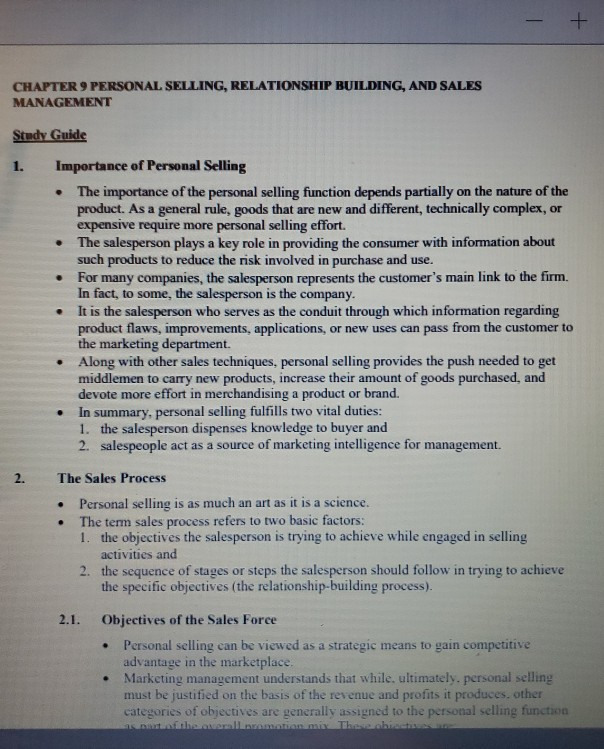
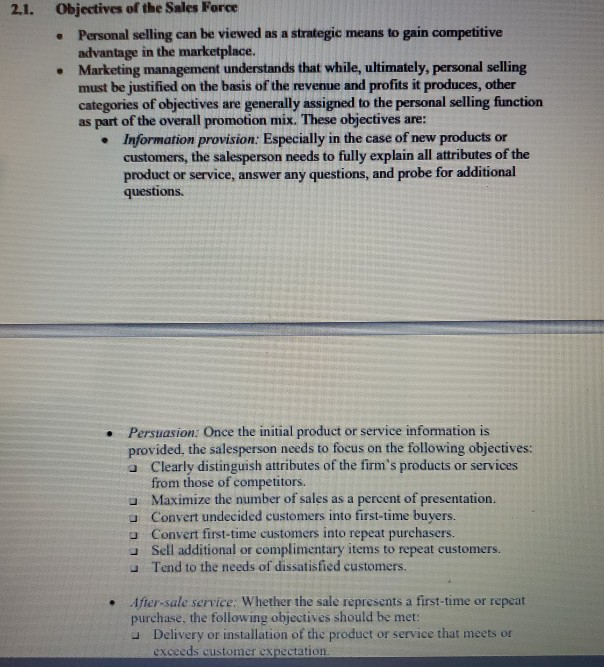
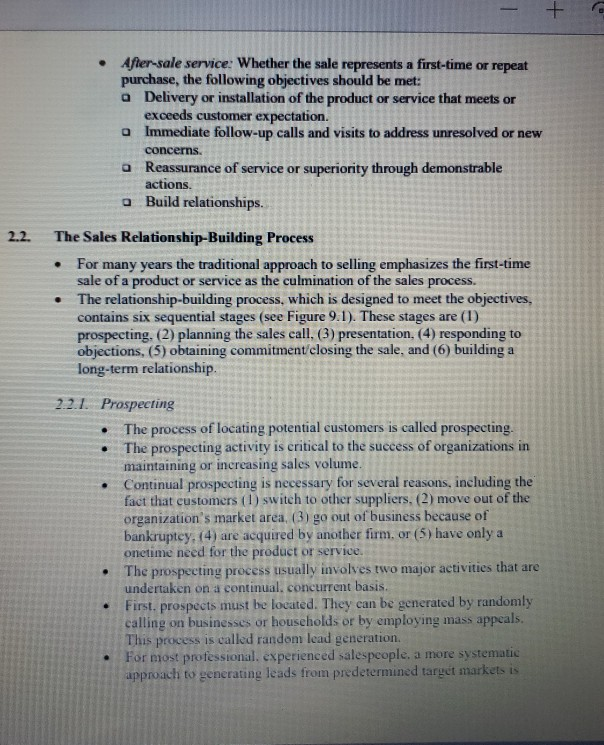
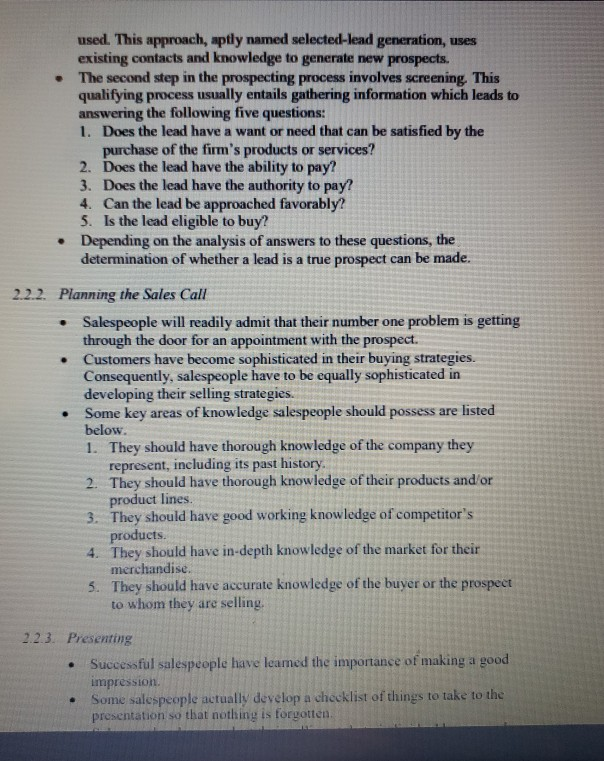
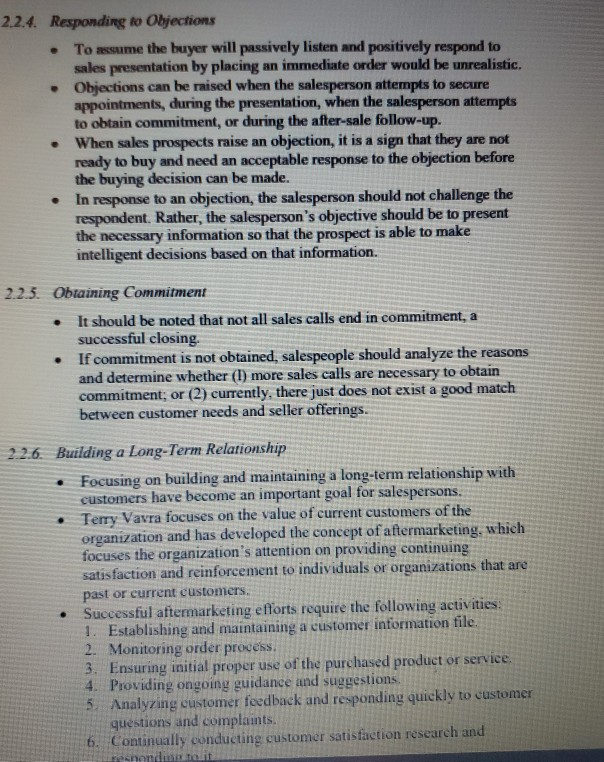
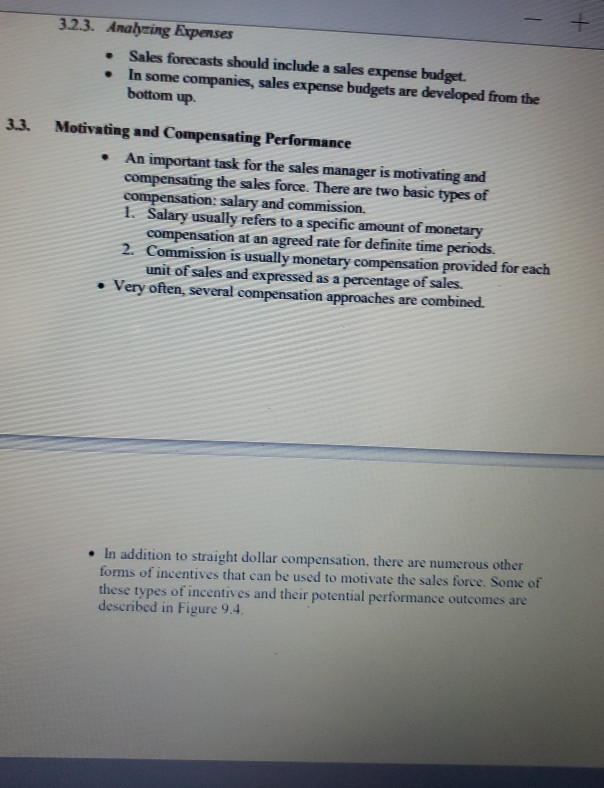
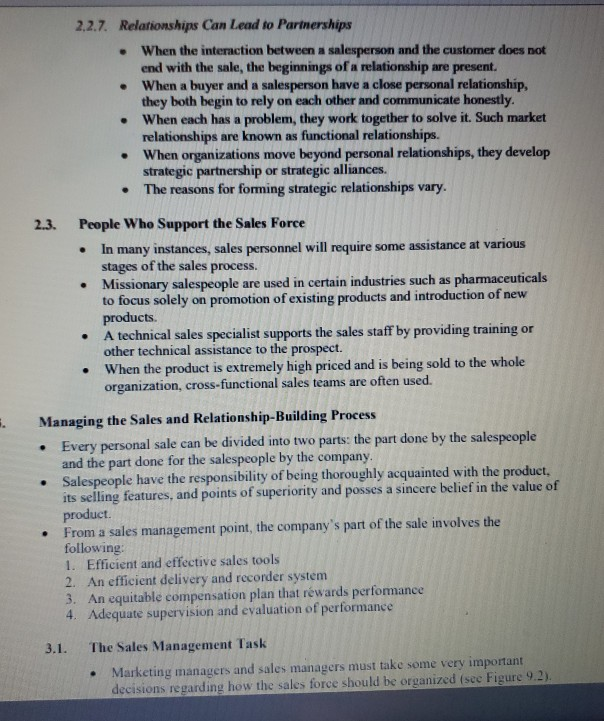
0 25 at Imagine that you have just been hired by a Fortune 500 company. You are asked what you think would be a "fair" compensation package for you. Using the information from the chapter, make a list of all the elements that should be included in your compensation package. CHAPTER 9 PERSONAL SELLING, RELATIONSHIP BUILDING, AND SALES MANAGEMENT Study Guide 1. Importance of Personal Selling The importance of the personal selling function depends partially on the nature of the product. As a general rule, goods that are new and different, technically complex, or expensive require more personal selling effort. The salesperson plays a key role in providing the consumer with information about such products to reduce the risk involved in purchase and use. For many companies, the salesperson represents the customer's main link to the firm. In fact, to some, the salesperson is the company. It is the salesperson who serves as the conduit through which information regarding product flaws, improvements, applications, or new uses can pass from the customer to the marketing department. Along with other sales techniques, personal selling provides the push needed to get middlemen to carry new products, increase their amount of goods purchased, and devote more effort in merchandising a product or brand. In summary, personal selling fulfills two vital duties: 1. the salesperson dispenses knowledge to buyer and 2. salespeople act as a source of marketing intelligence for management. 2. The Sales Process Personal selling is as much an art as it is a science. The term sales process refers to two basic factors: 1. the objectives the salesperson is trying to achieve while engaged in selling activities and 2. the sequence of stages or steps the salesperson should follow in trying to achieve the specific objectives (the relationship-building process). 2.1. Objectives of the Sales Force Personal selling can be viewed as a strategic means to gain competitive advantage in the marketplace. Marketing management understands that while ultimately. personal selling must be justified on the basis of the revenue and profits it produces. other categories of objectives are generally assigned to the personal selling function hallgatan mo Thesab 2.1. Objectives of the Sales Force Personal selling can be viewed as a strategic means to gain competitive advantage in the marketplace. Marketing management understands that while, ultimately, personal selling must be justified on the basis of the revenue and profits it produces, other categories of objectives are generally assigned to the personal selling function as part of the overall promotion mix. These objectives are: Information provision: Especially in the case of new products or customers, the salesperson needs to fully explain all attributes of the product or service, answer any questions, and probe for additional questions. Persuasion. Once the initial product or service information is provided, the salesperson needs to focus on the following objectives: Clearly distinguish attributes of the firm's products or services from those of competitors. Maximize the number of sales as a percent of presentation. Convert undecided customers into first-time buyers. Convert first-time customers into repeat purchasers. Sell additional or complimentary items to repeat customers. Tend to the needs of dissatisfied customers. After-sale service. Whether the sale represents a first-time or repeat purchase, the following objectives should be met: Delivery or installation of the product or service that meets or exceeds customer expectation - + After-sale service: Whether the sale represents a first-time or repeat purchase, the following objectives should be met: a Delivery or installation of the product or service that meets or exceeds customer expectation. Immediate follow-up calls and visits to address unresolved or new concerns. Reassurance of service or superiority through demonstrable actions. Build relationships. 2.2. The Sales Relationship-Building Process For many years the traditional approach to selling emphasizes the first-time sale of a product or service as the culmination of the sales process. The relationship-building process, which is designed to meet the objectives, contains six sequential stages (see Figure 9.1). These stages are (1) prospecting, (2) planning the sales call. (3) presentation. (4) responding to objections, (5) obtaining commitment/closing the sale, and (6) building a long-term relationship. 2.2.1. Prospecting The process of locating potential customers is called prospecting. The prospecting activity is critical to the success of organizations in maintaining or increasing sales volume. Continual prospecting is necessary for several reasons, including the fact that customers (1) switch to other suppliers, (2) move out of the organization's market area, Bi go out of business because of bankruptey, (4) are acquired by another firm, or (5) have only a onctime need for the product or service. The prospecting process usually involves two major activities that are undertaken on a continual, concurrent basis. First. prospects must be located. They can be generated by randomly calling on businesses or households or by employing mass appeals This process is called random lead generation. For most professional experienced salespeople, a more systematic approach to generating leads from predetermined target markets is used. This approach, aptly named selected-lead generation, uses existing contacts and knowledge to generate new prospects. The second step in the prospecting process involves screening. This qualifying process usually entails gathering information which leads to answering the following five questions: 1. Does the lead have a want or need that can be satisfied by the purchase of the firm's products or services? 2. Does the lead have the ability to pay? 3. Does the lead have the authority to pay? 4. Can the lead be approached favorably? 5. Is the lead eligible to buy? Depending on the analysis of answers to these questions, the determination of whether a lead is a true prospect can be made. 2.2.2. Planning the Sales Call Salespeople will readily admit that their number one problem is getting through the door for an appointment with the prospect. Customers have become sophisticated in their buying strategies. Consequently, salespeople have to be equally sophisticated in developing their selling strategies. Some key areas of knowledge salespeople should possess are listed below. 1. They should have thorough knowledge of the company they represent, including its past history. 2. They should have thorough knowledge of their products and/or product lines. 3. They should have good working knowledge of competitor's products. 4. They should have in-depth knowledge of the market for their merchandise. 5. They should have accurate knowledge of the buyer or the prospect to whom they are selling. 2.2.3. Presenting Successful salespeople have leamed the importance of making a good impression. Some salespeople actually develop a checklist of things to take to the presentation so that nothing is forgotten 2.2.4. Responding to Objections To assume the buyer will passively listen and positively respond to sales presentation by placing an immediate order would be unrealistic. Objections can be raised when the salesperson attempts to secure appointments, during the presentation, when the salesperson attempts to obtain commitment, or during the after-sale follow-up. When sales prospects raise an objection, it is a sign that they are not ready to buy and need an acceptable response to the objection before the buying decision can be made. In response to an objection, the salesperson should not challenge the respondent. Rather, the salesperson's objective should be to present the necessary information so that the prospect is able to make intelligent decisions based on that information. 2.2.3. Obtaining Commitment It should be noted that not all sales calls end in commitment, a successful closing If commitment is not obtained, salespeople should analyze the reasons and determine whether (l) more sales calls are necessary to obtain commitment; or (2) currently, there just does not exist a good match between customer needs and seller offerings. 2.2.6. Building a Long-Term Relationship Focusing on building and maintaining a long-term relationship with customers have become an important goal for salespersons. Terry Vavra focuses on the value of current customers of the organization and has developed the concept of aftermarketing, which focuses the organization's attention on providing continuing satisfaction and reinforcement to individuals or organizations that are past or current customers. Successful aftermarketing efforts require the following activities 1. Establishing and maintaining a customer information file. 2. Monitoring order process. 3. Ensuring initial proper use of the purchased product or service. 4. Providing ongoing guidance and suggestions 5. Analyzing customer feedback and responding quickly to customer questions and complaints. 6. Continually conducting customer satisfaction research and nenonductor 3.2.3. Anahzing Experses Sales forecasts should include a sales expense budget. In some companies, sales expense budgets are developed from the bottom up 3.3. Motivating and Compensating Performance An important task for the sales manager is motivating and compensating the sales force. There are two basic types of compensation: salary and commission. 1. Salary usually refers to a specific amount of monetary compensation at an agreed rate for definite time periods. 2. Commission is usually monetary compensation provided for each unit of sales and expressed as a percentage of sales. Very often, several compensation approaches are combined. In addition to straight dollar compensation, there are numerous other foms of incentives that can be used to motivate the sales force. Some of these types of incentives and their potential performance outcomes are described in Figure 9.4. 2.2.7. Relationships Can Lead to Partnerships When the interaction between a salesperson and the customer does not end with the sale, the beginnings of a relationship are present. When a buyer and a salesperson have a close personal relationship they both begin to rely on each other and communicate honestly. When each has a problem, they work together to solve it. Such market relationships are known as functional relationships. When organizations move beyond personal relationships, they develop strategic partnership or strategic alliances. The reasons for forming strategic relationships vary. 2.3. People Who Support the Sales Force In many instances, sales personnel will require some assistance at various stages of the sales process. Missionary salespeople are used in certain industries such as pharmaceuticals to focus solely on promotion of existing products and introduction of new products. A technical sales specialist supports the sales staff by providing training or other technical assistance to the prospect. When the product is extremely high priced and is being sold to the whole organization, cross-functional sales teams are often used. Managing the Sales and Relationship-Building Process Every personal sale can be divided into two parts: the part done by the salespeople and the part done for the salespeople by the company. Salespeople have the responsibility of being thoroughly acquainted with the product. its selling features, and points of superiority and posses a sincere belief in the value of product From a sales management point, the company's part of the sale involves the following: 1. Efficient and effective sales tools 2. An efficient delivery and recorder system 3. An equitable compensation plan that rewards perfomance 4. Adequate supervision and evaluation of performance 3.1. The Sales Management Task Marketing managers and sales managers must take some very important decisions Te parding how the sales force should be organized (see Figure 2)Step by Step Solution
There are 3 Steps involved in it
1 Expert Approved Answer
Step: 1 Unlock

Question Has Been Solved by an Expert!
Get step-by-step solutions from verified subject matter experts
Step: 2 Unlock
Step: 3 Unlock
 Study Help