







Question: using the IRAC METHOD to answer what is the issue in the case, the rule. the application and the conclusion. DePetris & Backrach, LLP v.
using the IRAC METHOD to answer what is the issue in the case, the rule. the application and the conclusion.
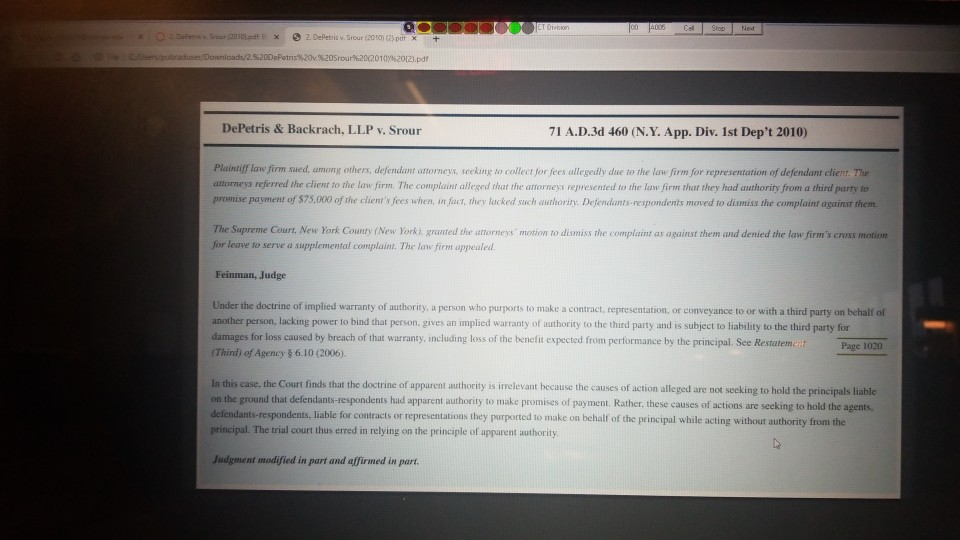
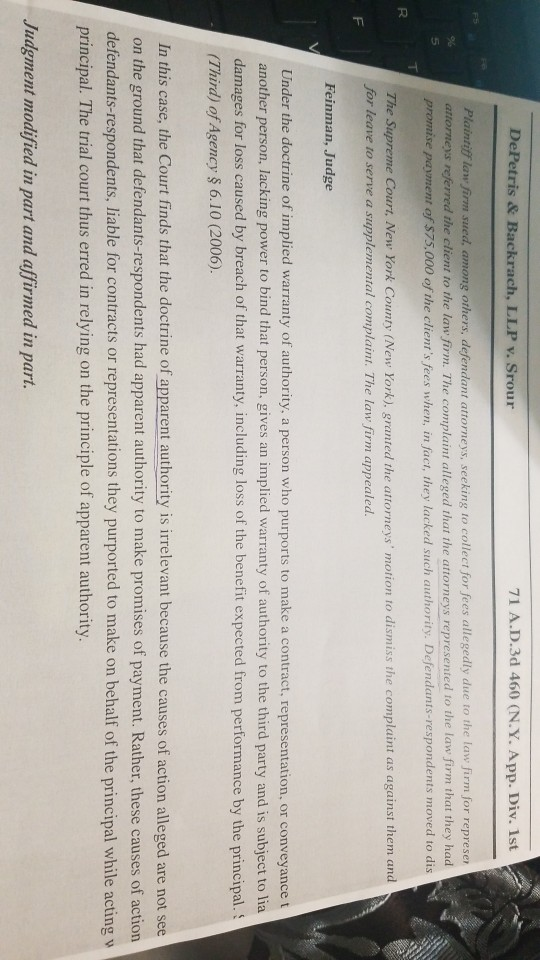
DePetris & Backrach, LLP v. Srour 71 A.D.3d 460 (N.Y. App. Div. 1st Plaintiff law firm sued, among others, defendant attorneys, seeking to collect for fees allegedly due to the law firm for represer attorneys referred the client to the law firm. The complaint alleged that the attorneys represented to the law firm that they had promise payment of $75,000 of the client's fees when, in fact, they lacked such authority. Defendants-respondents moved to dis The Supreme Court, New York County (New York), granted the attorneys' motion to dismiss the complaint as against them and for leave to serve a supplemental complaint. The law firm appealed. Feinman, Judge Under the doctrine of implied warranty of authority, a person who purports to make a contract, representation, or conveyancet another person, lacking power to bind that person, gives an implied warranty of authority to the third party and is subject to lia damages for loss caused by breach of that warranty, including loss of the benefit expected from performance by the principal. (Third) of Agency $ 6.10 (2006). In this case, the Court finds that the doctrine of apparent authority is irrelevant because the causes of action alleged are not see on the ground that defendants-respondents had apparent authority to make promises of payment. Rather, these causes of action defendants-respondents, liable for contracts or representations they purported to make on behalf of the principal while acting y principal. The trial court thus erred in relying on the principle of apparent authority. Judgment modified in part and affirmed in part. sono * Bebe u samoodbod0000 baduses/Downloads/2.5.200Putnis2020Srour20201020121.pdf DePetris & Backrach, LLP v. Srour 71 A.D.3d 460 (N.Y. App. Div. 1st Dep't 2010) Plaintiff law firm sued, among others, defendant afforneys, seeking to collect for fees allegedly due to the law firm for representation of defendant client. The attorneys referred the client to the law firm. The complaint alleged that the attorneys represented to the law firm that they had authority from a third party to promise payment of $75,000 of the client's fees when, in fact, they lacked such awthoris Defendants-respondents moved to dismiss the complaint against them The Supreme Court, New York County (New York), granted the attorneys motion to dismiss the complaint as against them and denied the law firm's cross motion for leave to serve a supplemental complaint. The law firm appealed. Feinman, Judge Under the doctrine of implied warranty of authority, a person who purports to make a contract, representation, or conveyance to or with a third party on behalf of another person, lacking power to bind that person, gives an implied warranty of authority to the third party and is subject to liability to the third party for damages for loss caused by breach of that warranty, including loss of the benefit expected from performance by the principal. See Restatement Page 1020 (Thirds of Agency 56.10 (2006). In this case, the Court finds that the doctrine of apparent authority is inrelevant because the causes of action alleged are not seeking to hold the principals liable on the ground that defendants-respondents had apparent authority to make promises of payment. Rather, these causes of actions are seeking to hold the agents defendants-respondents, liable for contracts or representations they purported to make on behalf of the principal while acting without authority from the principal. The trial court thus erred in relying on the principle of apparent authority Judgment modified in part and affirmed in part DePetris & Backrach, LLP v. Srour 71 A.D.3d 460 (N.Y. App. Div. 1st Plaintiff law firm sued, among others, defendant attorneys, seeking to collect for fees allegedly due to the law firm for represer attorneys referred the client to the law firm. The complaint alleged that the attorneys represented to the law firm that they had promise payment of $75,000 of the client's fees when, in fact, they lacked such authority. Defendants-respondents moved to dis The Supreme Court, New York County (New York), granted the attorneys' motion to dismiss the complaint as against them and for leave to serve a supplemental complaint. The law firm appealed. Feinman, Judge Under the doctrine of implied warranty of authority, a person who purports to make a contract, representation, or conveyancet another person, lacking power to bind that person, gives an implied warranty of authority to the third party and is subject to lia damages for loss caused by breach of that warranty, including loss of the benefit expected from performance by the principal. (Third) of Agency $ 6.10 (2006). In this case, the Court finds that the doctrine of apparent authority is irrelevant because the causes of action alleged are not see on the ground that defendants-respondents had apparent authority to make promises of payment. Rather, these causes of action defendants-respondents, liable for contracts or representations they purported to make on behalf of the principal while acting y principal. The trial court thus erred in relying on the principle of apparent authority. Judgment modified in part and affirmed in part. sono * Bebe u samoodbod0000 baduses/Downloads/2.5.200Putnis2020Srour20201020121.pdf DePetris & Backrach, LLP v. Srour 71 A.D.3d 460 (N.Y. App. Div. 1st Dep't 2010) Plaintiff law firm sued, among others, defendant afforneys, seeking to collect for fees allegedly due to the law firm for representation of defendant client. The attorneys referred the client to the law firm. The complaint alleged that the attorneys represented to the law firm that they had authority from a third party to promise payment of $75,000 of the client's fees when, in fact, they lacked such awthoris Defendants-respondents moved to dismiss the complaint against them The Supreme Court, New York County (New York), granted the attorneys motion to dismiss the complaint as against them and denied the law firm's cross motion for leave to serve a supplemental complaint. The law firm appealed. Feinman, Judge Under the doctrine of implied warranty of authority, a person who purports to make a contract, representation, or conveyance to or with a third party on behalf of another person, lacking power to bind that person, gives an implied warranty of authority to the third party and is subject to liability to the third party for damages for loss caused by breach of that warranty, including loss of the benefit expected from performance by the principal. See Restatement Page 1020 (Thirds of Agency 56.10 (2006). In this case, the Court finds that the doctrine of apparent authority is inrelevant because the causes of action alleged are not seeking to hold the principals liable on the ground that defendants-respondents had apparent authority to make promises of payment. Rather, these causes of actions are seeking to hold the agents defendants-respondents, liable for contracts or representations they purported to make on behalf of the principal while acting without authority from the principal. The trial court thus erred in relying on the principle of apparent authority Judgment modified in part and affirmed in part
Step by Step Solution
There are 3 Steps involved in it
1 Expert Approved Answer
Step: 1 Unlock

Question Has Been Solved by an Expert!
Get step-by-step solutions from verified subject matter experts
Step: 2 Unlock
Step: 3 Unlock
 Study Help