





Question: Using the module hierarchy given in Figure 7.13, show the orders of module integration for the top-down and bottom-up integration approached. Estimate the number of
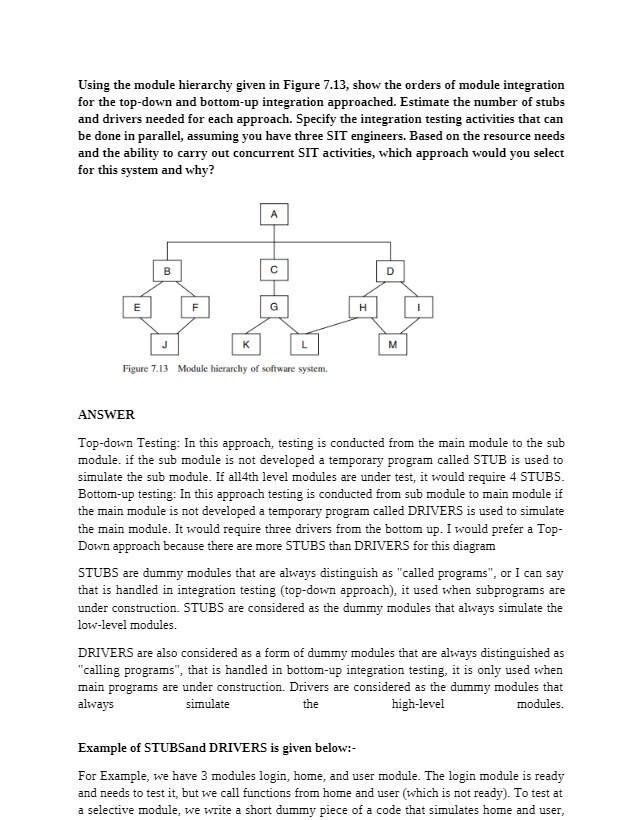
Using the module hierarchy given in Figure 7.13,
Using the module hierarchy given in Figure 7.13, show the orders of module integration for the top-down and bottom-up integration approached. Estimate the number of stubs and drivers needed for each approach. Specify the integration testing activities that can be done in parallel, assuming you have three SIT engineers. Based on the resource needs and the ability to carry out concurrent SIT activities, which approach would you select for this system and why? A B C D E F G H K M Figure 7.13 Module hierarchy of software system. ANSWER Top-down Testing: In this approach, testing is conducted from the main module to the sub module. if the sub module is not developed a temporary program called STUB is used to simulate the sub module. If all4th level modules are under test, it would require 4 STUBS. Bottom-up testing: In this approach testing is conducted from sub module to main module if the main module is not developed a temporary program called DRIVERS is used to simulate the main module. It would require three drivers from the bottom up. I would prefer a Top- Down approach because there are more STUBS than DRIVERS for this diagram STUBS are dummy modules that are always distinguish as "called programs", or I can say that is handled in integration testing (top-down approach), it used when subprograms are under construction. STUBS are considered as the dummy modules that always simulate the low-level modules. DRIVERS are also considered as a form of dummy modules that are always distinguished as "calling programs", that is handled in bottom-up integration testing, it is only used when main programs are under construction. Drivers are considered as the dummy modules that always simulate the high-level modules. Example of STUBSand DRIVERS is given below:- For Example, we have 3 modules login, home, and user module. The login module is ready and needs to test it, but we call functions from home and user (which is not ready). To test at a selective module, we write a short dummy piece of a code that simulates home and user

Step by Step Solution

There are 3 Steps involved in it

1 Expert Approved Answer
Step: 1 Unlock blur-text-image

Question Has Been Solved by an Expert!

Get step-by-step solutions from verified subject matter experts

Step: 2 Unlock
Step: 3 Unlock

Students Have Also Explored These Related Mathematics Questions!