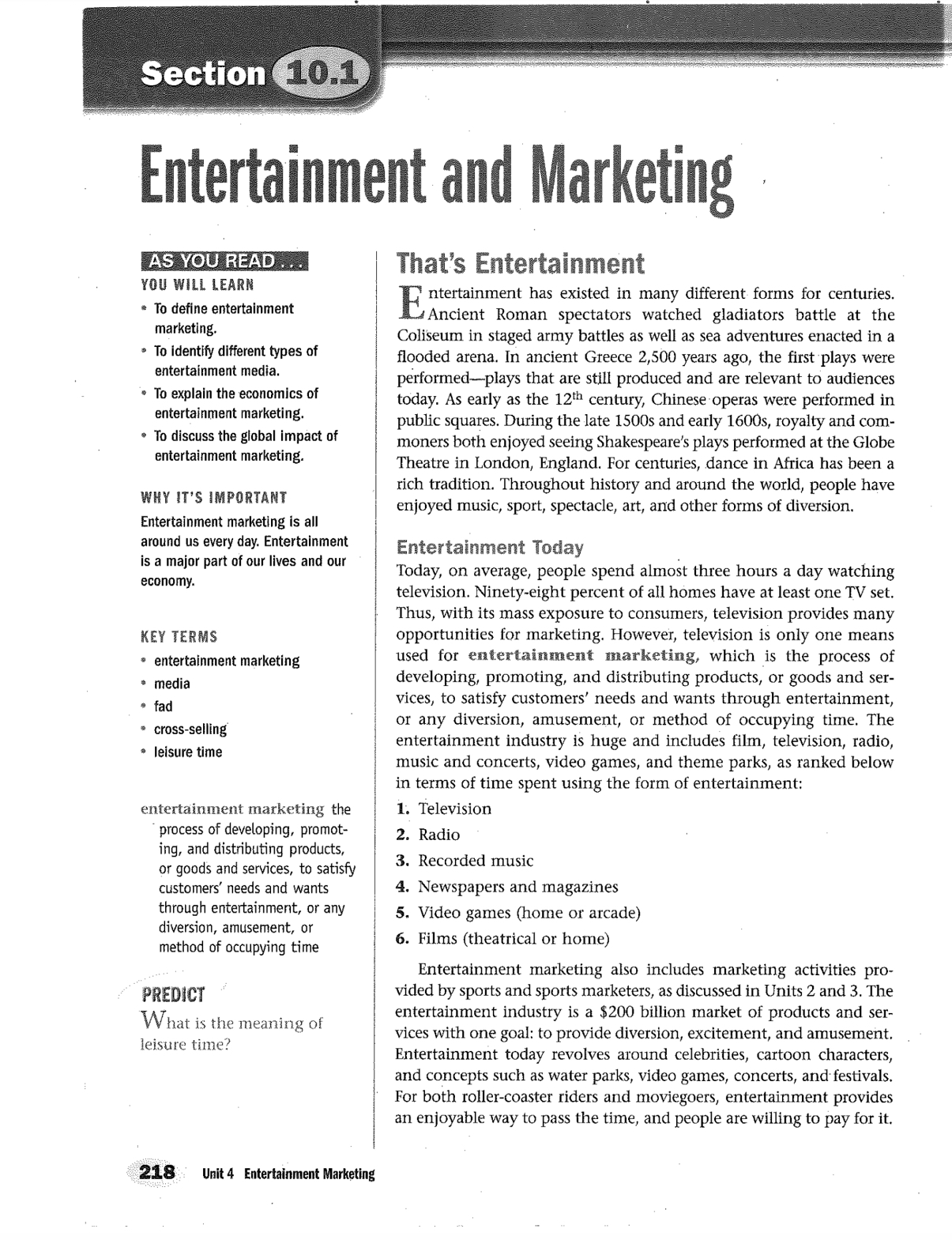
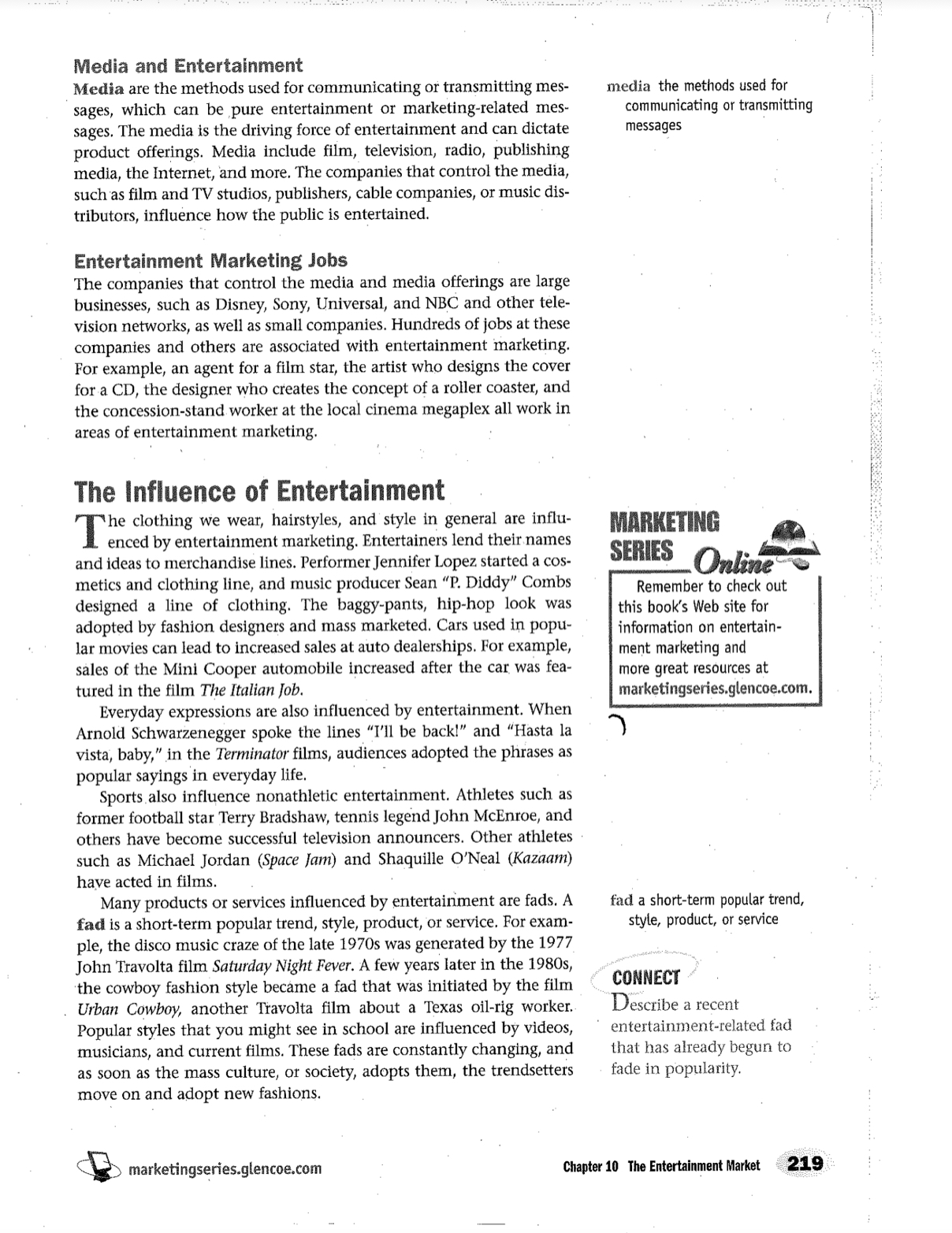
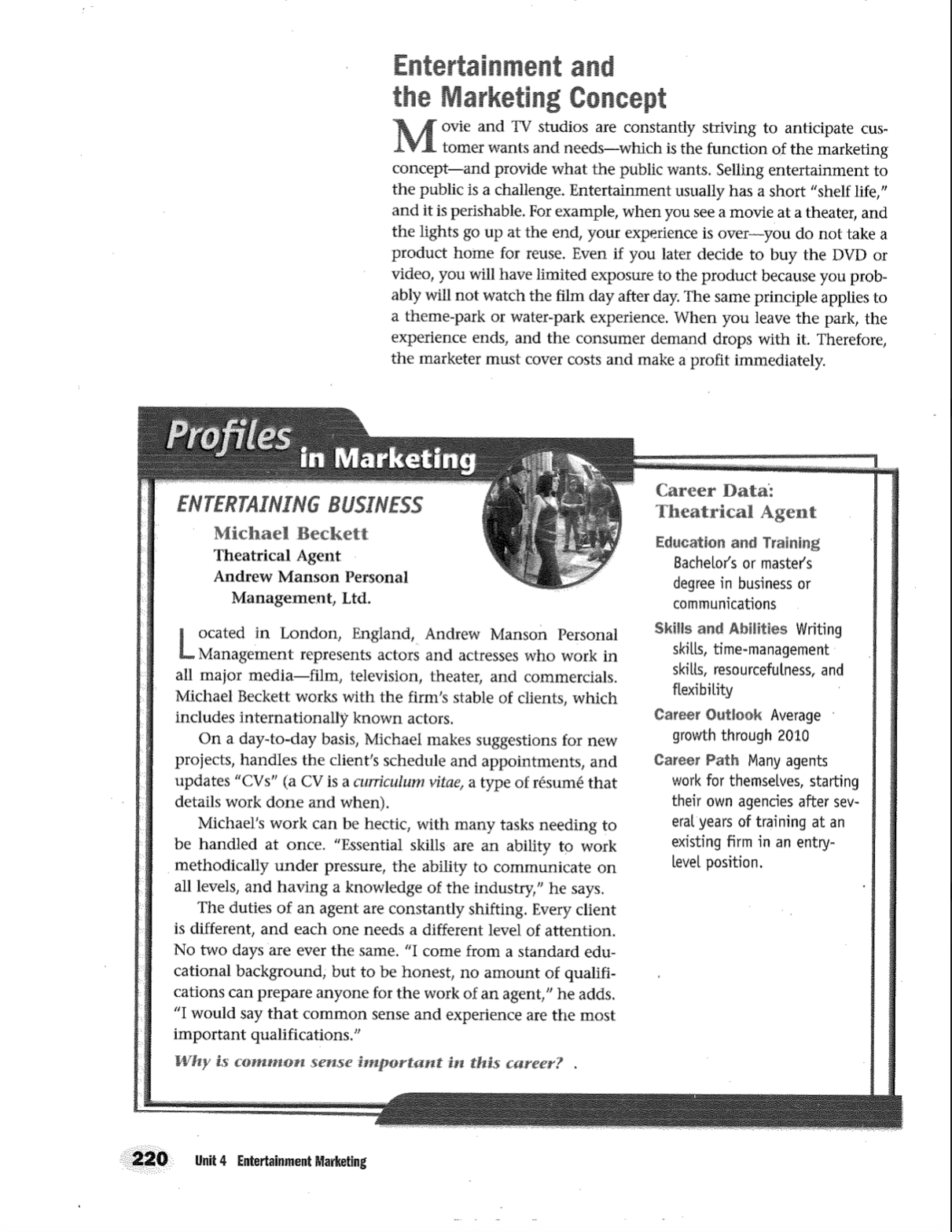
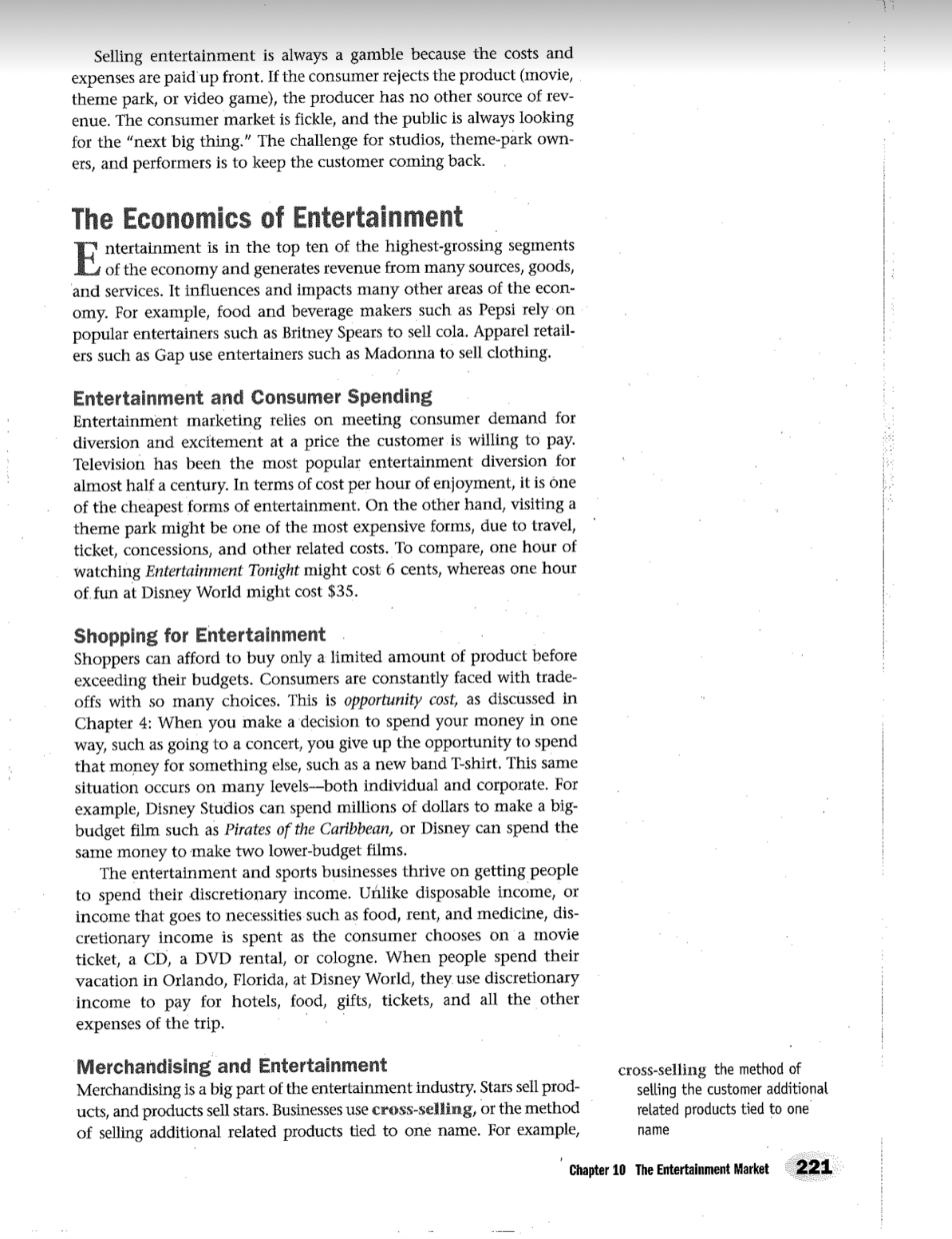
Question: Using the pages below, answer the following questions; Chapter 10 Read P.218- 223 Answer 223 Q.1-3 Read P.224-234 Answer P.234 Q.1-3 AS YOU READ .
Using the pages below, answer the following questions;
Chapter 10Read P.218- 223
Answer 223 Q.1-3Read P.224-234Answer P.234 Q.1-3
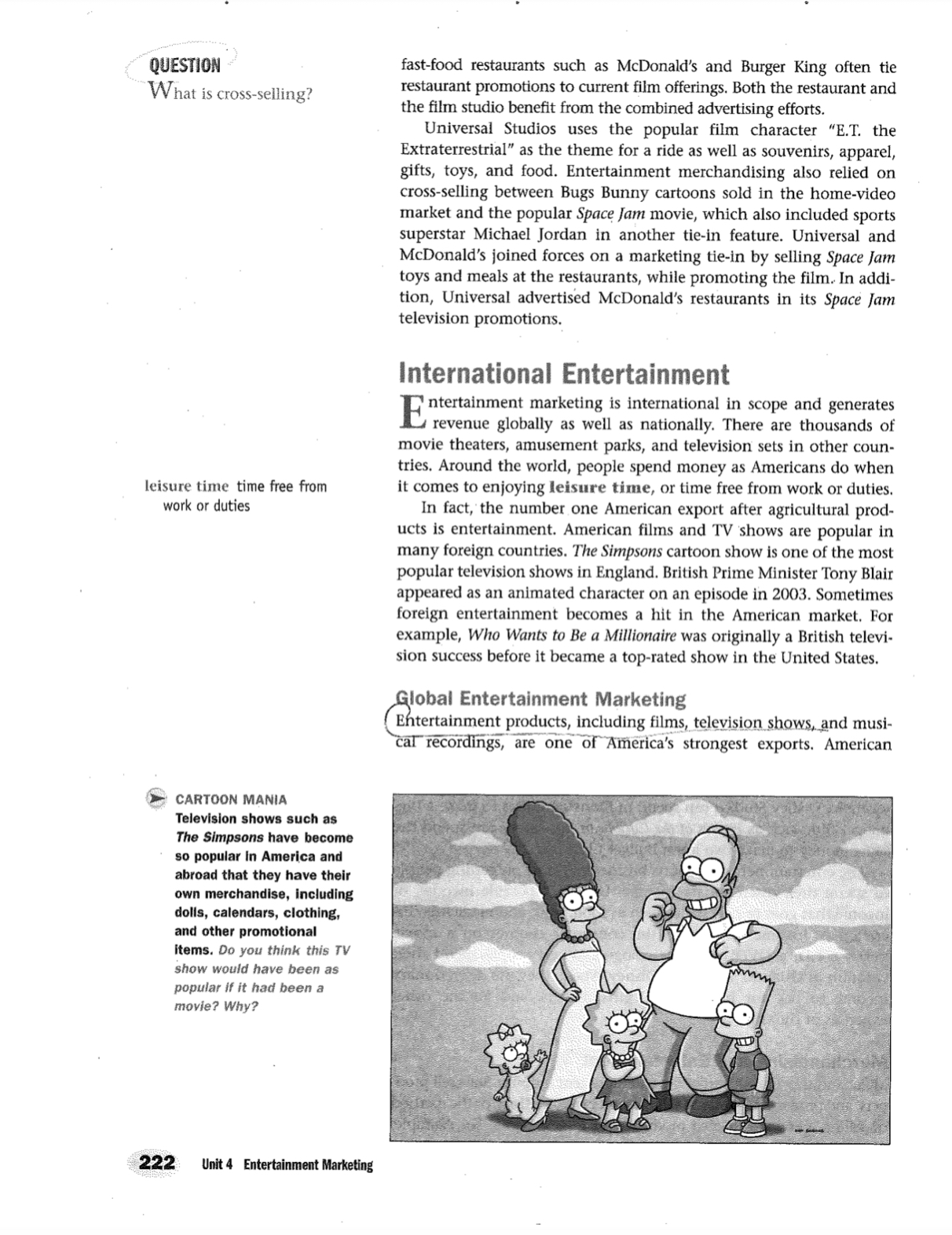
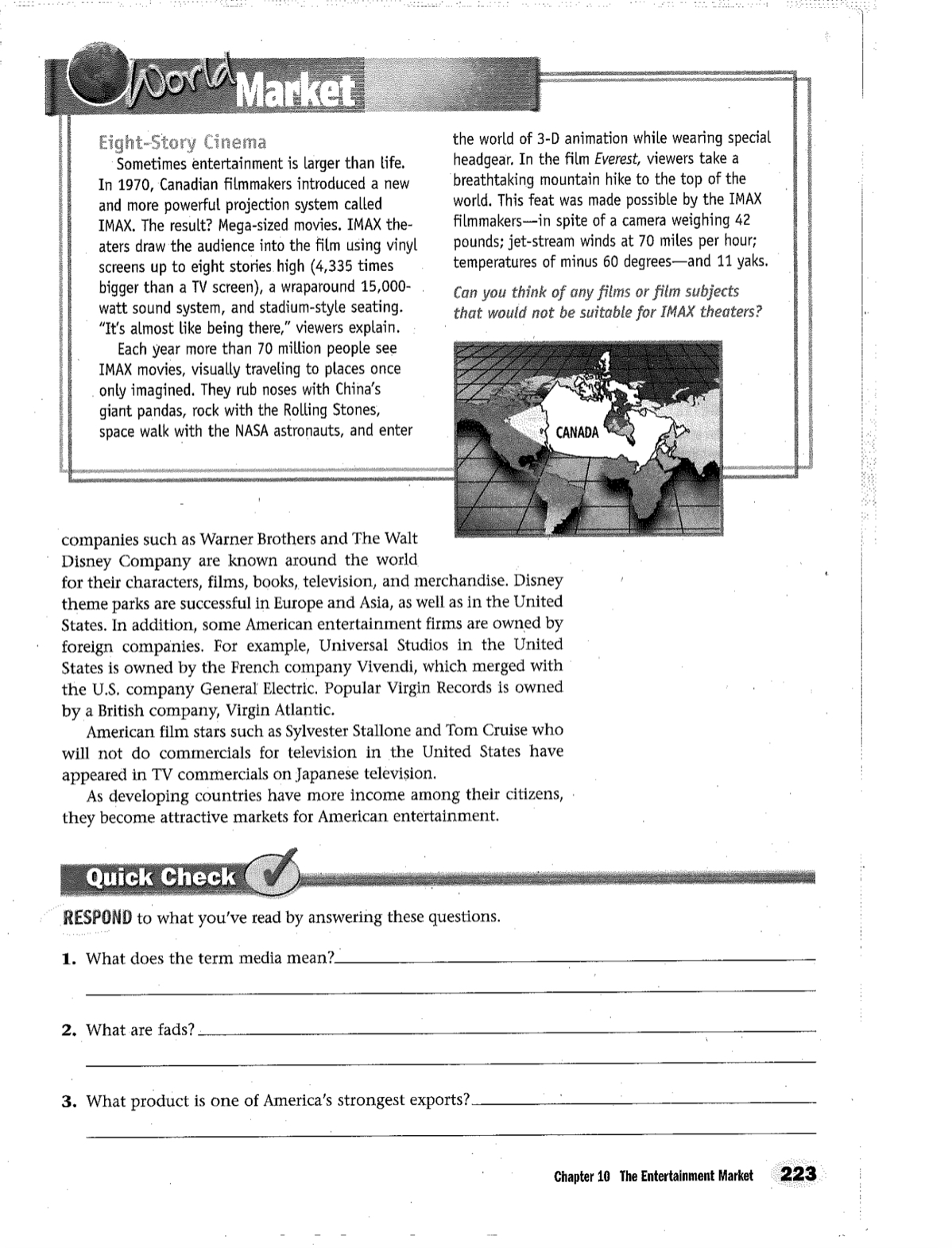
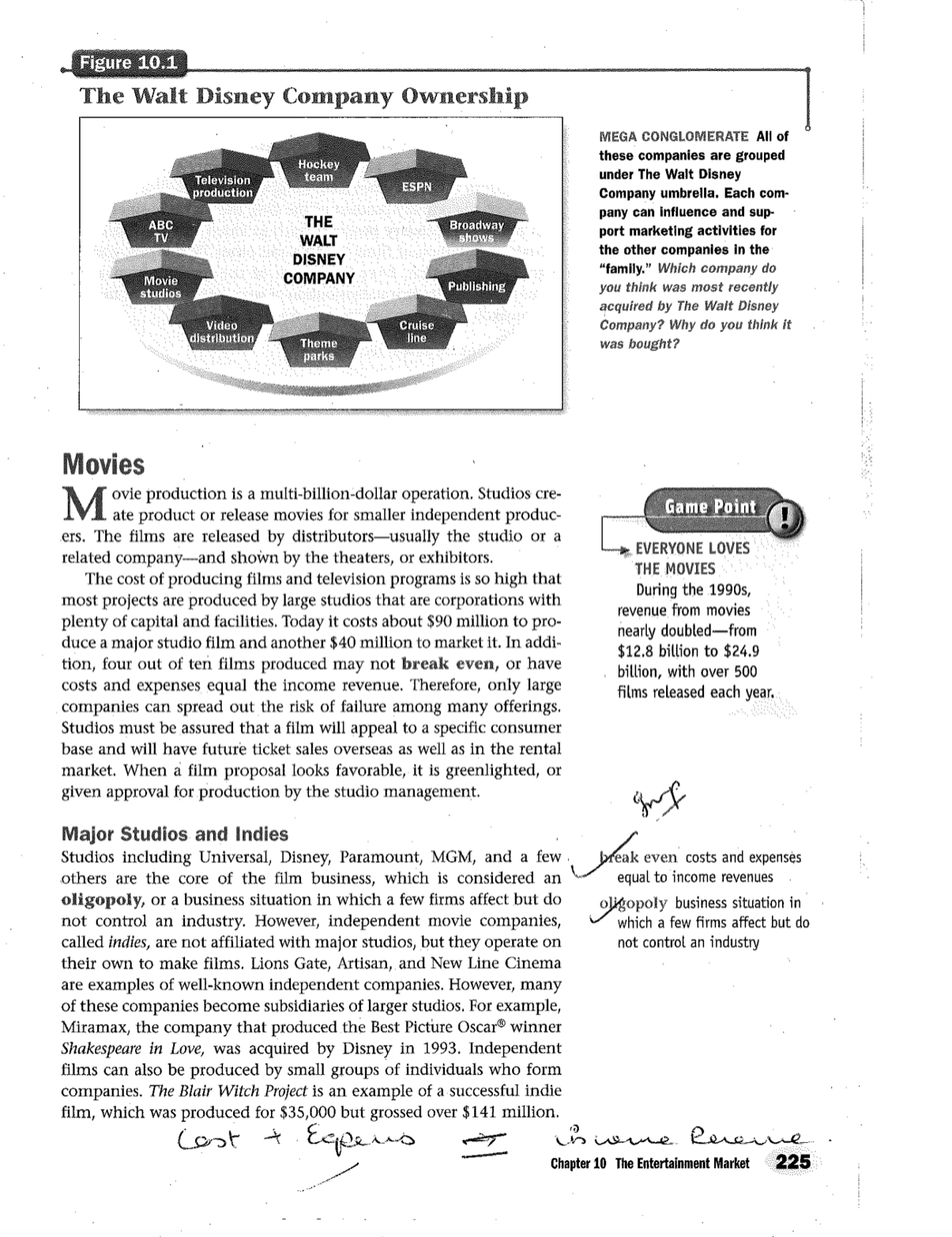
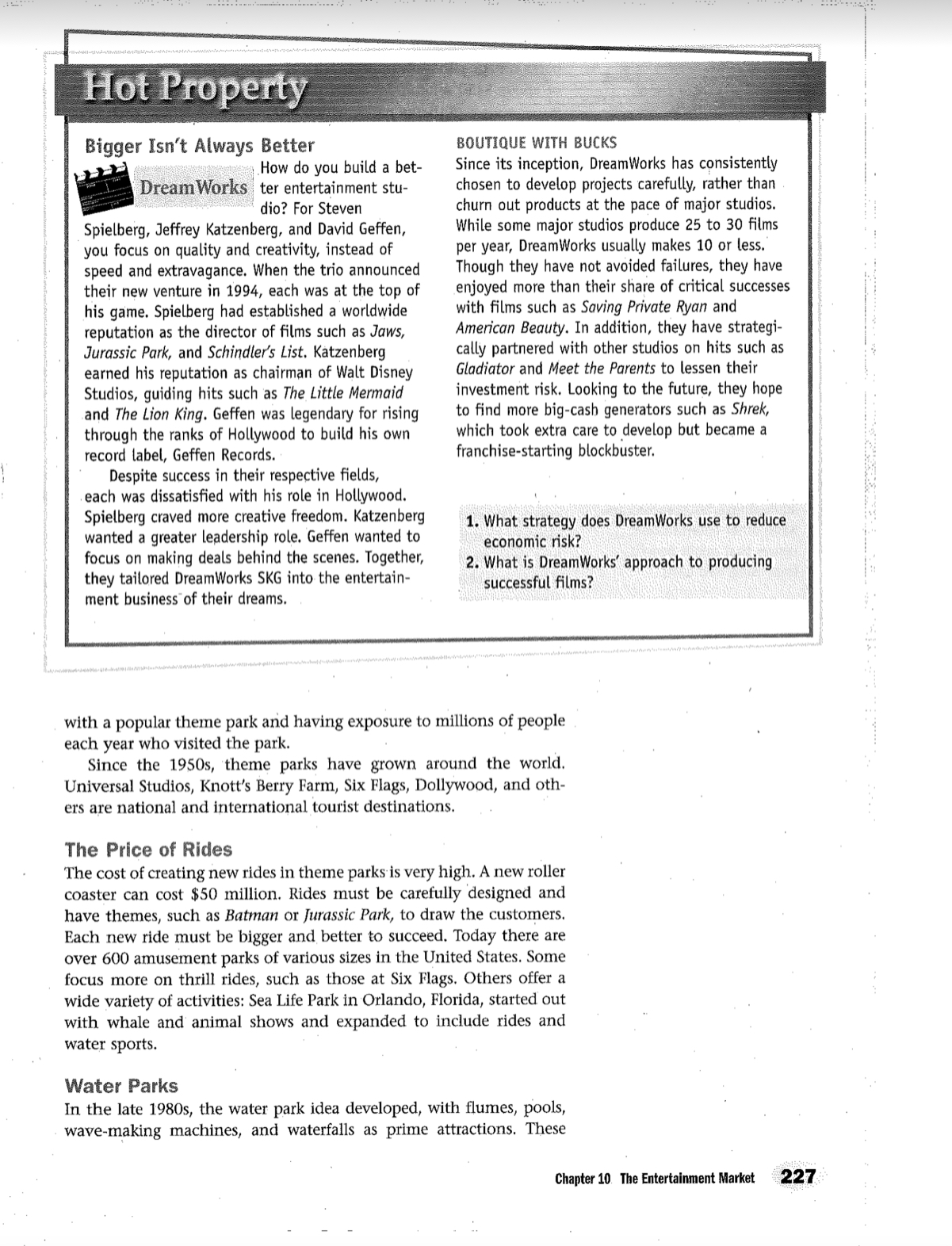
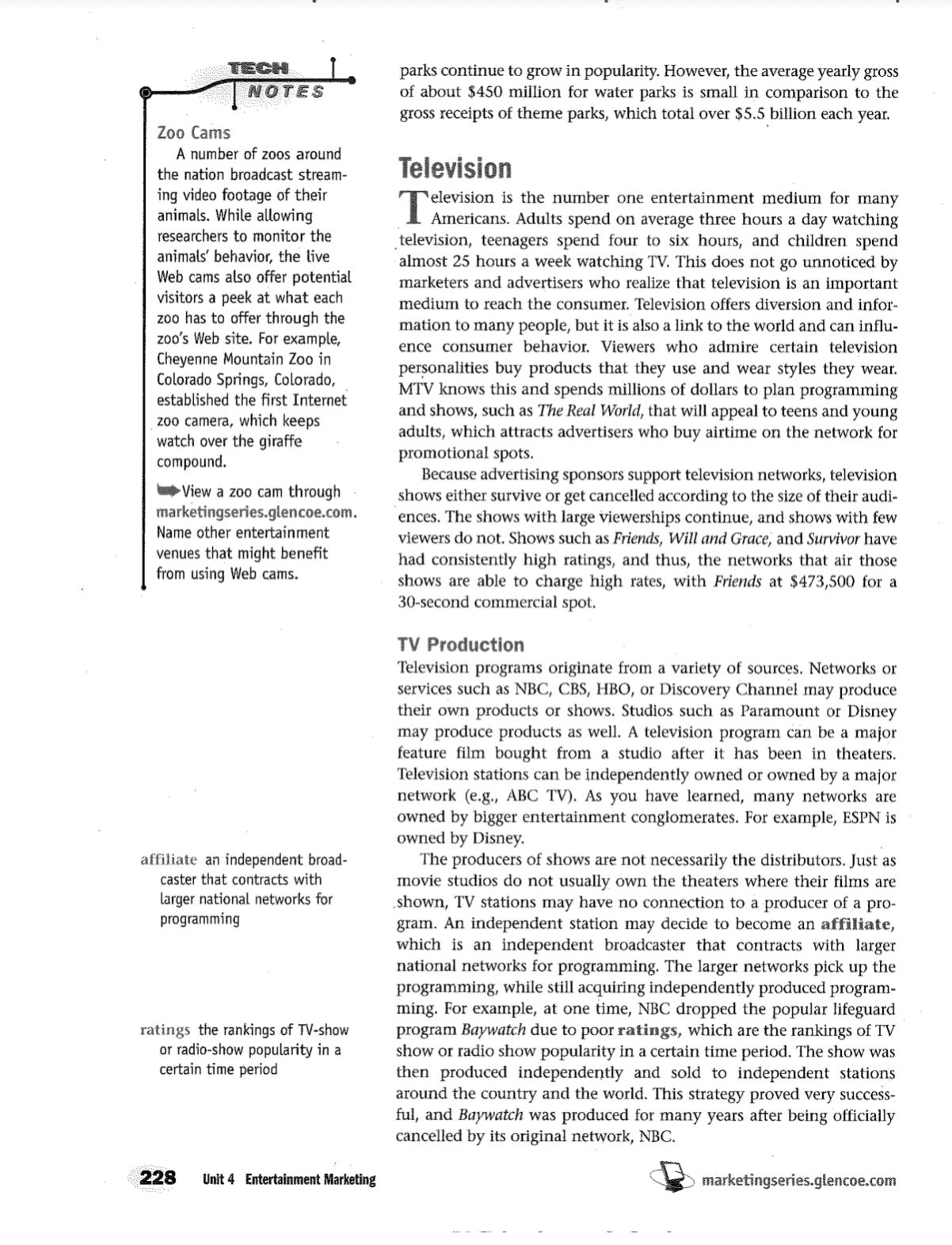
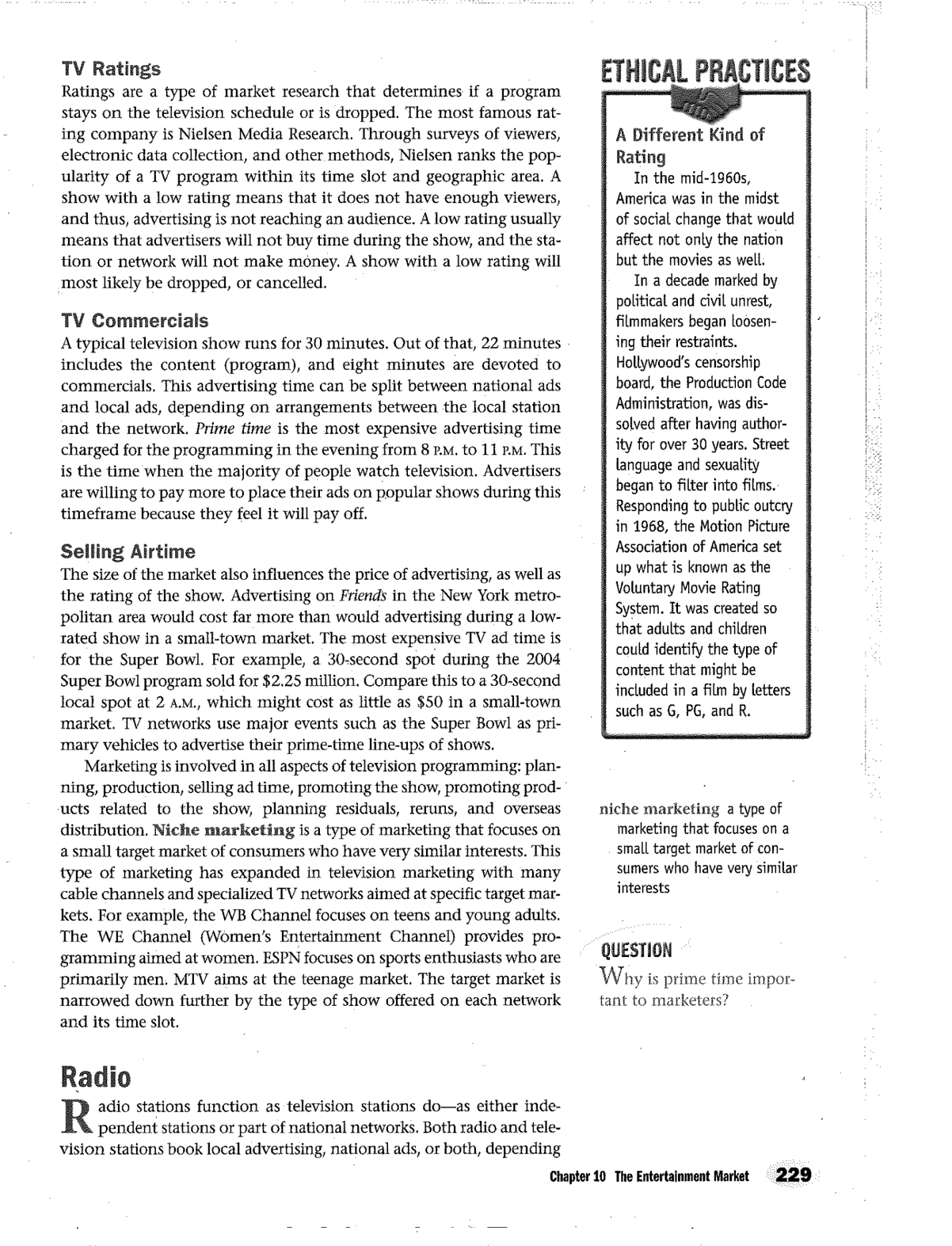
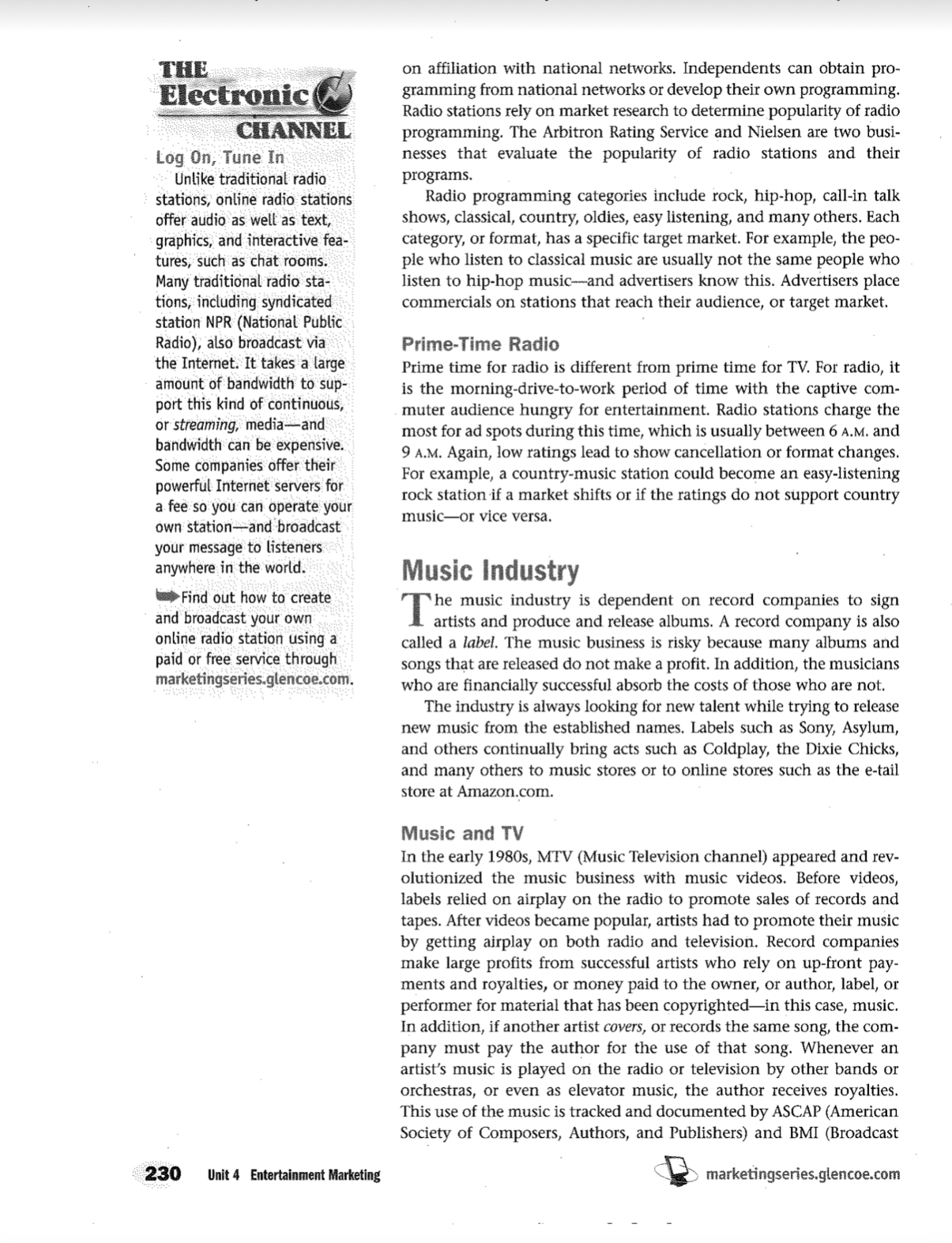
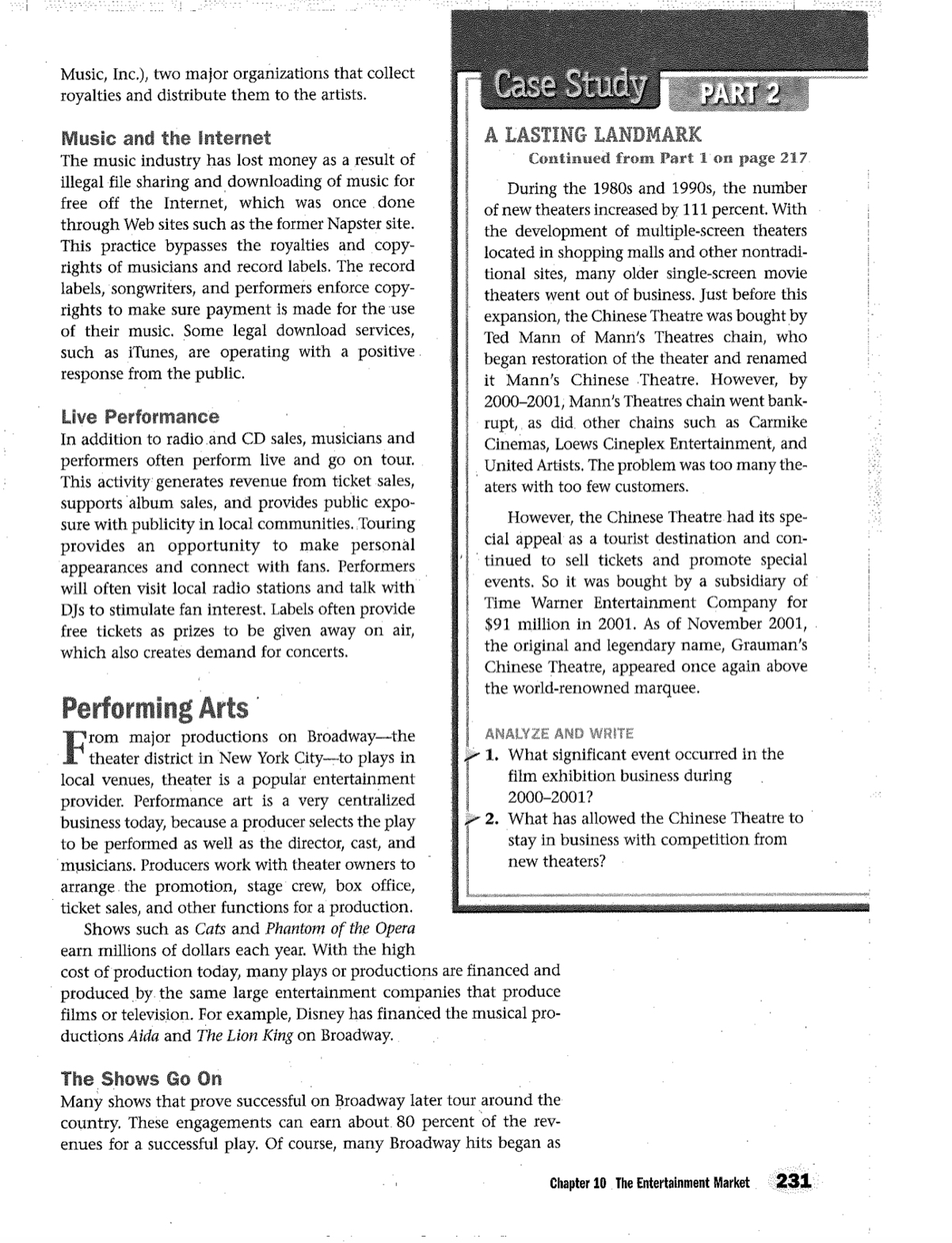
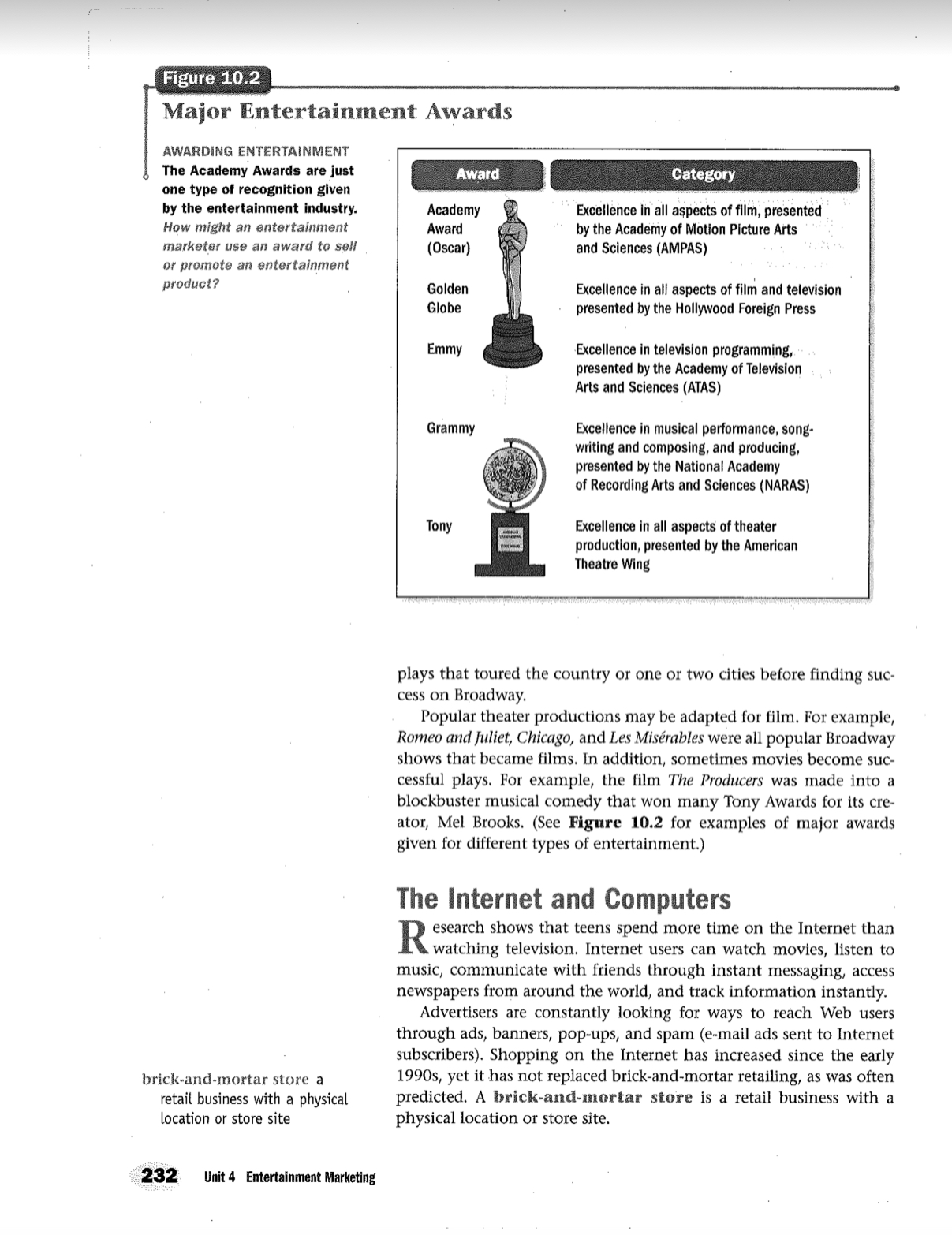
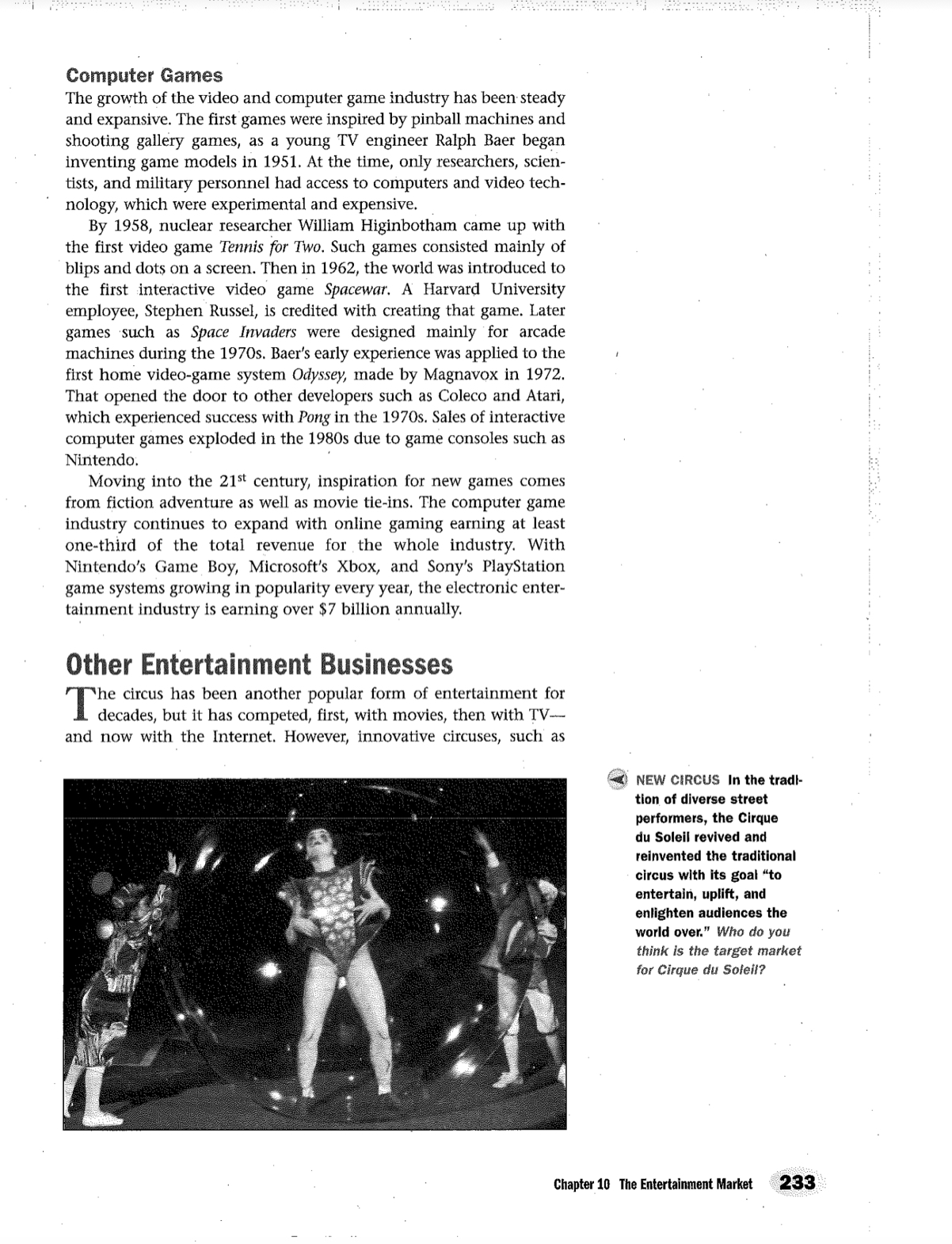
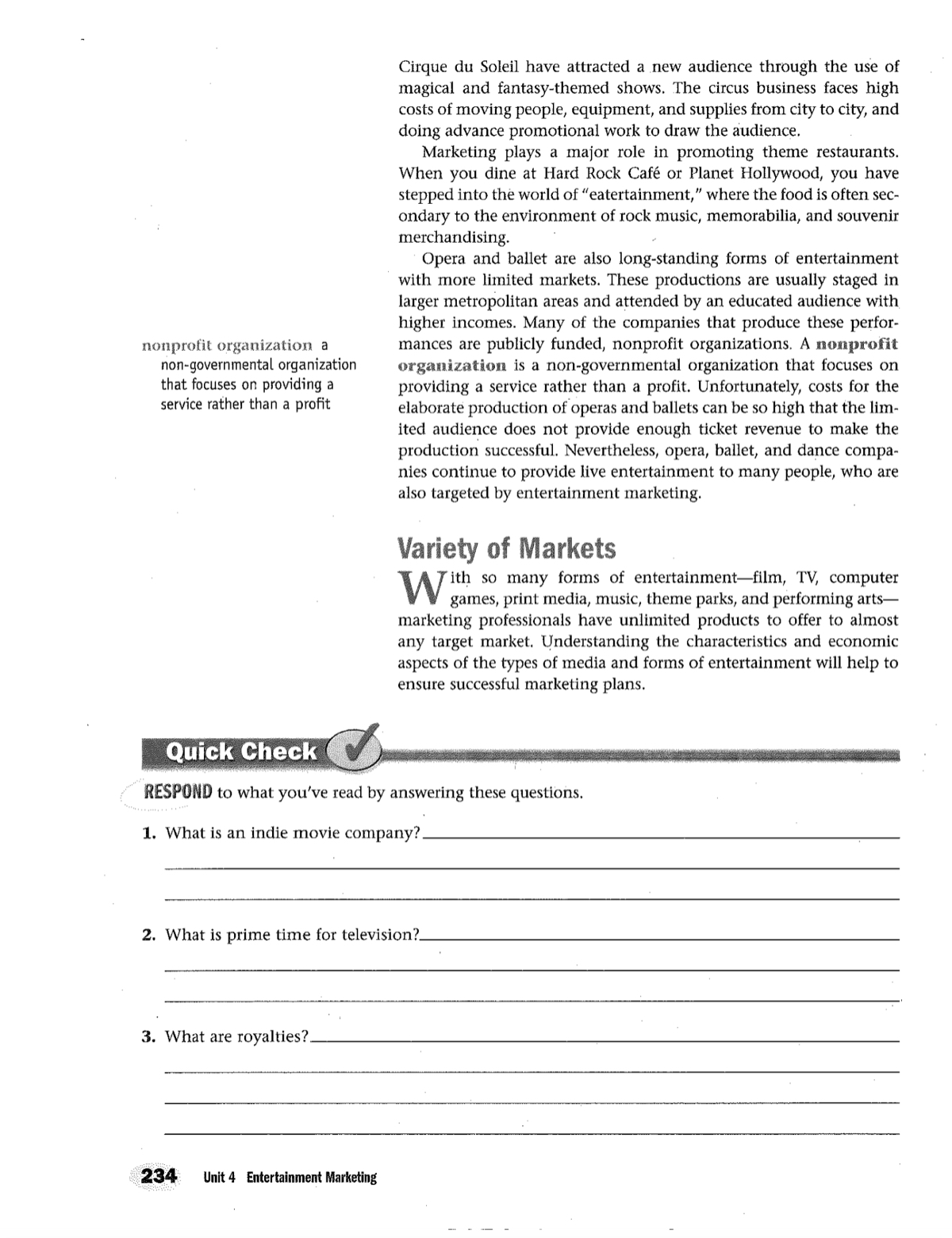
AS YOU READ . -. . YOU WILL LEARN ' To dene entertainment marketing. - To Identify different types of entertainment media. s To explain the economics of entertainment marketing. ' To discuss the global impact of entertainment marketing. WHY lT'S IMPU HTANT Entertainment marketing is all around as every day. Entertainment is a major part of our lives and our economy. KEY TERMS - entertainment marketing ' media . fad ' cross-selling - leisure time entertainment: marketing the ' process of developing, promot- ing, and distributing products. or goods and services, to satisfy customers' needs and wants through entertainment, or any diversion, amusement, or method of occupying time ?REDiC'i \"first is the meaning of leisure time? i .218 Unit-i Entertainment Marketing That's Entertainment ntertainrnent has existed in many different forms for centuries. Ancient Roman spectators watched gladiators battle at the Coliseum in staged army battles as well as sea adventures enacted in a ooded arena. In ancient Greece 2,500 years ago, the first'plays were performedplays that are still produced and are relevant to audiences today. As early as the 12*\" century, Chinese operas were performed in public squares. During the late 15005 and early 16005, royalty and com- moners both enjoyed seeing Shakespeare's plays performed at the Globe Theatre in London, England. For centuries, .dance in Africa has been a rich tradition. Throughout history and around the world, people have enjoyed music, sport, spectacle, art, and other forms of diversion. Entertainment Today Today, on average, people spend almost three hours a day watching television. Ninety-eight percent of all homes have at least one TV set. Thus, with its mass exposure to consumers, television provides many opportunities for marketing. However, television is only one means used for entertainment marketing, which is the process of developing, promoting, and distributing products, or goods and ser- vices, to satisfy customers' needs and wants through entertainment, or any diversion, amusement, or method of occupying time. The entertainment industry is huge and includes film, television, radio, music and concerts, video games, and theme parks, as ranked below in terms of time spent using the form of entertainment: 1. Television . Radio Recorded music Newspapers and magazines . Video games [home or arcade) @01pr Films (theatrical or home) Entertainment marketing also includes marketing activities pro- vided by sports and sports marketers, as discussed in Units 2 and 3. The entertainment industry is a $200 billion market of products and ser vices with one goal: to provide diversion, excitement, and amusement. Entertainment today revolves around celebrities, cartoon characters, and concepts such as water parks, video games, concerts, and-festivals. For both roller-coaster riders and moviegoers, entertainment provides an enjoyable way to pass the time, and people are willing to pay for it. Media and Entertainment Media are the methods used for communicating or transmitting mes- ' sages, which can be pure entertainment or marketing-related mes sages. The media is the driving force of entertainment and can dictate product offerings. Media include film, television, radio, publishing media, the internet, and more. The companies that control the media, such 'as film and TV studios, publishers, cable companies, or music dis- tributors, influence how the public is entertained. Entertainment Marketing Jobs The companies that control the media and media offerings are large businesses, such as Disney, Sony, Universal, and NBC and other tele- vision networks, as well as small companies. Hundreds of jobs at these companies and others are associated with entertainment marketing. For example, an agent for a film star, the artist who designs the cover for a CD, the designer who creates the concept of a roller coaster, and the concession-stand worker at the local cinema megaplex all work in areas of entertainment marketing. The Influence of Entertainment he clothing we wear, hairstyles, and style in general are inu- enced by entertainment marketing. Entertainers lend their names and ideas to merchandise lines. Performer Jennifer Lopez started it cos- metics and clothing line, and music producer Sean "P. Diddy\" Combs designed a litre of clothing. The baggy-pants, hip-hop look was adopted by fashion designers and mass marketed. Cars used in popu- lar movies can lead to increased sales at auto dealerships. For example, sales of the Mini Cooper automobile increased after the car was fea- tured in the film The ltrrlinn lob. Everyday expressions are also influenced by entertainment. When Arnold Schwarzenegger spoke the lines \"i'll be back!" and "Hasta la vista, baby," in the Terminator films, audiences adopted the phrases as popular sayings in everyday life. ' Sports also inuence nonathletlc entertainment. Athletes such as former football star Terry Bradsh aw. tennis legend John McEnroe, and others have become successful television announcers. Other athletes - such as Michael Jordan (Space Jam) and Shaquille O'Neal (Known) have acted in films. ' Many products or services inuenced by entertainment are fads. A fad is a short-term popular trend, style, product, or service. For exam- ple. the disco music craze of the late 1970s was generated by the 1977 John Travolta film Saturday Night Fever. A few years later in the 19805, the cowboy fashion style became a fad that was initiated by the film . Urban Cowboy, another 'llavolta film about a Texas oilrig worker. Popular styles that you might see in school are inuenced by videos, musicians, and current lms. These fads are constantly changing, and as soon as the mass culture, or society, adopts them, the trendsetters move on and adopt new fashions. Cg) marketingsees.glenree.com Chapter 10 The Entertainment Market media the methods used for communicating or transmitting messages ' MARKETING SERIES '1 Remember to check out this book's Web site for information on entertain- ment marketing and more great resources at marketingseries.glencee.com. fad a short-term popular trend, style, product, or service CONNECT Describe a recent ' entertainmenirelated.fad that has already begun to fade in popularity. .219 - Entertainment and the Marketing Concept M ovie and TV studios are constantly striving to anticipate cus tomer wants and needswhich is the function of the marketing conceptand provide what the public wants. Selling entertainment to the public is a challenge. Entertainment usually has a short "shelf life,\" and it is perishable. For example, when you see a movie at a theater, and the lights go up at the end, your experience is over~you do not take a product home for reuse. Even if you later decide to buy the DVD or video, you will have limited exposure to the product because you prob ably will not watch the film day after day. The same principle applies to a theme-park or water-park experience. When you leave the park, the experience ends, and the consumer demand drops with it. Therefore, the marketer must cover costs and make a profit immediately. Proles ENTERTAINING BUSINESS Michael Beckett Theatrical Agent Andrew Manson Personal Management, Ltd. in Marketing Career Data: 'l'heatrical A gent Education and Training Bachelor's or master's degree in business or communications Skills and Abilities Writing skills, timemanagement skills, resourcefulness, and exibility ocated in London, England, Andrew Manson PerSonal Management represents actors and actresses who work in all major mediafilm, television, theater, and commercials. Michael Beckett works with the firm's stable of clients, which includes internationally known actors. Career Outlook Average 220 On a day-to-day basis, Michael makes suggestions for new projects, handles the client's schedule and appointments, and updates "CV5" [a CV is a curriculum vitae, a type of resume that details work done and when). Michael's work can he hectic, with many tasks needing to be handled at once. \"Essential skills are an ability to work methodically under pressure, the ability to communicate on all levels, and having a knowledge of the industry, \" he says. The duties of an agent are constantly shifting. Every client is different, and each one needs a different level of attention. No two days are ever the same. "I come from a standard edu- cational background, but to be honest, no amount of quali- cations can prepare anyone for the work of an agent, \" he adds. \"I would say that common sense and experience are the most important qualifications.\" Milly is common sense important in this career? . Unit 4 Entertainment "irritating growth through 2010 Career Path Many agents work for themselves, starting their own agencies after sev eral years of training at an existing firm in an entry level position. Selling entertainment is always a gamble because the costs and expenses are paid'up front. if the consumer rejects the product (movie, theme park, or video game}, the producer has no other source of rev- enue. The consumer market is fickle, and the public is always looking for the "next big thing.\" The challenge for studios, theme-park own ers, and performers is to keep the customer coming back. The Economics of Entertainment E ntertatnment is in the top ten of the highest-grossing segments of the economy and generates revenue from many sources, goods, and services. It influences and impacts many other areas of the econ- orny. For example, food and beverage makers such as Pepsi rely on popular entertainers such as Britney Spears to sell cola. Apparel retail- ers such as Gap use entertainers such as Madonna to sell clothing. Entertainment and Consumer Spending Entertainment marketing relies on meeting consumer demand for diversion and excitement at a price the customer is willing to pay. 'l'elevision has been the most popular entertainment diversion for almost half a century. In terms of cost per hour of enjoyment, it is one of the cl'ieapest forms of entertainment. ()n the other hand, visiting a theme park might be one of the most expensive forms, due to travel, ticket, concessions, and other related costs. To compare, one hour of watching Entertainment Tonight might cost 6 cents, whereas one hour of fun at Disney World might cost $35. Shopping for Entertainment Shoppers can afford to buy only a limited amount of product before exceeding their budgets. Consumers are constantly faced with trade ofi's with so many choices. This is opportunity cost, as discussed in Chapter 4: When you make a decision to spend your money in one way, such as going to a concert, you give up the opportunity to spend that money for something else, such as a new band Tshirt. This same situation occurs on many levels-both individual and corporate. For example, Disney Studios can spend millions of dollars to make a big- budget lm such as Pirates ofthe (faribbeun, or Disney can spend the same money to make two lower-budget films. The entertainment and sports businesses thrive on getting people to spend their discretionary income. Unlike disposable income, or income that goes to necessities such as food, rent, and medicine, dis- cretionary income is spent as the consumer chooses on a movie ticket, at CD, a DVD rental, or cologne. When people spend their vacation in Orlando, Florida, at Disney World, they. use discretionary income to pay for hotels, food, gifts, tickets, and all the other expenses of the trip. I I Merchandising and Entertainment Merchandising is a big part of the entertainment industry. Stars sell prod- ucts, and products sell stars. Businesses use cross-selling, or the method of selling additional related products tied to one name. For example, cross-selling the method of selling the customer additional related products tied to one name ' Bhapler10 TheEninrtalnmeni Market :221 QUESTION fast-food restaurants such as Mcdonald's and Burger King often tie What is cross-selling? restaurant promotions to current film offerings. Both the restaurant and the film studio benefit from the combined advertising efforts. Universal Studios uses the popular film character "E.T. the Extraterrestrial" as the theme for a ride as well as souvenirs, apparel, gifts, toys, and food. Entertainment merchandising also relied on cross-selling between Bugs Bunny cartoons sold in the home-video market and the popular Space Jam movie, which also included sports superstar Michael Jordan in another tie-in feature. Universal and Mcdonald's joined forces on a marketing tie-in by selling Space Jam toys and meals at the restaurants, while promoting the film. In addi- tion, Universal advertised Mcdonald's restaurants in its Space Jam television promotions. International Entertainment Entertainment marketing is international in scope and generates revenue globally as well as nationally. There are thousands of movie theaters, amusement parks, and television sets in other coun- tries. Around the world, people spend money as Americans do when leisure time time free from it comes to enjoying leisure time, or time free from work or duties. work or duties In fact, the number one American export after agricultural prod- ucts is entertainment. American films and TV shows are popular in many foreign countries. The Simpsons cartoon show is one of the most popular television shows in England. British Prime Minister Tony Blair appeared as an animated character on an episode in 2003. Sometimes foreign entertainment becomes a hit in the American market. For example, Who Wants to Be a Millionaire was originally a British televi- sion success before it became a top-rated show in the United States. Global Entertainment Marketing Entertainment products, including films, television shows, and musi- cal recordings, are one of America's strongest exports. American CARTOON MANIA Television shows such as The Simpsons have become so popular in America and abroad that they have their own merchandise, including dolls, calendars, clothing, and other promotional items. Do you think this TV show would have been as popular if it had been a movie? Why? 222 Unit 4 Entertainment MarketingWorld Market Eight-Story Cinema the world of 3-D animation while wearing special Sometimes entertainment is larger than life. headgear. In the film Everest, viewers take a In 1970, Canadian filmmakers introduced a new breathtaking mountain hike to the top of the and more powerful projection system called world. This feat was made possible by the IMAX IMAX. The result? Mega-sized movies. IMAX the- Filmmakers-in spite of a camera weighing 42 aters draw the audience into the film using vinyl pounds; jet-stream winds at 70 miles per hour; screens up to eight stories high (4,335 times temperatures of minus 60 degrees-and 11 yaks. bigger than a TV screen), a wraparound 15,000- Can you think of any films or film subjects watt sound system, and stadium-style seating. 'It's almost like being there," viewers explain. that would not be suitable for IMAX theaters? Each year more than 70 million people see IMAX movies, visually traveling to places once only imagined. They rub noses with China's giant pandas, rock with the Rolling Stones, space walk with the NASA astronauts, and enter CANADA companies such as Warner Brothers and The Walt Disney Company are known around the world for their characters, films, books, television, and merchandise. Disney theme parks are successful in Europe and Asia, as well as in the United States. In addition, some American entertainment firms are owned by foreign companies. For example, Universal Studios in the United States is owned by the French company Vivendi, which merged with the U.S. company General Electric. Popular Virgin Records is owned by a British company, Virgin Atlantic. American film stars such as Sylvester Stallone and Tom Cruise who will not do commercials for television in the United States have appeared in TV commercials on Japanese television. As developing countries have more income among their citizens, they become attractive markets for American entertainment. Quick Check RESPOND to what you've read by answering these questions. 1. What does the term media mean?- . ... ...." 2. What are fads? 3. What product is one of America's strongest exports? Chapter 10 The Entertainment Market 223Section 10.2 Types of Entertainment Businesses AS YOU READ ... Business Structures YOU WILL LEARN In the United States, the entertainment industry is concentrated in . To explain types of businesses in a number of areas, such as film, TV, radio, music, and theme parks. the entertainment industry. Most businesses that produce entertainment for consumers are large . To identify forms of entertainment corporations with many investors and employees. Most of these busi- marketed to consumers. nesses started out as single proprietorships (owned by one person) or partnerships (owned by two or more persons) and grew over the years. WHY IT'S IMPORTANT In the early 20th century, Walt Disney started as an entrepreneur Understanding the scope, structure, with artistic talent. The business that he founded is now a giant in the and types of entertainment busi- entertainment field, employing hundreds of thousands of people. nesses is necessary for marketers Entertainment companies are often corporate conglomerates, or com- to be effective in the many different panies that have merged with or bought other companies and areas. absorbed them into larger, more competitive businesses. Often a com- pany is more competitive because it has bought out competing com- . KEY TERMS panies to become the major producer. The company Clear Channel . break even Communications is an example. After years of buying radio stations . oligopoly across the country, this corporation owns over 1,200 stations and con- affiliate trols 60 percent of the rock radio market in the United States. . ratings The Major Companies . niche marketing There are only a few major companies that produce film, television, . brick-and-mortar store radio, music, and print media, as well as Internet-based entertainment . nonprofit organization and marketing. These companies include The Walt Disney Company, Sony Entertainment, Viacom (Paramount), Time Warner, Vivendi Universal, and The News Corporation (20th Century Fox). These large companies have experienced many mergers and acquisitions to build a wide range of firms to compete in all entertainment areas. PREDICT An example is Time Warner. Besides owning the popular Internet Name five entertainment server AOL, this company also owns Time magazine, Warner Brothers companies that you know. Pictures, the WB Television Network, HBO, Sports Illustrated maga- zine, the Atlanta Braves baseball team, and Rhino Records-and this is only a partial list of associated companies. Figure 10.1 lists com- panies owned by The Walt Disney Company, an entertainment- industry conglomerate. These companies are structured, or organized, with vertical distri- bution. In other words, they create and produce entertainment prod- ucts and services; they market them; and they distribute them. These companies perform all the functions in the channel of distribution from producer to consumer. A local video-rental shop might be struc tured differently with horizontal distribution. The video-rental shop relies on others for the product and most of the promotion. 224 Unit 4 Entertainment MarketingFigure 10.1 The Walt Disney Company Ownership MEGA CONGLOMERATE All of Hockey these companies are grouped Television team under The Walt Disney production ESPN Company umbrella. Each com- pany can influence and sup- ABC THE Broadway WALT shows port marketing activities for DISNEY the other companies in the "family." Which company do Movie COMPANY studios Publishing you think was most recently acquired by The Walt Disney Video Cruise Company? Why do you think it distribution Theme line was bought? parks Movies Movie production is a multi-bilion-dollar operation, Studios cre- ate product or release movies for smaller independent produc- Game Point ers. The films are released by distributors-usually the studio or a related company-and shown by the theaters, or exhibitors. EVERYONE LOVES THE MOVIES The cost of producing films and television programs is so high that most projects are produced by large studios that are corporations with During the 1990s, revenue from movies plenty of capital and facilities. Today it costs about $90 million to pro- nearly doubled-from duce a major studio film and another $40 million to market it. In addi- $12.8 billion to $24.9 tion, four out of ten films produced may not break even, or have billion, with over 500 costs and expenses equal the income revenue. Therefore, only large films released each year. companies can spread out the risk of failure among many offerings. Studios must be assured that a film will appeal to a specific consumer base and will have future ticket sales overseas as well as in the rental market. When a film proposal looks favorable, it is greenlighted, or given approval for production by the studio management. Major Studios and Indies Studios including Universal, Disney, Paramount, MGM, and a few break even costs and expenses others are the core of the film business, which is considered an equal to income revenues oligopoly, or a business situation in which a few firms affect but do oligopoly business situation in not control an industry. However, independent movie companies, which a few firms affect but do called indies, are not affiliated with major studios, but they operate on not control an industry their own to make films. Lions Gate, Artisan, and New Line Cinema are examples of well-known independent companies. However, many of these companies become subsidiaries of larger studios. For example, Miramax, the company that produced the Best Picture Oscar winner Shakespeare in Love, was acquired by Disney in 1993. Independent films can also be produced by small groups of individuals who form companies. The Blair Witch Project is an example of a successful indie film, which was produced for $35,000 but grossed over $141 million. Cost + Eopens Chapter 10 The Entertainment Market 225CONNECT Do you watch more In: Nit-s on TV, in theaters, or on r idem'l 'i\\"l.i.' hath {heck RECEIPTS FOR FUN Theme parks collect $5.5 billion per year in receipts, and the average ticket costs about $25. Estimate how many people buy tickets per year on average. 'For tips on nding the solution, go to marketingseries.glencoe.com. ' 226 Unit 4 Entertainment Hunting Theatricai Distribution The primary market for lm is theatrical distribution. Usually the first week a film is in theaters, all ticket-sale money goes to the distributor, or studio, and after that, the revenue is split more evenly. A11 conces- sion sales, such as sales of popcorn and drinks, stay with the exhibitor, or theater, and this is a major source of its income. About half of the income from theaters comes from foreign ticket sales. Besides the primary product of the film, the movie business today also relies on secondary products, such as video and DVD sales and rentals, distribution of films to cable and other TV markets, and for- eign TV distribution. Over 50 percent of the revenue from a film comes from nontheatrical distribution of secondary products. In 2000, the breakdown of revenues for film was as follows: I 26 percent theatrical receipts " 28 percent television sales ' 46 percent video! DVD saies and rentals The film business is always a business, but one that balances art with the entertainment needs of the audience. Artistic and creative aspects may be sacrificed to make a film that will reach the widest audience or bring in the quickest money. This practice creates an ongoing debate among writers, directors, marketing people, and accountants. Theme Parks he first amusement parks, called "pleasure gardens,\" appeared in Europe around 1550. They were landscaped gardens with games, music, and simple rides. In 1583, the world's oldest amusement park, Bakken, opened near Copenhagen, Denmark. During the 18005 in the United States, parks such as Coney Island with Luna Park in New York were built, as ca rouseis, roller coasters, and Ferris wheels became pop- ular. By 1910, there were over 2,000 amusement parks in the U.S., but within a decade many closed. it was not until the 19505 and the creation of Disneyiand that amusement parks evolved into what they are today. Before that, amuse- ment parks were often unclean and unsafe, and employees were known to be rude and poorly trained. Walt Disney noticed this while taking his own young daughters to amusement parks. So, he developed the idea of a grand park with a variety of areas, each with a themefantasy, the Wild West, the future, and cartoons. Disney planned Disneyland to have exhibits and attractions for all agesrides, different types of foods, many shops, bands, and other entertainers. Other services included a kennel to house visitors' pets while they were in the park as well as a post office. Cleanliness, organization, and friendly employees were a major part of the whole experience for customers, called \"guests." Disney went even further. To help pay for building Disneyland, he signed sponsors to contribute funds for different rides and exhibits. COmpanies such as Pepsi, Goodyear, and Kodak signed on to sponsor attractions at Disneyland. The sponsors benefited by being associated $3 marketingseesglencoexom _ Bigger Isn't Always Better 2' __ , . . .5 How do you build a bet- ' DreamWorks: ter entertainment stu- ' dio? For Steven Spielberg, Jeffrey Katzenberg, and David Geffen, you focus on quality and creativity, instead of speed and extravagance. When the trio announced their new venture in 1994, each was at the top of his game. Spielberg had established a worldwide reputation as the director of films such as Jaws, Jurassic Park, and Schindler's list. Katzenberg earned his reputation as chairman of Walt Disney Studios, guiding hits such as The little Mermaid and The Lion King. Geffen was Legendary for rising through the ranks of Hollywood to build his own record label, Geffen Records. BOUTIQUE WITH BUCKS Since its inception, DreamWorks has consistently chosen to develop projects carefully, rather than churn out products at the pace of major studios. While some major studios produce 25 to 30 lms per year, DreamWorks usually makes 10 or less. Though they have not avoided failures, they have enjoyed more than their share of critical successes with films sueh as Saving Private Ryan and American Beauty. In addition, they have strategi cally partnered with other studios on hits such as Gladiator and Meet the Parents to lessen their investment risk. Looking to the future, they hope to find more big-cash generators such as Shack, which took extra care to develop but became a franchise-starting blockbuster. Despite success in their respective elds, each was dissatised with his role in Hollywood. Spielberg craved more creative freedom. Katzenberg wanted a greater leadership role. Geffen wanted to focus on making deals behind the scenes. Together, they tailored DreamWorks SKG into the entertain- ment business of their dreams. 1'. What strategy does Dreamiiiorks use to reduce economic risk? 2. What is DreamWorks' approach to producing successful films? with a popular theme park and having exposure to millions of people each year who visited the park. Since the 19505, theme parks have grown around the world. Universal Studios, Knott's Berry Farm, Six Flags, Dollywood, and oth- ers are national and international tourist destinations. The Price of Rides The cost of creating new rides in theme parks-is very high. A new roller coaster can cost $50 million. Rides must be carefully designed and have themes, such as Batman or [rimssr'c Park, to draw the customers. Each new ride must be bigger and better to succeed. Today there are over 600 amusement parks of various sizes in the United States. Some focus more on thrill rides, such as those at Six Flags. Others offer a wide variety of activities: Sea Life Park in Orlando, Florida, started out with whale and animal shows and expanded to include rides and water sports. Water Parks In the late 19805, the water park idea developed, with umes, pools, wavemaking machines, and waterfalls as prime attractions. These Chapter 1|] The Entertainment Mattel 227 Zoo Cams A number of zoos around the nation broadcast stream- ing video footage of their animals. While allowing researchers to monitor the animals' behavior, the live Web cams also offer potential visitors a peek at what each zoo has to offer through the 200's Web site. For example, Cheyenne Mountain Zoo in Colorado Springs, Colorado. established the rst Internet zoo camera, which keeps watch over the giraffe compound. h'liew a zoo cam through marketingser'ies.giencoe.com. Name other entertainment venues that might benet from using Web cams. affiliate an independent broad- caster that contracts with larger national networks for programming ratings the rankings of Til-show or radio-show popularity in a certain time period 228 Unit-i mummnam parks continue to grow in popularity. However, the average yearly gross of about $450 million for water parks is small in comparison to the gross receipts of theme parks, which total over $5.5 billion each year. Television elevision is the number one entertainment medium for many Americans. Adults spend on average three hours a day watching television, teenagers spend [our to six hours, and children spend almost 25 hours a week watching TV. This does not go unnoticed by marketers and advertisers who realize that television is an important medium to reach the consumer. Television offers diversion and infor- mation to many people, but it is also a link to the world and can inu- ence consumer behavior. Viewers who admire certain television personalities buy products that they use and wear styles they wear. MTV knows this and spends millions of dollars to plan programming and shows, such as The Real World, that will appeal to teens and young adults, which attracts advertisers who buy airtime on the network for promotional spots. Because advertising sponsors support television networks, television shows either survive or get cancelled according to the size of their audi- ences. The shows with large viewerships continue, and shows with few viewers do not. Shows such as Friends, Will and Grace, and Survivor have had consistently high ratings, and thus, the networks that air those shows are able to charge high rates, with Friends at $473,500 for a Sill-second commercial spot. TV Production Television programs originate from a variety of sources. Networks or services such as NBC, CBS, 1130, or Discovery Channel may produce their own products or shows. Studios such as Paramount or Disney may produce products as well. A television program can he a maior feature film bought from a studio after it has been in theaters. Television stations can be independently owned or owned by a maior network (e.g., ABC TV). As you have learned, many networks are owned by bigger entertainment conglomerates. For example, ESPN is owned by Disney. _ The producers of shows are not necessarily the distributors. Just as movie studios do not usually own the theaters where their films are .shown, TV stations may have no connection to a producer of a pro- gram. An independent station may decide to become an afliate, which is an independent broadcaster that contracts with larger national networks for programming. The larger networks pick up the programming, while still acquiring independently produced program- ming. For example, at one time, NBC dropped the popular lifeguard program Baywatch due to poor ratings, which are the rankings of TV show or radio show popularity in a certain time period. The show was then produced independently and sold to independent stations around the country and the world. This strategy proved very succeSs- ful, and Baywatch was produced for many years after being ofcially cancelled by its original network, NBC. $3 marketingseries.glencoe.com TV Ratings Ratings are a type of market research that determines if a program stays on the television schedule or is dropped. The most famous rat- ing company is Nielsen Media Research. Through surveys of viewers, electronic data collection, and other methods, Nielsen ranks the pop- ularity of a TV program within its time slot and geographic area. A show with a low rating means that it does not have enough viewers, and thus, advertising is not reaching an audience. A low rating usually means that advertisers will not buy time during the show, and the sta- tion or network will not make meney. A show with a low rating will most likely be dropped, or cancelled. TV Commercials A typical television show runs for 30 minutes. Out of that, 22. minutes includes the content (program), and eight minutes are devoted to commercials. This advertising time can be split between national ads and local ads, depending on arrangements between the local station and the network. Prime time is the most expensive advertising time charged for the programming in the evening from 81am. to 11 em. This is the time when the majority of people watch television. Advertisers are willing to pay more to place their ads on popular shows during this timeframe because they feel it will pay off. Selling Airtime The size of the market also inuences the price of advertising, as well as the rating of the show. Advertising on Friends in the New York metro- politan area would cost far more than would advertising during a low- rated show in a small-town market. The most expensive TV ad time is for the Super Bowl. For example, a 30-.second spot during the 2,004 Super Bowl program sold for $2.25 million. Compare this to a ISO-second local spot at 2 A.M., which might cost as little as $50 in a small-town market. TV networks use major events such as the Super Bowl as pri mary vehicles to advertise their prime-time line-ups of shows. Marketing is involved in all aspects of television programming: plan- ning, production, selling ad time, promoting the show, promoting prod- ucts related to the show, planning residuals, reruns, and overseas distribution. Niche marketing is a type of marketing that focuses on a small target market of consumers who have very similar interests. This type of marketing has expanded in television marketing with many cable channels and specialized TV networks aimed at specific target mar- kets. For example, the WB Channel focuses on teens and young adults. The WE Channel (WOl'nert's Entertainment Channel) provides pro- gramming aimed at women. ESPN focuses on sports enthusiasts who are primarily men. MTV aims at the teenage market. The target market is narrowed down further by the type of show offered on each network and its time slot. Radio R adio stations function as television stations doas either inde- pendent stations or part of national networks. Both radio and tele- vision stations book local advertising, national ads, or both, depending . I such as G, PG, and R. rrmcu PRACTICES 3 A Different Kind of 2' Rating j In the mid-19605, i_ America was in the midst of social change that would 3 affect not only the nation ' but the movies as well. In a decade marked by I political and civil unrest, - lmmakers began loosen~ 2 ing their restraints. f Hollywood's censorship . board, the Production Code : Administration, was dis- _ solved after having author- ity for over 30 years. Street _ language and sexuality began to lter into lms. : Responding to public outcry I in 1968, the Motion Picture 1 Association of America set ' up what is known as the 3- Voluntary Movie Rating 3 System. It was created so ' that adults and children - could identify the type of content that might be 3 included in a lm by letters niche marketing a type of marketing that focuses on a small target market of con- sumers who have very similar interests QUESTION Why is prime time impor- tant to marketers? diaper to the Entertalnmeiii Market 229 \"Resume ill-EL Log (in, Tune In Unlike traditional radio stations, online radio stations offer audio as well as text, graphics, and interactive fea- tures, such as chat rooms. Many traditional radio sta- tions, including syndicated station NPR (National Public Radio), also broadcast via the Internet. It takes a large amount of bandwidth to sup- port this kind of continuous. or streaming, media-wand bandwidth can be expensive. Some companies offer their powerful Internet servers for a fee so you can operate your own stationand broadcast your message to listeners anywhere in the world. \"Find out how to create and broadcast your own online radio station using a paid or free service through markengseesglencoexom. 230 Uni\" Entertainment mutating on afliation with national networks. independents can obtain pro- gramming from national networks or develop their own programming. Radio stations rely on market research to determine popularity of radio programming. The Arbitron Rating Service and Nielsen are two busi- nesses that evaluate the popularity of radio stations and their programs. Radio programming categories include rock, hip-hop, call-in talk shows, classical, country, oldies, easy listening, and many others. Each category, or format, has a specific target market. For example, the peo- ple who listen to classical music are usually not the same people who listen to hip-hop musicand advertisers know this. Advertisers place commercials on stations that reach their audience, or target market. Prime-Time Radio Prime time for radio is different from prime time for TV. For radio, it is the morningvdrivetowork period of time with the captive com- muter audience hungry for entertainment. Radio stations charge the most for ad spots during this time, which is usually between 6 A.M. and 9 AM. Again, low ratings lead to show cancellation or format changes. For example, a country-music station could become an easy-listening rock station-if a market shifts or if the ratings do not support country musicor vice versa. Music Industry he music industry is dependent on record companies to sign artists and produce and release albums. A record company is also called a label. The music business is risky because many albums and songs that are released do not make a prot. In addition, the musicians who are nancially successful absorb the costs of those who are not. The industry is always looking for new talent while trying to release new music from the established names. Labels such as Sony, Asylum, and others continually bring acts such as Coldplay, the Dixie Chicks, and many others to music stores or to online stores such as the e-tail store at Amazon.com. Music and TV In the early 1980s, MTV (Music Television channel) appeared and rev- olutionized the music business with music videos. Before videos, labels relied on airplay on the radio to promote sales of records and tapes. After videos became popular, artists had to promote their music by getting airplay on both radio and television. Record companies make large profits from successful artists who rely on up-Eront pay- ments and royalties, or money paid in the owner, or author, label, or performer for material that has been copyrightedin this case, music. In addition, if another artist covers, or records the same song, the com- pany must pay the author for the use of that song. Whenever an artist's music is played on the radio or television by other bands or orchestras, or even as elevator music, the author receives royalties. This use of the music is tracked and documented by ASCAP (American Society of Composers, Authors, and Publishers) and BMI (Broadcast Q marketingseries.glencoe.com Music, Inc), two major organizations that collect royalties and distribute them to the artists. Music and the Internet The music industry has lost money as a result of illegal le sharing and downloading of music for free off the Internet, which was once done through Web sites such as the former Napster site. This practice bypasses the royalties and copy- rights of musicians and record labels. The record labels, songwriters, and performers enforce copy rights to make sure payment is made for the 'use of their music. Some legal download services, such as iTunes, are operating with a positive. response from the public. Live Performance In addition to radioand CD sales, musicians and performers often perform live and go on tour. This activity generates revenue from ticket sales, supports album sales, and provides public expo sure with publicity in local communities. Touring provides an opportunity to make personal appearances and connect with fans. Performers will often visit local radio stations and talk with Djs to stimulate fan interest. labels often provide free tickets as prizes to be given away on air, which also creates demand for concerts. Performing Arts ' From major productions on Broadwaythe theater district in New York Citywto plays in local venues, theater is a popular entertainment provider. Performance art is a very centralized business today, because a producer selects the play to be performed as well as the director, cast, and musicians. Producers work with theater owners to arrange the promotion, stage crew, box office, ' ticket sales, and other functions for a production. Shows such as Cats and Phantom of the Opera earn millions of dollars each year. With the high m,\" "M WWMWWWWMWMWMWMhT If I i i l A LASTING LANDMARK Continued from Part I on page 217 During the 19805 and 19905, the number of new theaters increased by 11 1 percent. With the development of multiple-screen theaters located in shopping malls and other nontradi- tional sites, many older singlescreen movie theaters went out of business. Just before this expansion, the Chinese Theatre was bought by Ted Mann of Mann's Theatres chain, who began restoration of the theater and renamed it Mann's Chinese .Theatre. However, by 20002001, Mann's Theatres chain went bank- rupt, as did. other chains such as Carmike Cinemas, Loews Cinepiex Entertainment, and . United Artists. The problem was too many the- aters with too few customers. However, the Chinese Theatre had its spe- cial appeal as a tourist destination and con- tinued to sell tickets and promote special events. So it. was bought by a subsidiary of Time Warner Entertainment Company for $91 million in 2001. As of November 2001, the original and legendary name, Cirauman's Chinese 'i'heatre, appeared once again above. the world-renowned marquee. NAL'lZE Mitt) WREYE 1. What significant event occurred in the film exhibition business during 20002001? 2. What has allowed the Chinese Theatre to ' stay in business with competition from new theaters? cost of production today, many plays or productions are financed and producedby. the same large entertainment companies that produce films or television. For example, Disney has finanCed the musical pro- ductions Aida and The Lion King on Broadway. TheShows Go On Many shows that prove successful on Broadway later tour around the country. These engagements can earn about 80 percent of the rev- enues for a successful play. Of course, many Broadway hits began as Chapter 1|] the Entertainment Market --'2'_3_1 Figure 10.2 _ Major Entertainment Awards AWARDING ENTERTAINMENT The Academy Awards are just one type of recognition given by the entertainment industry. How might an entertainment marketer use an award to sell or promote an entertainment product? trrick-und-nmrtar storc a retail business with a physical location or store site :; 232 limit Entertainmnt Marketing Category Excellence In all aspects of lm, presented by the Academy of Motion Picture Arts Academy Award {Oscar} and Sciences (AMPAS) Golden Excellence in all aspects of film and television I Globe presented by the Hollywood Foreign Press Emmy Excellence in television programming, presented by the Academy of Television Arts and Sciences (ATAS) Grammy Excellence in musical performance, song- writing and composing, and producing. presented by the National Academy of Recording Arts and Sciences (NARAS) Excellence In all aspects of theater production, presented by the American Theatre Wing plays that tourcd the country or one or two cities before finding suc- cess on Broadway. Popular theater productions may be adapted for film. For example, Romeo and Juliet, Chicago, and Les Misrnbics were all popular Broadway shows that became. films. In addition, sometimes movies become suc- cessful plays. For example, the film The Prodncens was made into a blockbuster musical comedy that won many Tony Awards for its cre- ator, Mel Brooks. (See Figure 10.2 for examples of major awards given for clifferenl types of entertainment.) The Internet and Computers csearch shows that teens spend more time on the internet than watching television. Internet users can watch movies, listen to music, communicate with friends through instant messaging, access newspapers from around the world, and track information instantly. Advertisers are constantly looking for ways to reach Web users through ads, banners, pop-ups, and spam (e-mail ads sent to internet subscribers). Shopping on the internet has increased since the early 19905, yet it has not replaced brick-and-mortar retailing, as was often predicted. A hrick-and-mortar store is a retail business with a physical location or store site. Computer Games The growth of the video and computer game industry has been steady and expansive. The first games were inspired by pinball machines and shooting gallery games, as a young TV engineer Ralph Baer began inventing game models in 1951. At the time, only researchers, scien- tists, and military personnel had access to computers and video tech- nology, which were experimental and expensive. By 1958, nuclear researcher William Higinbotham came up with the first video game Tennis for Two. Such games consisted mainly of blips and dots on a screen. Then in 1962, the world was introduced to the first interactive video game Spacewar. A Harvard University employee, Stephen Russel, is credited with creating that game. Later games such as Space Invaders were designed mainly for arcade machines during the 1970s. Baer's early experience was applied to the first home video-game system Odyssey, made by Magnavox in 1972. That opened the door to other developers such as Coleco and Atari, which experienced success with Pong in the 1970s. Sales of interactive computer games exploded in the 1980s due to game consoles such as Nintendo. Moving into the 21st century, inspiration for new games comes from fiction adventure as well as movie tie-ins. The computer game industry continues to expand with online gaming earning at least one-third of the total revenue for the whole industry. With Nintendo's Game Boy, Microsoft's Xbox, and Sony's PlayStation game systems growing in popularity every year, the electronic enter- tainment industry is earning over $7 billion annually. Other Entertainment Businesses The circus has been another popular form of entertainment for decades, but it has competed, first, with movies, then with TV- and now with the Internet. However, innovative circuses, such as NEW CIRCUS In the tradl- tion of diverse street performers, the Cirque du Soleil revived and reinvented the traditional circus with its goal "to entertain, uplift, and enlighten audiences the world over." Who do you think is the target market for Cirque du Soleil? Chapter 10 The Entertainment Market 233nonprot organization a non-governmental. organization that focuses on providing a service rather than a prot Cirque du Soleil have attracted a new audience through the use of magical and fantasy-themed shows. The circus business faces high costs of moving people, equipment, and supplies from city to city, and doing advance promotional work to draw the audience. Marketing plays a major role in promoting theme restaurants. when you dine at Hard Rock Cafe or Planet Hollywood, you have stepped into the world of \"eatertainment,\" where the food is often sec- ondary to the environment of rock music, memorabilia, and souvenir merchandising. ' - Opera and ballet are also long-standing forms of entertainment ' with more limited markets. These productions are usually staged in larger metropolitan areas and attended by an educated audience with higher incomes. Many of the companies that produce these perfor- mances are publicly funded, nonprofit organizations. A nonprot organization is a non-governmental organization that focuses on providing a service rather than a profit. Unfortunately, costs for the elaborate production of'operas and ballets can be so high that the lim- ited audience does not provide enough ticket revenue to make the production successful. Nevertheless, Opera, ballet, and dance compa- nies continue to provide live entertainment to many people. who are also targeted by entertainment marketing. Variety of Markets With so many forms of entertainmentfilm, TV, computer games, print media, music, theme parks, and performing arts marketing professionals have unlimited products to offer to almost any target market, Understanding the characteristics and economic aspects of the types of media and forms of entertainment will help to ensure successful marketing plans. .. Mick9h9k RESPOND to what you've read by answering these questions. 1. What is an indie movie company? 2. What is prime time for television? 3. What are royalties? .234 Univ: Entertainment Marketing
Step by Step Solution
There are 3 Steps involved in it
1 Expert Approved Answer
Step: 1 Unlock
Question Has Been Solved by an Expert!
Get step-by-step solutions from verified subject matter experts
Step: 2 Unlock
Step: 3 Unlock
Students Have Also Explored These Related General Management Questions!










 Study Help