







Question: Using the Production Data provided in the attachments below (pages 95-102), please show how you can produce the results on page 101, Table 7.1: Summary
Using the Production Data provided in the attachments below (pages 95-102), please show how you can produce the results on page 101, Table 7.1: Summary of Models, which is the final solution.
For each of the five models presented on page 101, Table 7.1: Summary of Models, show how the results are derived from the production data presented on pages 95-100. Solve each model as an application of the methods of linear models. Use Maple (or any other computer algebra software preferred).
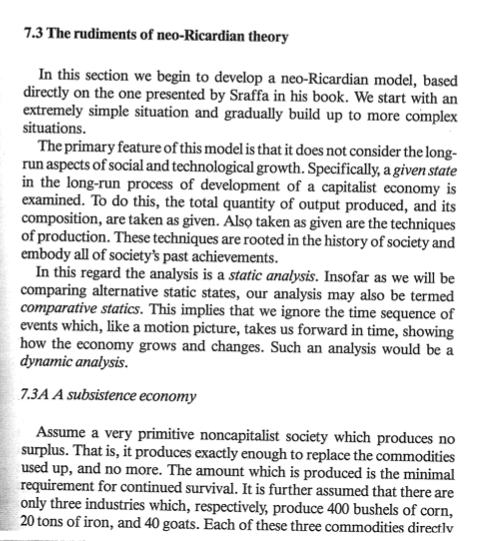
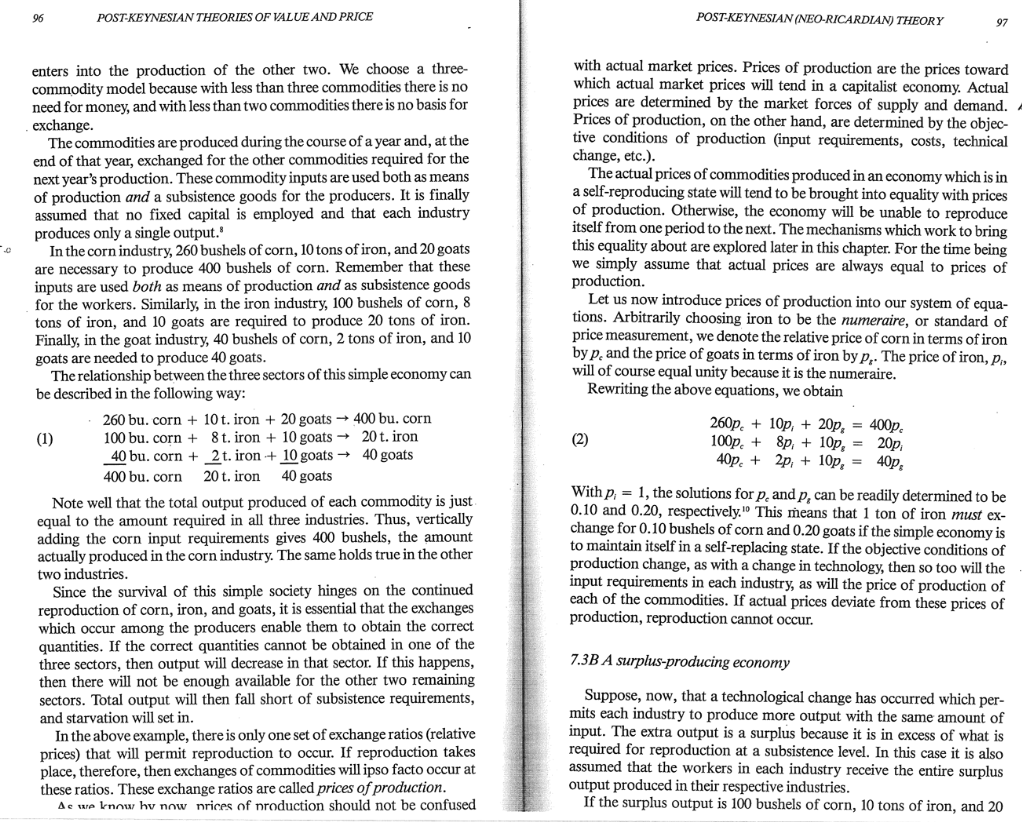
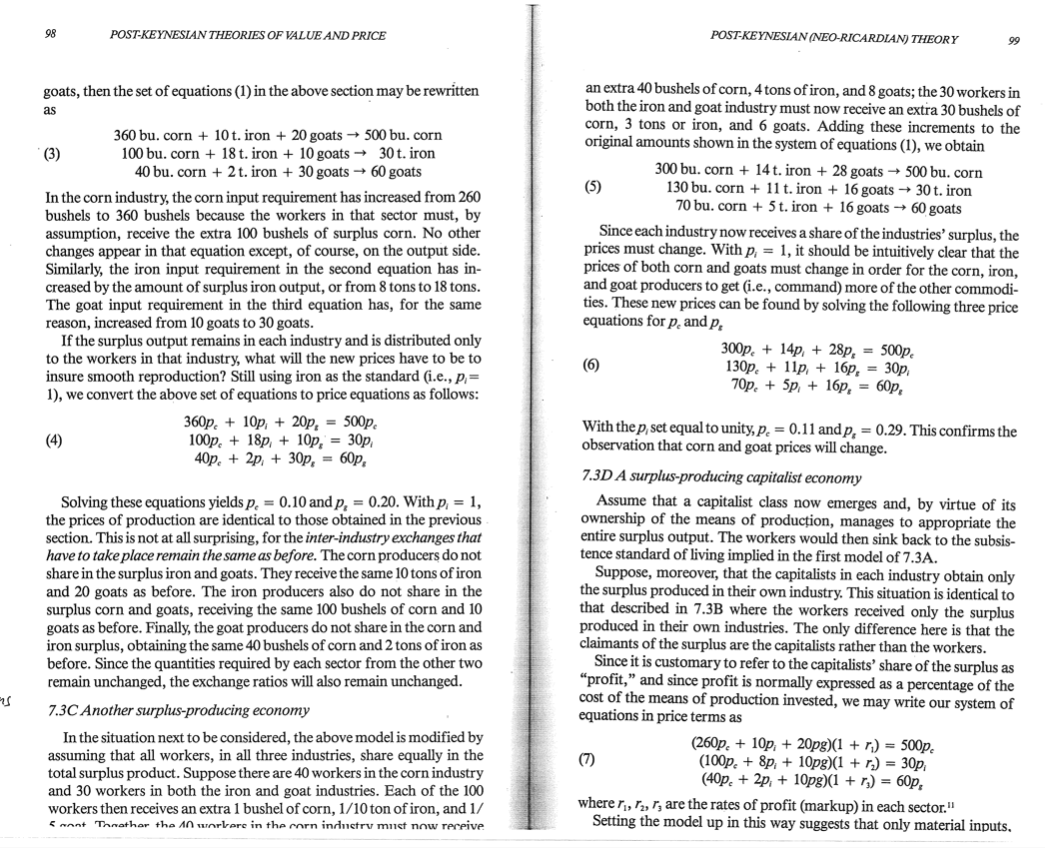
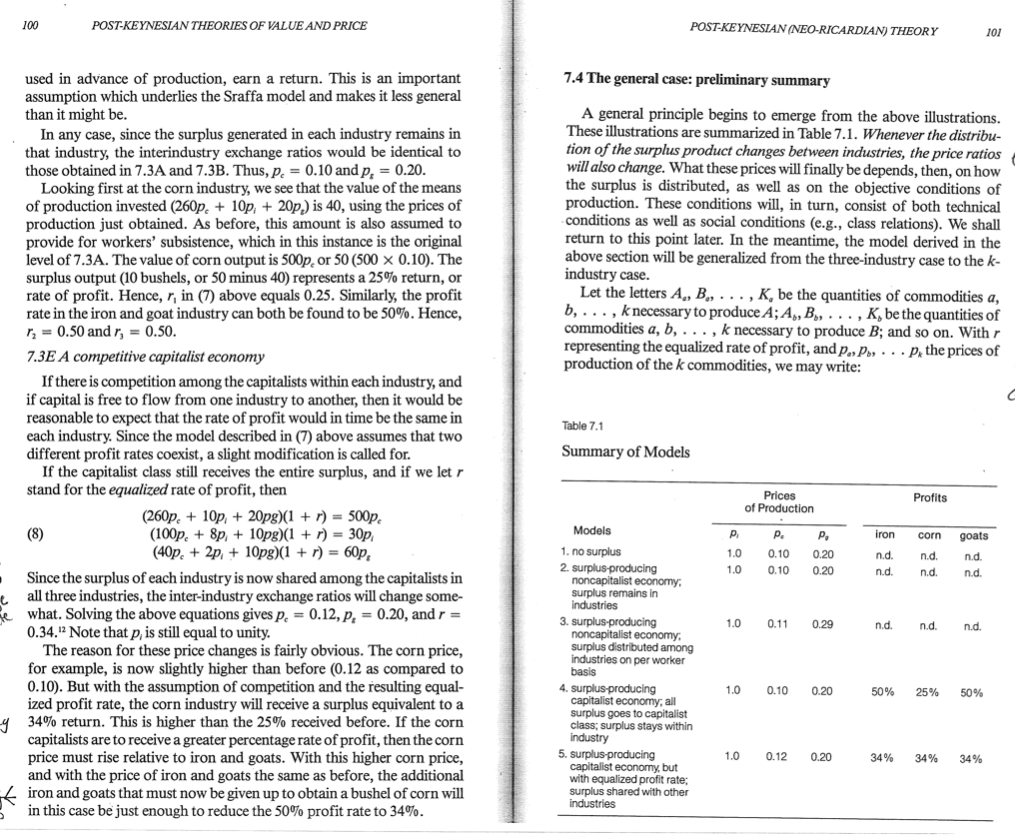
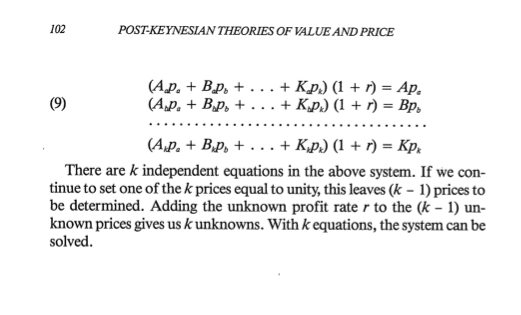
7.3 The rudiments of neo-Ricardian theory In this section we begin to develop a neo-Ricardian model, based directly on the one presented by Sraffa in his book. We start with an extremely simple situation and gradually build up to more complex situations. The primary feature of this model is that it does not consider the longrun aspects of social and technological growth. Specifically, a given state in the long-run process of development of a capitalist economy is examined. To do this, the total quantity of output produced, and its composition, are taken as given. Also taken as given are the techniques of production. These techniques are rooted in the history of society and embody all of society's past achievements. In this regard the analysis is a static analysis. Insofar as we will be comparing alternative static states, our analysis may also be termed comparative statics. This implies that we ignore the time sequence of events which, like a motion picture, takes us forward in time, showing how the economy grows and changes. Such an analysis would be a dynamic analysis. 7.3A A subsistence economy Assume a very primitive noncapitalist society which produces no surplus. That is, it produces exactly enough to replace the commodities used up, and no more. The amount which is produced is the minimal requirement for continued survival. It is further assumed that there are only three industries which, respectively, produce 400 bushels of corn, 20 tons of iron, and 40 goats. Each of these three commodities directlv 102 POST-KEYNESIAN THEORIES OF VALUE AND PRICE There are k independent equations in the above system. If we continue to set one of the k prices equal to unity, this leaves (k1) prices to be determined. Adding the unknown profit rate r to the (k1) unknown prices gives us k unknowns. With k equations, the system can be solved. 7.3 The rudiments of neo-Ricardian theory In this section we begin to develop a neo-Ricardian model, based directly on the one presented by Sraffa in his book. We start with an extremely simple situation and gradually build up to more complex situations. The primary feature of this model is that it does not consider the longrun aspects of social and technological growth. Specifically, a given state in the long-run process of development of a capitalist economy is examined. To do this, the total quantity of output produced, and its composition, are taken as given. Also taken as given are the techniques of production. These techniques are rooted in the history of society and embody all of society's past achievements. In this regard the analysis is a static analysis. Insofar as we will be comparing alternative static states, our analysis may also be termed comparative statics. This implies that we ignore the time sequence of events which, like a motion picture, takes us forward in time, showing how the economy grows and changes. Such an analysis would be a dynamic analysis. 7.3A A subsistence economy Assume a very primitive noncapitalist society which produces no surplus. That is, it produces exactly enough to replace the commodities used up, and no more. The amount which is produced is the minimal requirement for continued survival. It is further assumed that there are only three industries which, respectively, produce 400 bushels of corn, 20 tons of iron, and 40 goats. Each of these three commodities directlv 102 POST-KEYNESIAN THEORIES OF VALUE AND PRICE There are k independent equations in the above system. If we continue to set one of the k prices equal to unity, this leaves (k1) prices to be determined. Adding the unknown profit rate r to the (k1) unknown prices gives us k unknowns. With k equations, the system can be solved
Step by Step Solution
There are 3 Steps involved in it

Get step-by-step solutions from verified subject matter experts
 Study Help