Question: Using the Questionnaire Design Checklist (Table 8.2) critically evaluated the attached questionnaire. Please indicate five separate issues in the questionnaire. Indicate the Question #; Step
Using the "Questionnaire Design Checklist" (Table 8.2) critically evaluated the attached questionnaire.
Please indicate five separate issues in the questionnaire.
Indicate the Question #; Step # and Issue # from Table 8.2; and how to correct it.
Here is an example (cannot use this as one of answers) Question #2 "Age:"; Step #5 Issue #2 "Use structured questions whenever possible"; could correct this question by giving age options for people to choose: "Age: 17 or younger, 18-25, 26-35, 36-45, 46- 55, 56- 65, 65 or older"
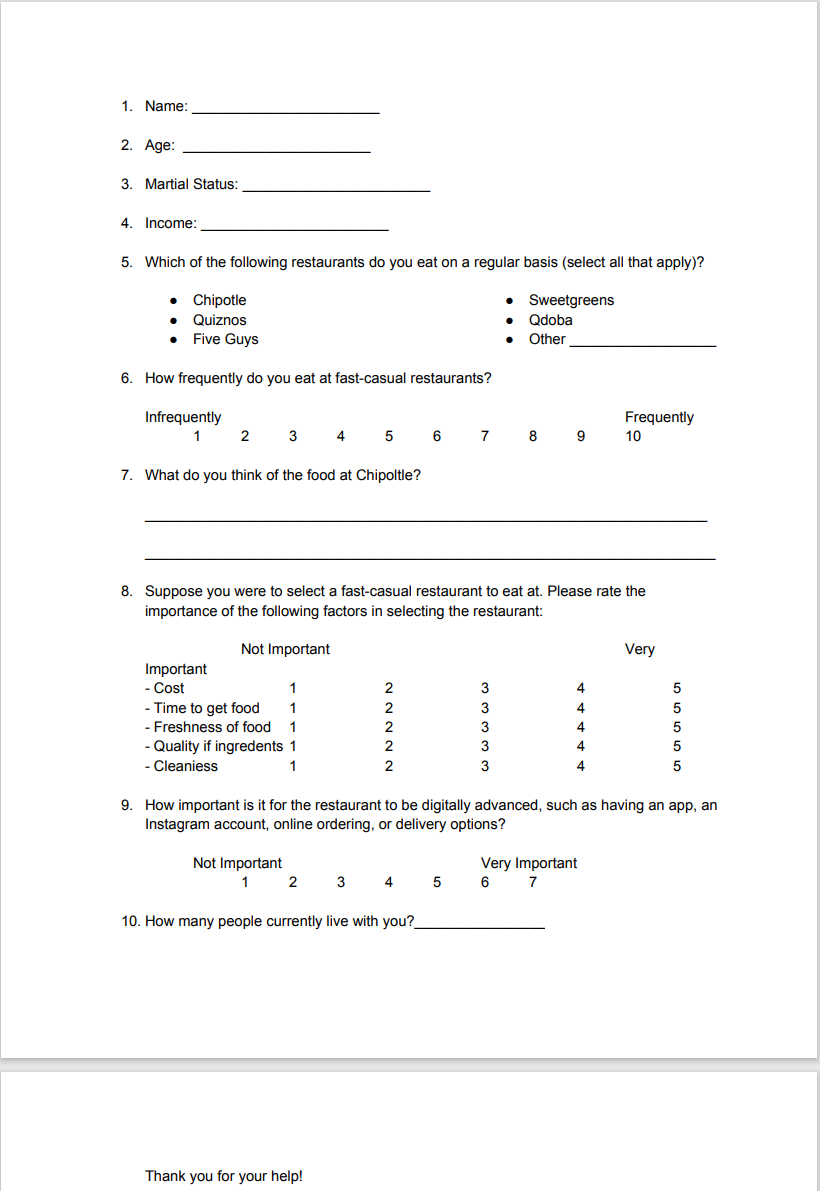
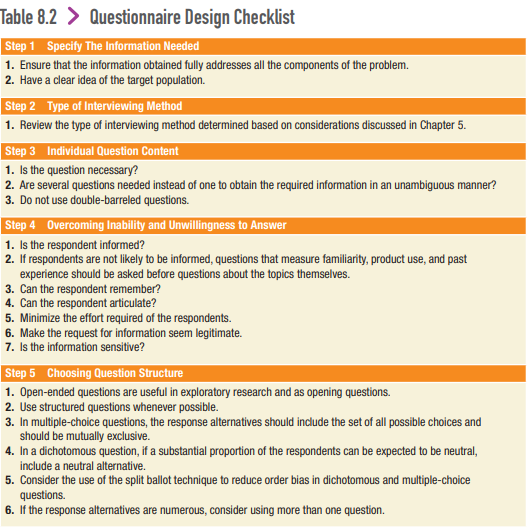
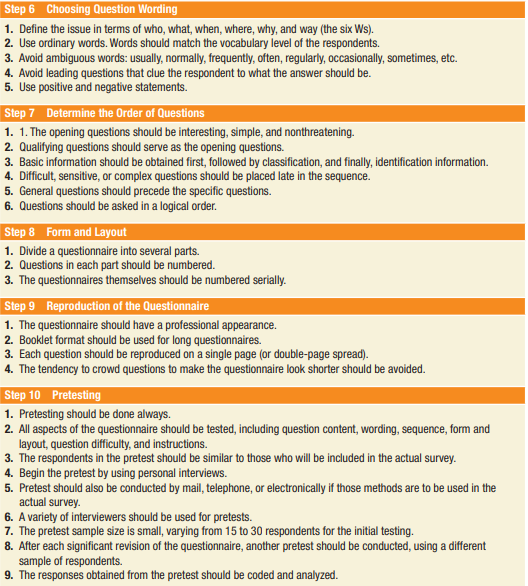
1. Name: 2. Age: 3. Martial Status: 4. Income: 5. Which of the following restaurants do you eat on a regular basis (select all that apply)? . Chipotle Quiznos Five Guys Sweetgreens Qdoba Other . 6. How frequently do you eat at fast-casual restaurants? Infrequently Frequently 10 1 2 3 4 5 6 7 8 9 7. What do you think of the food at Chipoltle? 8. Suppose you were to select a fast-casual restaurant to eat at. Please rate the importance of the following factors in selecting the restaurant: Very 3 4 Not Important Important - Cost 1 - Time to get food 1 - Freshness of food 1 - Quality if ingredents 1 - Cleaniess 1 2 2 2 2 2 5 5 5 5 5 4 4 4 3 3 9. How important is it for the restaurant to be digitally advanced, such as having an app, an Instagram account, online ordering, or delivery options? Not Important 1 2 Very Important 6 3 4 5 10. How many people currently live with you? Thank you for your help! Table 8.2 > Questionnaire Design Checklist Step 1 Specify The Information Needed 1. Ensure that the information obtained fully addresses all the components of the problem. 2. Have a clear idea of the target population. Step 2 Type of Interviewing Method 1. Review the type of interviewing method determined based on considerations discussed in Chapter 5. Step 3 Individual Question Content 1. Is the question necessary? 2. Are several questions needed instead of one to obtain the required information in an unambiguous manner? 3. Do not use double-barreled questions. Step 4 Overcoming Inability and Unwillingness to Answer 1. Is the respondent informed? 2. If respondents are not likely to be informed, questions that measure familiarity, product use, and past experience should be asked before questions about the topics themselves. 3. Can the respondent remember? 4. Can the respondent articulate? 5. Minimize the effort required of the respondents. 6. Make the request for information seem legitimate. 7. Is the information sensitive? Step 5 Choosing Question Structure 1. Open-ended questions are useful in exploratory research and as opening questions. 2. Use structured questions whenever possible. 3. In multiple-choice questions, the response alternatives should include the set of all possible choices and should be mutually exclusive. 4. In a dichotomous question, if a substantial proportion of the respondents can be expected to be neutral, include a neutral alternative. 5. Consider the use of the split ballot technique to reduce order bias in dichotomous and multiple-choice questions 6. If the response alternatives are numerous, consider using more than one question. Step 6 Choosing Question Wording 1. Define the issue in terms of who, what, when, where, why, and way (the six Ws). 2. Use ordinary words. Words should match the vocabulary level of the respondents. 3. Avoid ambiguous words: usually, normally, frequently, often, regularly, occasionally, sometimes, etc. 4. Avoid leading questions that clue the respondent to what the answer should be. 5. Use positive and negative statements. Step 7 Determine the Order of Questions 1. 1. The opening questions should be interesting, simple, and nonthreatening. 2. Qualifying questions should serve as the opening questions. 3. Basic information should be obtained first, followed by classification, and finally, identification information. 4. Difficult sensitive, or complex questions should be placed late in the sequence. 5. General questions should precede the specific questions. 6. Questions should be asked in a logical order. Step 8 Form and Layout 1. Divide a questionnaire into several parts. 2. Questions in each part should be numbered. 3. The questionnaires themselves should be numbered serially. Step 9 Reproduction of the Questionnaire 1. The questionnaire should have a professional appearance. 2. Booklet format should be used for long questionnaires. 3. Each question should be reproduced on a single page (or double-page spread). 4. The tendency to crowd questions to make the questionnaire look shorter should be avoided. Step 10 Pretesting 1. Pretesting should be done always. 2. All aspects of the questionnaire should be tested, including question content, wording, sequence, form and layout, question difficulty, and instructions. 3. The respondents in the pretest should be similar to those who will be included in the actual survey. 4. Begin the pretest by using personal interviews. 5. Pretest should also be conducted by mail, telephone, or electronically if those methods are to be used in the actual survey 6. A variety of interviewers should be used for pretests. 7. The pretest sample size is small, varying from 15 to 30 respondents for the initial testing. 8. After each significant revision of the questionnaire, another pretest should be conducted using a different sample of respondents 9. The responses obtained from the pretest should be coded and analyzed









 Study Help