



Question: Using the stock price data for any two companies provided below carry out the following tasks: Activity 1. Compute, for each asset: i. Total Returns
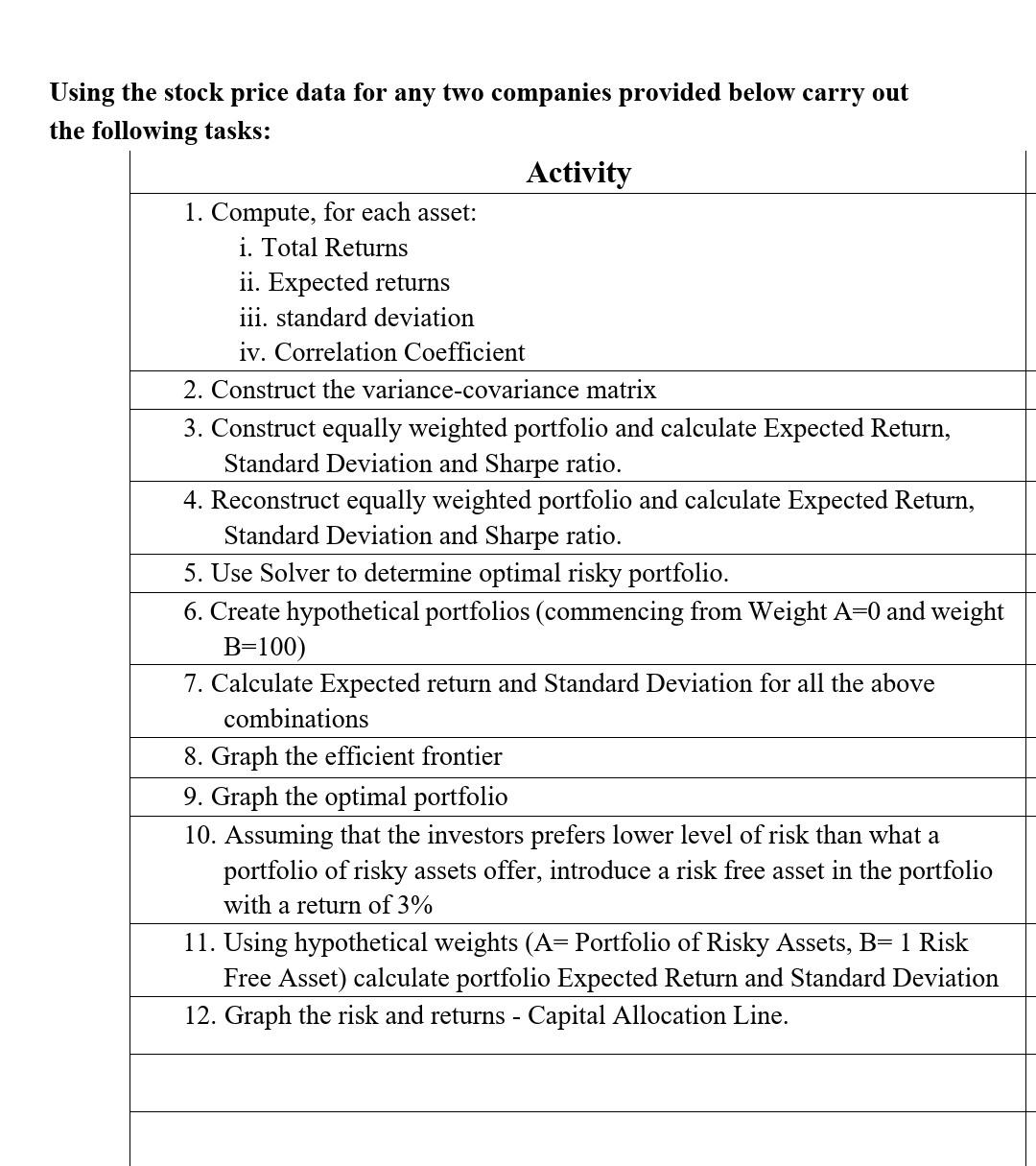
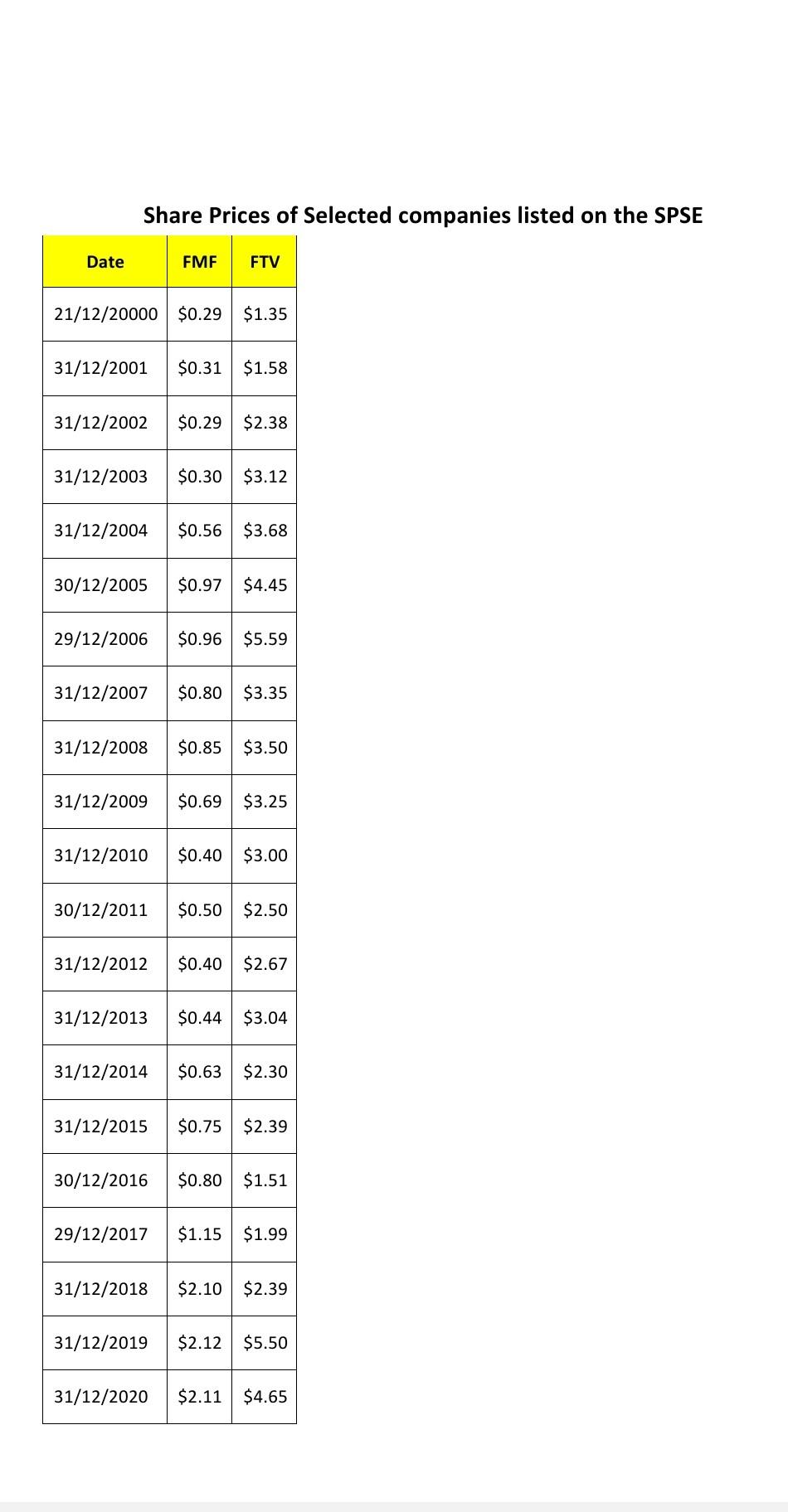
Using the stock price data for any two companies provided below carry out the following tasks: Activity 1. Compute, for each asset: i. Total Returns ii. Expected returns iii. standard deviation iv. Correlation Coefficient 2. Construct the variance-covariance matrix 3. Construct equally weighted portfolio and calculate Expected Return, Standard Deviation and Sharpe ratio. 4. Reconstruct equally weighted portfolio and calculate Expected Return, Standard Deviation and Sharpe ratio. 5. Use Solver to determine optimal risky portfolio. 6. Create hypothetical portfolios (commencing from Weight A=0 and weight B=100) 7. Calculate Expected return and Standard Deviation for all the above combinations 8. Graph the efficient frontier 9. Graph the optimal portfolio 10. Assuming that the investors prefers lower level of risk than what a portfolio of risky assets offer, introduce a risk free asset in the portfolio with a return of 3% 11. Using hypothetical weights (A= Portfolio of Risky Assets, B= 1 Risk Free Asset) calculate portfolio Expected Return and Standard Deviation 12. Graph the risk and returns - Capital Allocation Line. Share Prices of Selected companies listed on the SPSE Date FMF FTV 21/12/20000 $0.29 $1.35 31/12/2001 $0.31 $1.58 31/12/2002 $0.29 $2.38 31/12/2003 $0.30 $3.12 31/12/2004 $0.56 $3.68 30/12/2005 $0.97 $4.45 29/12/2006 $0.96 $5.59 31/12/2007 $0.80 $3.35 31/12/2008 $0.85 $3.50 31/12/2009 $0.69 $3.25 31/12/2010 $0.40 $3.00 30/12/2011 $0.50 $2.50 31/12/2012 $0.40 $2.67 31/12/2013 $0.44 $3.04 31/12/2014 $0.63 $2.30 31/12/2015 $0.75 $2.39 30/12/2016 $0.80 $1.51 29/12/2017 $1.15 $1.99 31/12/2018 $2.10 $2.39 31/12/2019 $2.12 $5.50 31/12/2020 $2.11 $4.65
Step by Step Solution
There are 3 Steps involved in it

Get step-by-step solutions from verified subject matter experts