







Question: Using the tables, answer the questions. Part II: Answer the following questions using graphs and equations. Justifying your answers worth half the points. (80 points)
Using the tables, answer the questions.
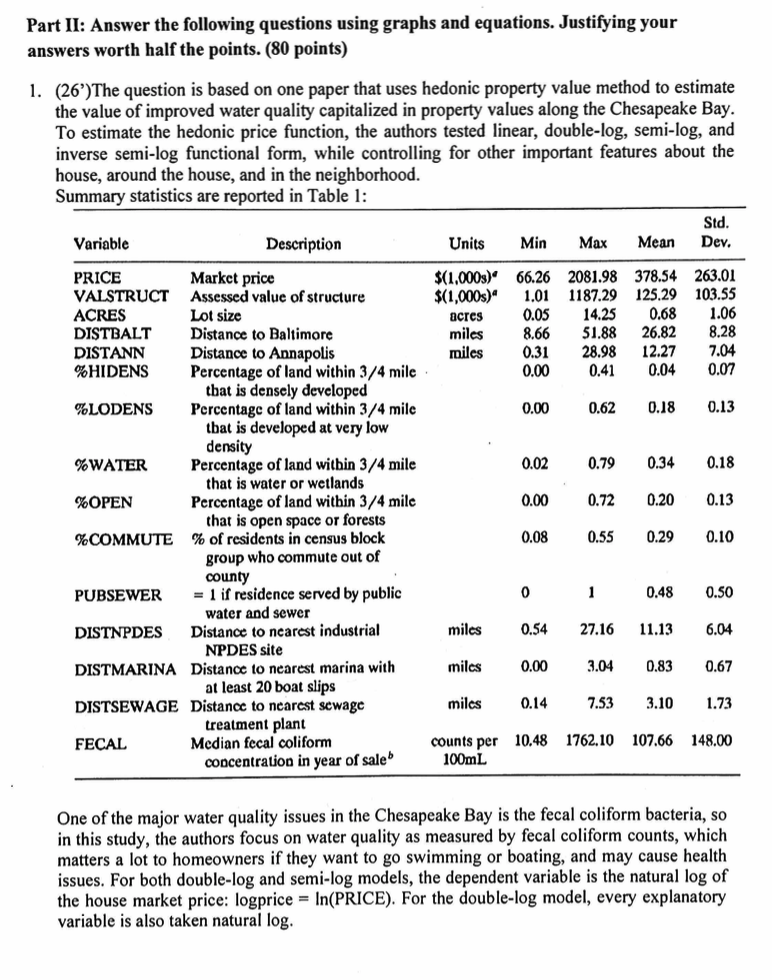
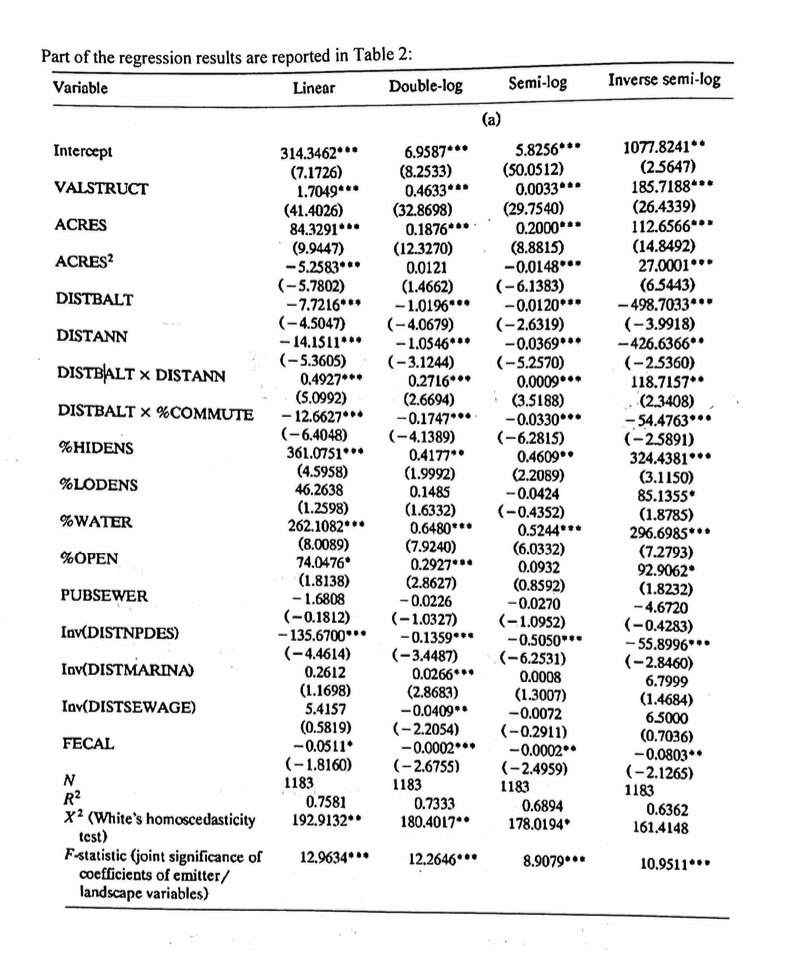
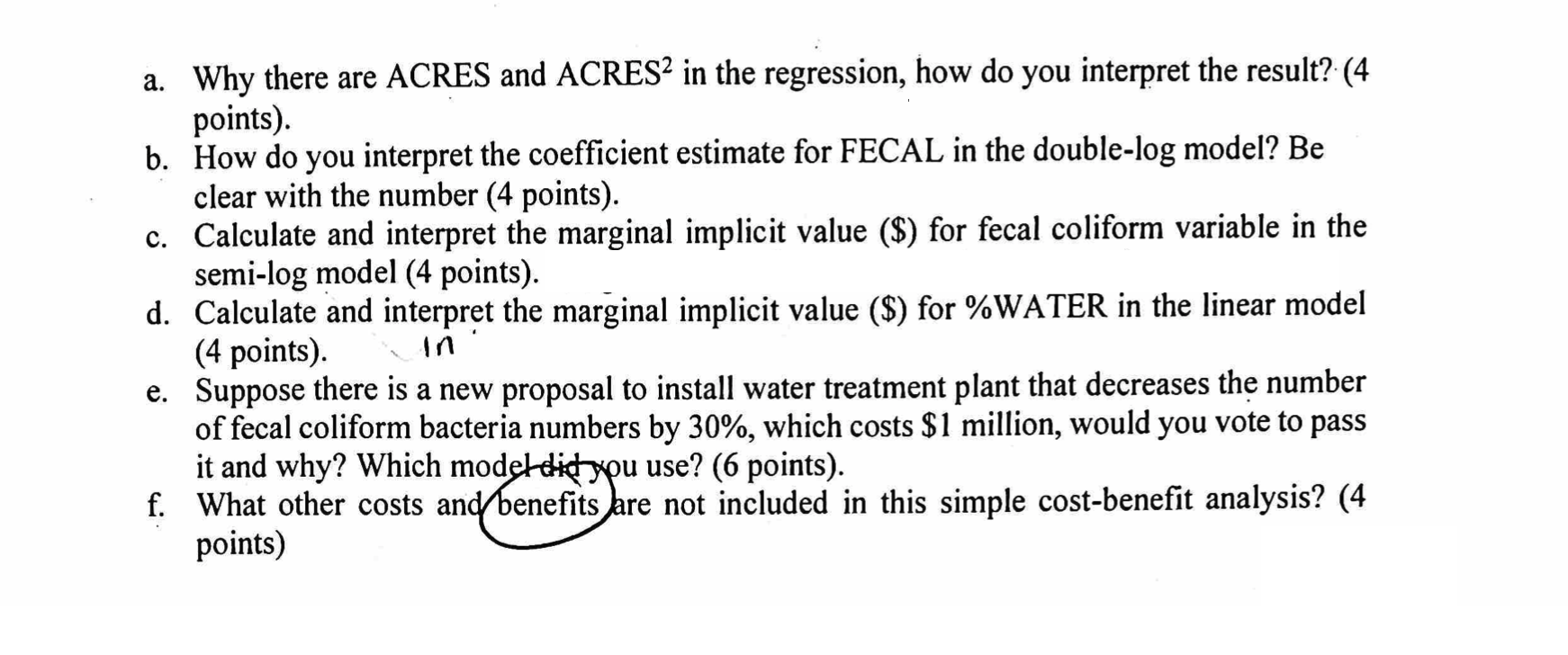
Part II: Answer the following questions using graphs and equations. Justifying your answers worth half the points. (80 points) 1. (26')The question is based on one paper that uses hedonic property value method to estimate the value of improved water quality capitalized in property values along the Chesapeake Bay. To estimate the hedonic price function, the authors tested linear, double-log, semi-log, and inverse semi-log functional form, while controlling for other important features about the house, around the house, and in the neighborhood. Summary statistics are reported in Table 1: One of the major water quality issues in the Chesapeake Bay is the fecal coliform bacteria, so in this study, the authors focus on water quality as measured by fecal coliform counts, which matters a lot to homeowners if they want to go swimming or boating, and may cause health issues. For both double-log and semi-log models, the dependent variable is the natural log of the house market price: logprice =ln (PRICE). For the double-log model, every explanatory variable is also taken natural log. T-1.1-n. a. Why there are ACRES and ACRES2 in the regression, how do you interpret the result? (4 points). b. How do you interpret the coefficient estimate for FECAL in the double-log model? Be clear with the number (4 points). c. Calculate and interpret the marginal implicit value ($) for fecal coliform variable in the semi-log model (4 points). d. Calculate and interpret the marginal implicit value (\$) for \%WATER in the linear model (4 points). e. Suppose there is a new proposal to install water treatment plant that decreases the number of fecal coliform bacteria numbers by 30%, which costs $1 million, would you vote to pass it and why? Which modeldiptyou use? (6 points). f. What other costs and benefits are not included in this simple cost-benefit analysis? (4 points) Part II: Answer the following questions using graphs and equations. Justifying your answers worth half the points. (80 points) 1. (26')The question is based on one paper that uses hedonic property value method to estimate the value of improved water quality capitalized in property values along the Chesapeake Bay. To estimate the hedonic price function, the authors tested linear, double-log, semi-log, and inverse semi-log functional form, while controlling for other important features about the house, around the house, and in the neighborhood. Summary statistics are reported in Table 1: One of the major water quality issues in the Chesapeake Bay is the fecal coliform bacteria, so in this study, the authors focus on water quality as measured by fecal coliform counts, which matters a lot to homeowners if they want to go swimming or boating, and may cause health issues. For both double-log and semi-log models, the dependent variable is the natural log of the house market price: logprice =ln (PRICE). For the double-log model, every explanatory variable is also taken natural log. T-1.1-n. a. Why there are ACRES and ACRES2 in the regression, how do you interpret the result? (4 points). b. How do you interpret the coefficient estimate for FECAL in the double-log model? Be clear with the number (4 points). c. Calculate and interpret the marginal implicit value ($) for fecal coliform variable in the semi-log model (4 points). d. Calculate and interpret the marginal implicit value (\$) for \%WATER in the linear model (4 points). e. Suppose there is a new proposal to install water treatment plant that decreases the number of fecal coliform bacteria numbers by 30%, which costs $1 million, would you vote to pass it and why? Which modeldiptyou use? (6 points). f. What other costs and benefits are not included in this simple cost-benefit analysis? (4 points)
Step by Step Solution
There are 3 Steps involved in it

Get step-by-step solutions from verified subject matter experts
 Study Help