







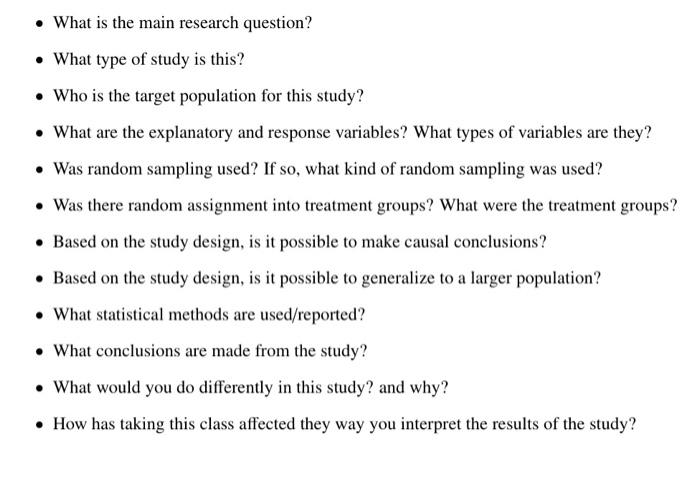
Question: using the text below I need help with finding the answers to the questions in the picture. im a bit confused. Background We assessed the
using the text below I need help with finding the answers to the questions in the picture. im a bit confused.
Background
We assessed the impact of total and partial sleep loss on neural correlates of fear conditioning and extinction learning and recall in healthy young adults.
Methods
Participants (56.3% female, age 24.83.4) were randomized to a night of normal sleep (NS, n=48), sleep restriction (SR, n=53), or sleep deprivation (SD, n=53). All completed fear conditioning and extinction learning phases the following morning. Extinction recall was tested in the evening of the same day. Task-based contrasts were modeled at the beginning, end and across fear conditioning and extinction learning phases, and at the beginning of extinction recall. These contrasts were compared between the 3 groups using ANOVA. Nonparametric permutation corrected analyses using a cluster-determining threshold of p
Results
At the end of fear conditioning, NS activated medial prefrontal (PFC) regions, SR activated motor areas and SD showed no significant activations. Across extinction learning, only NS activated both salience (fear) and extinction (regulatory) areas. For extinction recall, SD activated similar regions as NS across extinction learning, while SR activated salience and motor areas. During early fear conditioning, compared to NS, SD activated more medial PFC and SR activated more salience-network areas. For extinction recall, NS activated more PFC areas and SD activated more of both salience- and extinction-related areas than SR.
Conclusions
Relative to NS, SR may enhance fear- and diminish extinction-related activity, whereas SD may delay engagement of extinction learning. Findings may have clinical implications for populations and occupations in which sleep loss is common.
Step by Step Solution
There are 3 Steps involved in it
1 Expert Approved Answer
Step: 1 Unlock

Question Has Been Solved by an Expert!
Get step-by-step solutions from verified subject matter experts
Step: 2 Unlock
Step: 3 Unlock
 Study Help