Question: Using these terms fill in the blanks cargo separation bill of lading deck cargo stowage of cargo broken stowage freight containers tally business transport chain
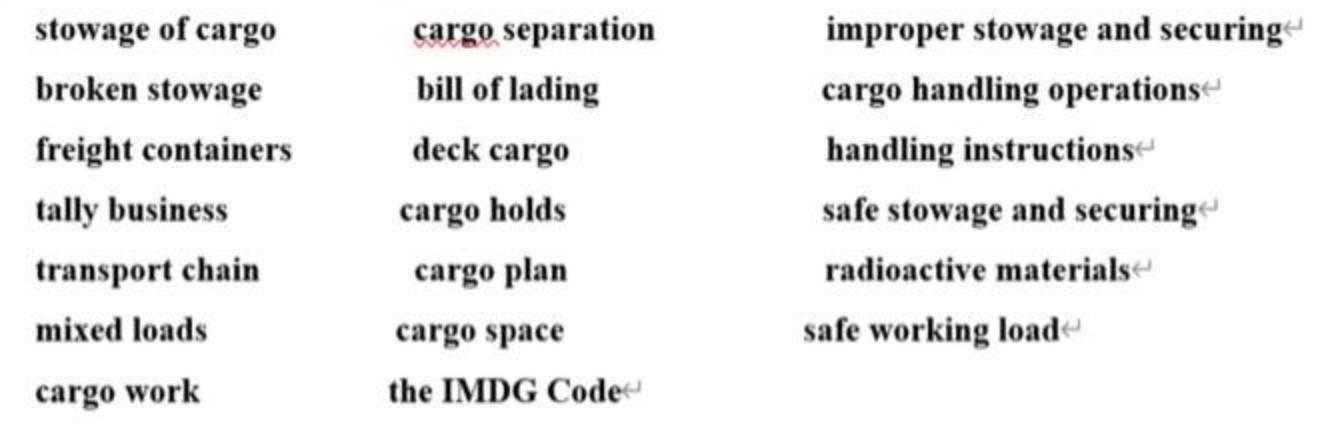
Using these terms fill in the blanks
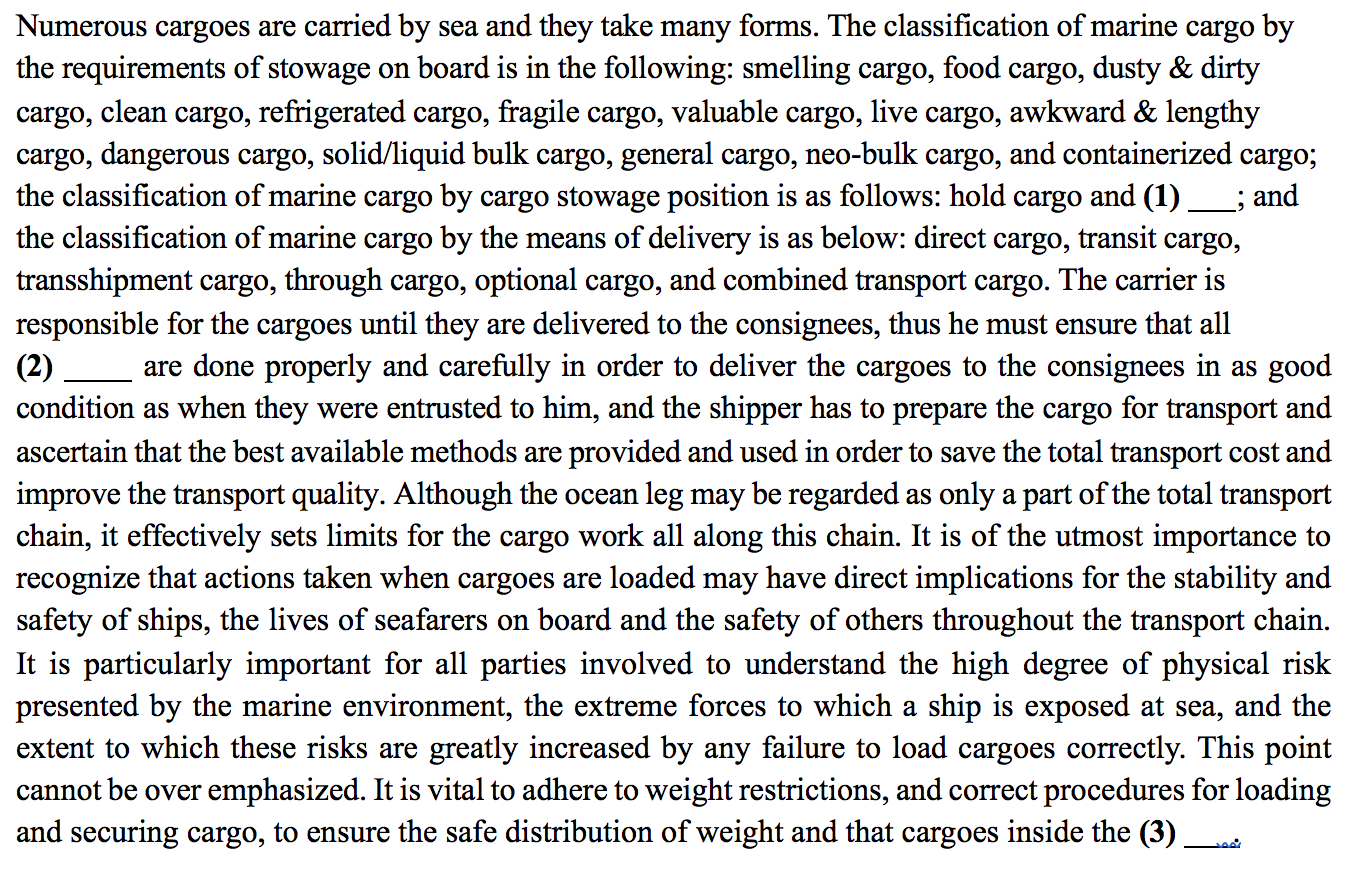
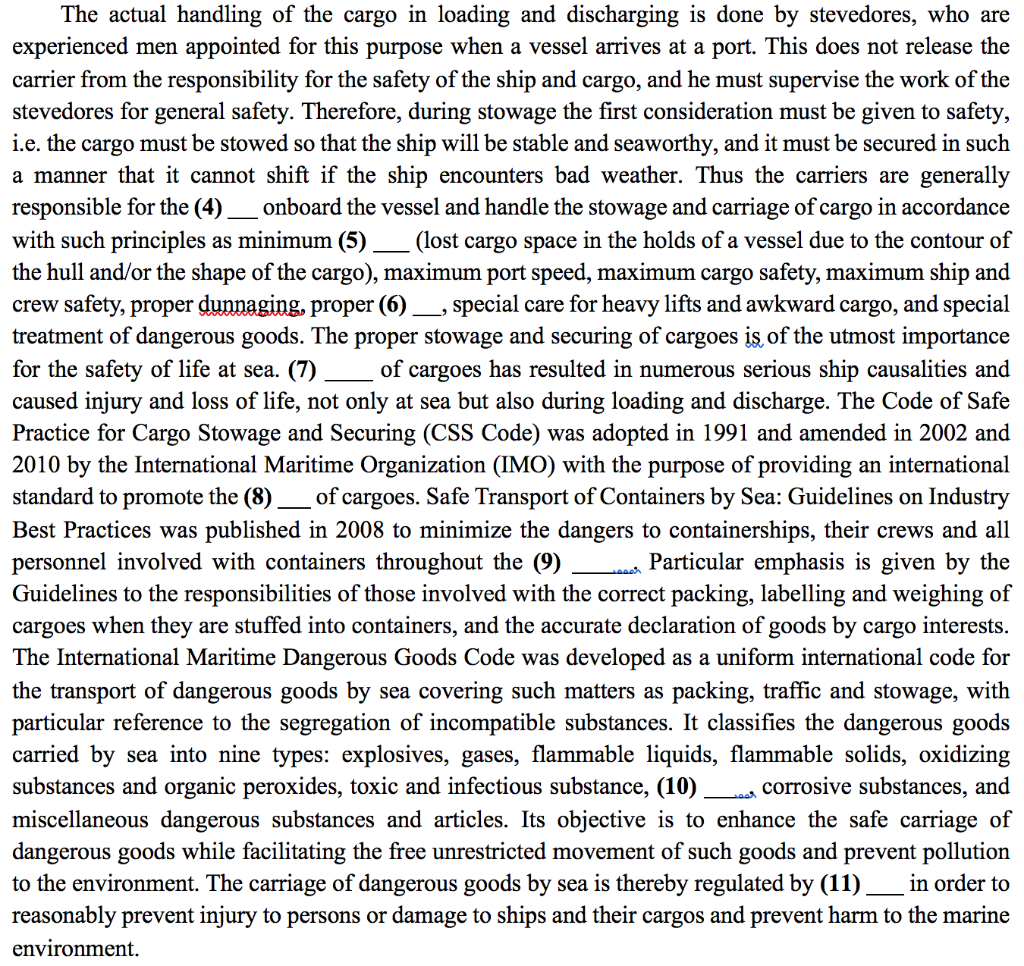
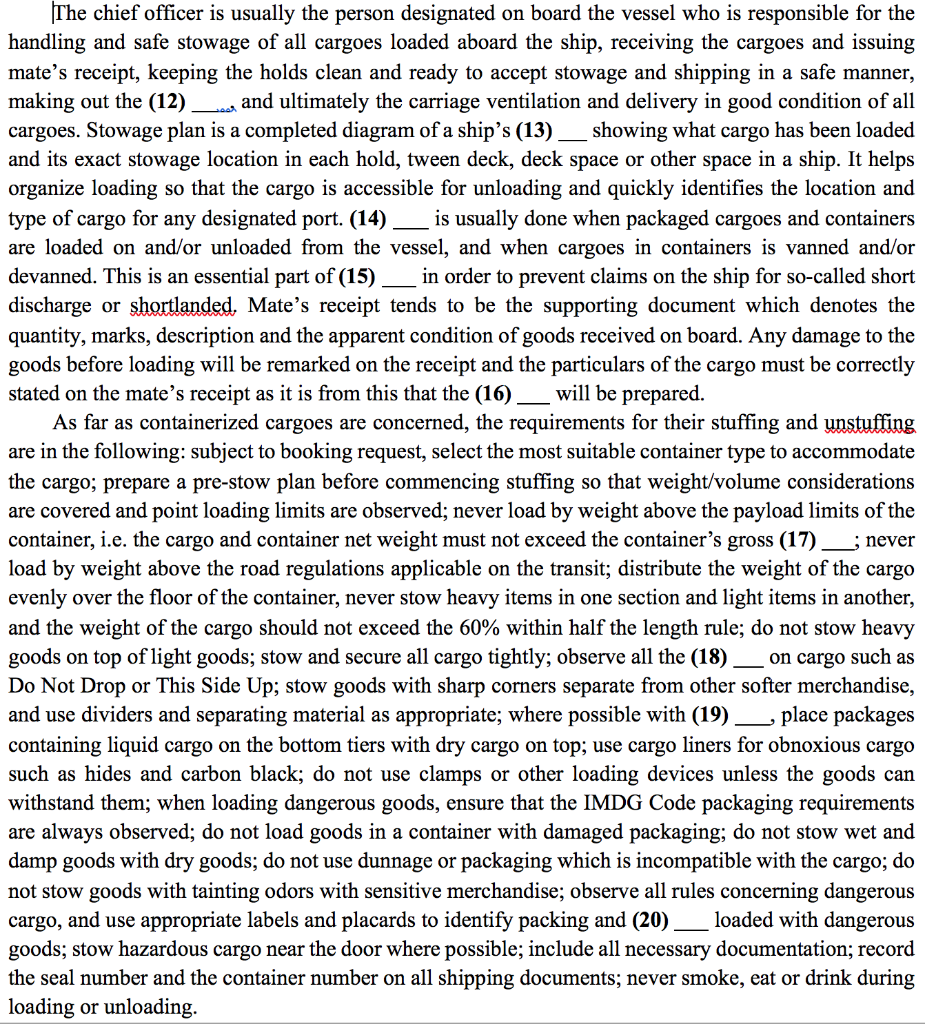
cargo separation bill of lading deck cargo stowage of cargo broken stowage freight containers tally business transport chain mixed loads improper stowage and securing cargo handling operations handling instructions safe stowage and securing radioactive materials safe working load cargo holds cargo plan cargo space the IMDG Code cargo work (2) Numerous cargoes are carried by sea and they take many forms. The classification of marine cargo by the requirements of stowage on board is in the following: smelling cargo, food cargo, dusty & dirty cargo, clean cargo, refrigerated cargo, fragile cargo, valuable cargo, live cargo, awkward & lengthy cargo, dangerous cargo, solid/liquid bulk cargo, general cargo, neo-bulk cargo, and containerized cargo; the classification of marine cargo by cargo stowage position is as follows: hold cargo and (1) __; and the classification of marine cargo by the means of delivery is as below: direct cargo, transit cargo, transshipment cargo, through cargo, optional cargo, and combined transport cargo. The carrier is responsible for the cargoes until they are delivered to the consignees, thus he must ensure that all are done properly and carefully in order to deliver the cargoes to the consignees in as good condition as when they were entrusted to him, and the shipper has to prepare the cargo for transport and ascertain that the best available methods are provided and used in order to save the total transport cost and improve the transport quality. Although the ocean leg may be regarded as only a part of the total transport chain, it effectively sets limits for the cargo work all along this chain. It is of the utmost importance to recognize that actions taken when cargoes are loaded may have direct implications for the stability and safety of ships, the lives of seafarers on board and the safety of others throughout the transport chain. It is particularly important for all parties involved to understand the high degree of physical risk presented by the marine environment, the extreme forces to which a ship is exposed at sea, and the extent to which these risks are greatly increased by any failure to load cargoes correctly. This point cannot be over emphasized. It is vital to adhere to weight restrictions, and correct procedures for loading and securing cargo, to ensure the safe distribution of weight and that cargoes inside the (3) The actual handling of the cargo in loading and discharging is done by stevedores, who are experienced men appointed for this purpose when a vessel arrives at a port. This does not release the carrier from the responsibility for the safety of the ship and cargo, and he must supervise the work of the stevedores for general safety. Therefore, during stowage the first consideration must be given to safety, i.e. the cargo must be stowed so that the ship will be stable and seaworthy, and it must be secured in such a manner that it cannot shift if the ship encounters bad weather. Thus the carriers are generally responsible for the (4) onboard the vessel and handle the stowage and carriage of cargo in accordance with such principles as minimum (5) (lost cargo space in the holds of a vessel due to the contour of the hull and/or the shape of the cargo), maximum port speed, maximum cargo safety, maximum ship and crew safety, proper dunnaging, proper (6) __, special care for heavy lifts and awkward cargo, and special treatment of dangerous goods. The proper stowage and securing of cargoes is of the utmost importance for the safety of life at sea. (7) of cargoes has resulted in numerous serious ship causalities and caused injury and loss of life, not only at sea but also during loading and discharge. The Code of Safe Practice for Cargo Stowage and Securing (CSS Code) was adopted in 1991 and amended in 2002 and 2010 by the International Maritime Organization (IMO) with the purpose of providing an international standard to promote the (8). of cargoes. Safe Transport of Containers by Sea: Guidelines on Industry Best Practices was published in 2008 to minimize the dangers to containerships, their crews and all personnel involved with containers throughout the (9) Particular emphasis is given by the Guidelines to the responsibilities of those involved with the correct packing, labelling and weighing of cargoes when they are stuffed into containers, and the accurate declaration of goods by cargo interests. The International Maritime Dangerous Goods Code was developed as a uniform international code for the transport of dangerous goods by sea covering such matters as packing, traffic and stowage, with particular reference to the segregation of incompatible substances. It classifies the dangerous goods carried by sea into nine types: explosives, gases, flammable liquids, flammable solids, oxidizing substances and organic peroxides, toxic and infectious substance, (10) corrosive substances, and miscellaneous dangerous substances and articles. Its objective is to enhance the safe carriage of dangerous goods while facilitating the free unrestricted movement of such goods and prevent pollution to the environment. The carriage of dangerous goods by sea is thereby regulated by (11) ___ in order to reasonably prevent injury to persons or damage to ships and their cargos and prevent harm to the marine environment. WAAN The chief officer is usually the person designated on board the vessel who is responsible for the handling and safe stowage of all cargoes loaded aboard the ship, receiving the cargoes and issuing mate's receipt, keeping the holds clean and ready to accept stowage and shipping in a safe manner, making out the (12) and ultimately the carriage ventilation and delivery in good condition of all cargoes. Stowage plan is a completed diagram of a ship's (13) showing what cargo has been loaded and its exact stowage location in each hold, tween deck, deck space or other space in a ship. It helps organize loading so that the cargo is accessible for unloading and quickly identifies the location and type of cargo for any designated port. (14) is usually done when packaged cargoes and containers are loaded on and/or unloaded from the vessel, and when cargoes in containers is vanned and/or devanned. This is an essential part of (15) in order to prevent claims on the ship for so-called short discharge or shortlanded, Mate's receipt tends to be the supporting document which denotes the quantity, marks, description and the apparent condition of goods received on board. Any damage to the goods before loading will be remarked on the receipt and the particulars of the cargo must be correctly stated on the mate's receipt as it is from this that the (16)_will be prepared. As far as containerized cargoes are concerned, the requirements for their stuffing and unstuffing are in the following: subject to booking request, select the most suitable container type to accommodate the cargo; prepare a pre-stow plan before commencing stuffing so that weight/volume considerations are covered and point loading limits are observed; never load by weight above the payload limits of the container, i.e. the cargo and container net weight must not exceed the containers gross (17) __; never load by weight above the road regulations applicable on the transit; distribute the weight of the cargo evenly over the floor of the container, never stow heavy items in one section and light items in another, and the weight of the cargo should not exceed the 60% within half the length rule; do not stow heavy goods on top of light goods; stow and secure all cargo tightly; observe all the (18) on cargo such as Do Not Drop or This Side Up; stow goods with sharp corners separate from other softer merchandise, and use dividers and separating material as appropriate; where possible with (19) __place packages containing liquid cargo on the bottom tiers with dry cargo on top; use cargo liners for obnoxious cargo such as hides and carbon black; do not use clamps or other loading devices unless the goods can withstand them; when loading dangerous goods, ensure that the IMDG Code packaging requirements are always observed; do not load goods in a container with damaged packaging; do not stow wet and damp goods with dry goods; do not use dunnage or packaging which is incompatible with the cargo; do not stow goods with tainting odors with sensitive merchandise; observe all rules concerning dangerous cargo, and use appropriate labels and placards to identify packing and (20) ___ loaded with dangerous goods; stow hazardous cargo near the door where possible; include all necessary documentation; record the seal number and the container number on all shipping documents; never smoke, eat or drink during loading or unloading









 Study Help