







Question: Using transaction data to prepare a statement of cash flows - direct method The electric company engaged in the following transactions during 2017. The beginning
Using transaction data to prepare a statement of cash flows - direct method
The electric company engaged in the following transactions during 2017. The beginning cash balance was $43,000 and the ending cash balance was $48,600
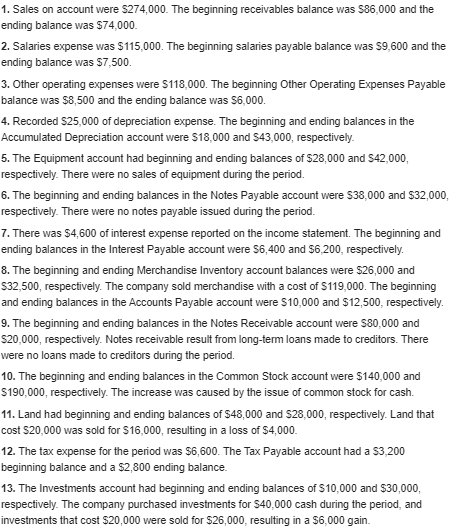
A. Determine the amount of cash flow for each item and indicate whether the item should appear in the operating, investing, or financing activities section of a statement of cash flows. Also, identify any items that do not affect the cash flow statement. Assume the electric company uses the direct method for showing net cash flow from operating activities
1. Sales on account were 5274,000. The beginning receivables balance was 586,000 and the ending balance was $74,000 2. Salaries expense was $115,000. The beginning salaries payable balance was 59,600 and the ending balance was $7,500 3. Other operating expenses were $118,000. The beginning Other Operating Expenses Payable balance was $8,500 and the ending balance was $6,000. 4. Recorded $25,000 of depreciation expense. The beginning and ending balances in the Accumulated Depreciation account were $18,000 and 543,000, respectively. 5. The Equipment account had beginning and ending balances of $28,000 and $42,000, respectively. There were no sales of equipment during the period. 6. The beginning and ending balances in the Notes Payable account were $38,000 and $32,000, respectively. There were no notes payable issued during the period. 7. There was $4,600 of interest expense reported on the income statement. The beginning and ending balances in the Interest Payable account were 56,400 and $6,200, respectively 8. The beginning and ending Merchandise Inventory account balances were $26,000 and $32,500, respectively. The company sold merchandise with a cost of $119,000. The beginning and ending balances in the Accounts Payable account were $10,000 and $12,500, respectively 9. The beginning and ending balances in the Notes Receivable account were $80.000 and espectively. Notes receivable result from long-term loans made to creditors. There were no loans made to creditors during the period. 10. The beginning and ending balances in the Common Stock account were $140,000 and $190,000, respectively. The increase was caused by the issue of common stock for cash. 11. Land had beginning and ending balances of $48,000 and $28,000, respectively. Land that cost $20,000 was sold for $16,000, resulting in a loss of $4,000 12. The tax expense for the period was $6.600. The Tax Payable account had a $3.200 beginning balance and a $2,800 ending balance. 13. The Investments account had beginning and ending balances of $10,000 and $30,000, respectively. The company purchased investments for $40,000 cash during the period, and investments that cost $20,000 were sold for $26,000, resulting in a $6,000 gain
Step by Step Solution
There are 3 Steps involved in it

Get step-by-step solutions from verified subject matter experts
 Study Help