







Question: V. SIMPLE FORECASTING USING @RISK This question illustrates two similar ways to forecast future stock prices. You will use SimpleForecast.xlsx for this exercise. It gives
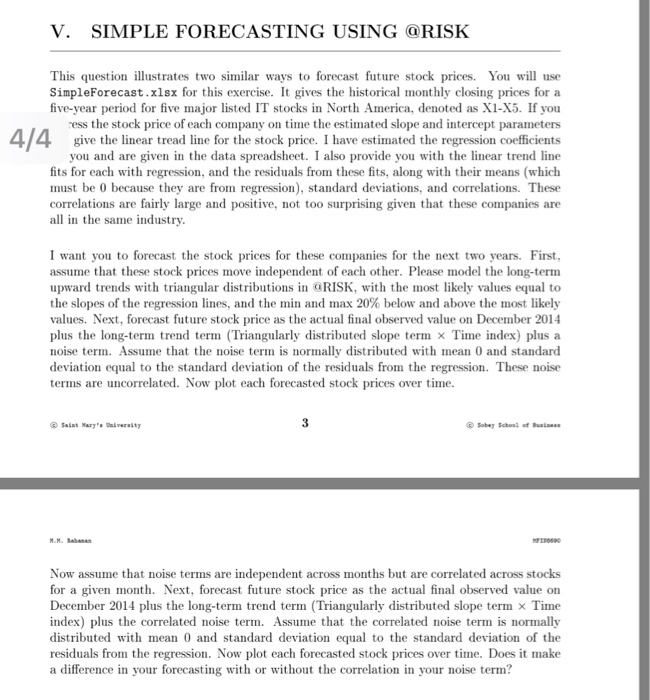
V. SIMPLE FORECASTING USING @RISK This question illustrates two similar ways to forecast future stock prices. You will use SimpleForecast.xlsx for this exercise. It gives the historical monthly closing prices for a five-year period for five major listed IT stocks in North America, denoted as X1-X5. If you ress the stock price of each company on time the estimated slope and intercept parameters give the linear tread line for the stock price. I have estimated the regression coefficients you and are given in the data spreadsheet. I also provide you with the linear trend line fits for each with regression, and the residuals from these fits, along with their means (which must be 0 because they are from regression), standard deviations, and correlations. These correlations are fairly large and positive, not too surprising given that these companies are all in the same industry I want you to forecast the stock prices for these companies for the next two years. First, assume that these stock prices move independent of each other. Please model the long-term upward trends with triangular distributions in RISK, with the most likely values equal to the slopes of the regression lines, and the min and max 20% below and above the most likely values. Next, forecast future stock price as the actual final observed value on December 2014 plus the long-term trend tern (Triangularly distributed slope tern Time index) plus a noise term. Assume that the noise term is normally distributed with mean 0 and standard deviation equal to the standard deviation of the residuals from the regression. These noise terms are uncorrelated. Now plot each forecasted stock prices over time. Saint Hary's ?&versity Now assume that noise terms are independent across months but are correlated across stocks for a given month. Next, forecast future stock price as the actual final observed value on December 2014 plus the long-term trend term (Triangularly distributed slope term x Time index) plus the correlated noise term. Assume that the correlated noise term is normally distributed with mean 0 and standard deviation equal to the standard deviation of the residuals from the regression. Now plot each forecasted stock prices over time. Doest make a difference in your forecasting with or without the correlation in your noise term? V. SIMPLE FORECASTING USING @RISK This question illustrates two similar ways to forecast future stock prices. You will use SimpleForecast.xlsx for this exercise. It gives the historical monthly closing prices for a five-year period for five major listed IT stocks in North America, denoted as X1-X5. If you ress the stock price of each company on time the estimated slope and intercept parameters give the linear tread line for the stock price. I have estimated the regression coefficients you and are given in the data spreadsheet. I also provide you with the linear trend line fits for each with regression, and the residuals from these fits, along with their means (which must be 0 because they are from regression), standard deviations, and correlations. These correlations are fairly large and positive, not too surprising given that these companies are all in the same industry I want you to forecast the stock prices for these companies for the next two years. First, assume that these stock prices move independent of each other. Please model the long-term upward trends with triangular distributions in RISK, with the most likely values equal to the slopes of the regression lines, and the min and max 20% below and above the most likely values. Next, forecast future stock price as the actual final observed value on December 2014 plus the long-term trend tern (Triangularly distributed slope tern Time index) plus a noise term. Assume that the noise term is normally distributed with mean 0 and standard deviation equal to the standard deviation of the residuals from the regression. These noise terms are uncorrelated. Now plot each forecasted stock prices over time. Saint Hary's ?&versity Now assume that noise terms are independent across months but are correlated across stocks for a given month. Next, forecast future stock price as the actual final observed value on December 2014 plus the long-term trend term (Triangularly distributed slope term x Time index) plus the correlated noise term. Assume that the correlated noise term is normally distributed with mean 0 and standard deviation equal to the standard deviation of the residuals from the regression. Now plot each forecasted stock prices over time. Doest make a difference in your forecasting with or without the correlation in your noise term
Step by Step Solution
There are 3 Steps involved in it

Get step-by-step solutions from verified subject matter experts
 Study Help